AI-Driven Reverse Pharmacognosy: Target-Guided Bioprospecting with Integrated Conservation Prioritization
 , Vasimkhan Taslimkhan Pathan2, Vaishali Dattattray Naphade3and Tushar Dilip Fegade4
1Department of pharmaceutical chemistry, Mahavir Institute of pharmacy, Nashik, India
2Department of pharmaceutics, Mahavir Institute of pharmacy, Nashik, India
3Department of pharmacology, Sandip University, School of pharmaceutical sciences, Nashik, India
4Department of pharmaceutics, Shellino Education Society's Arunamai College of Pharmacy Mamurabad, Jalgaon, India
Corresponding Author E-mail: atulbendale123@gmail.com
Download this article as:
ABSTRACT:This review provides an overview of the new paradigm of reverse pharmacognosy, which has been developed using AI, and provides a comprehensive analysis of this paradigm. Unlike the traditional plant collection, bioactivity screening and target identification process, this strategy starts with a predetermined therapeutic target (a molecule) and uses artificial intelligence to foretell which plant species is most likely to have a bioactive ligand that could activate the target. The review critically evaluates the data that needs to be utilized to feed into these predictive models, including chemical, genomic, metabolomic and conservation databases. It covers in detail key computational approaches that take data to testable hypotheses such as virtual screening, network-based activity propagation and explainable AI (XAI). One main idea is the need to incorporate the IUCN Red List status and cultivation potential of candidates directly into the candidate scoring algorithms, thus promoting a conservation-driven approach to bioprospecting. The review addresses not only the retrospective but also the prospective case studies confirming the paradigm, but also outlines some important technical hurdles and ethical issues such as the biases associated with data and the concerns of digital biopiracy and suggests future directions that combine the application of AI and genome mining with predictive metabolomics in global collaborations. The main conclusion is that AI in reverse pharmacognosy can be a rational approach to speed up the discovery of natural products and contribute to the conservation of biodiversity, through transparent sustainability parameters.
KEYWORDS:AI-driven reverse pharmacognosy; Biosynthetic gene clusters (BGCs); Conservation prioritization; Digital biopiracy; explainable AI (XAI); In silico screening; Natural product databases; Phylogenetic prediction; Sustainable bioprospecting; Target-based drug discovery
Introduction
In the past, the discovery of bioactive natural products has always been a key component in pharmacotherapy and a large portion of today’s drug entities are derived from plants1. But it has been fraught with issues of scalability, reproducibility, environmental sustainability and so on.
Rather than selection of the biological material (often based on ethnobotanical information or taxonomic surveys), extraction, bioactivity-directed fractionation, and isolation and structural elucidation of pure compounds2-4, the starting point of the paradigm is in fact a molecular target of therapeutic interest (in the case of SARS-CoV-2, main protease) or some aberrantly regulated receptor or an important node of protein-protein interactions. The paradigm problematises the question of ‘What activities does this plant have?’, to the question of which plant species are likely to have ligands for this target?
Artificial intelligence (AI) specifically machine learning (ML) and deep learning (DL) have been the necessary enabler technology that can build predictive models that were previously impossible, by taking in multiple streams of heterogeneous data such as phytochemical databases (e.g., LOTUS, NPASS), genomic and metabolomic data, 3D protein structures, and traditional ethnobotanical records. 5,6
These models operate at multiple interconnected levels. In silico target prediction methods, including those based on molecular docking, pharmacophore mapping, or more advanced, deep neural networks, can screen virtual libraries of known plant-derived compounds against a target of interest. Beyond identifying plants with a high probability of containing target-specific hits, these methods can also map chemical portfolios onto disease-associated biological networks to predict polypharmacology and potential toxicity.7-9
AI discovery is the cutting-edge data-driven drug discovery approach that uses AI algorithms to analyze vast amounts of chemical, biological, genomic, metabolomic, and pharmacological data to uncover unexplored connections between natural products and therapeutic targets. Unlike trial-and-error screening, AI-driven discovery leverages predictive computational models to prioritize candidate compounds, provide estimates of target affinity, predict biological activity, assess toxicity potential, address conservation sustainability concerns, and suggest how to go about experimental validation. As a result, AI serves as a hypothesis generator that significantly cuts the number of experiments required and optimizes the efficiency, speed, and rate of natural product discovery.
Scope and Validation Framework
It is important to note that AI-driven reverse pharmacognosy is an emerging discipline, and many of the workflows discussed in this review represent conceptual frameworks synthesized from published computational, phytochemical, and bioactivity studies. Unless explicitly stated otherwise, examples presented in this review should not be interpreted as fully validated end-to-end discovery pipelines. To distinguish the level of evidence supporting each example, we classify reported studies as (i) in silico prediction only, (ii) in vitro validated, (iii) in vivo validated, or (iv) clinically validated. This distinction is essential because many AI-assisted natural product discovery studies remain at the computational or early experimental stage and have not yet progressed to clinical development.
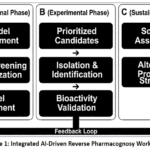 |
Figure 1: Integrated AI-Driven Reverse Pharmacognosy Workflow Click here to View Figure |
The whole AI-powered RP pipeline is the outcome of three steps interconnected with each other and continuous feedback mechanism, as shown in figure 1.
Computational Phase
The first step in the workflow is to develop a computational model. During this phase, AI models are developed by training them with curated datasets that include information on phytochemical structures, experimentally validated bioactivity data, molecular target details, genomic data, metabolomic profiles, and conservation databases. Data preprocessing consists of normalizing molecular structure, computing descriptors, generating molecular fingerprints, selecting features, eliminating duplicated records and normalizing biological activity values.
After the development of the models, virtual screening is carried out on the chosen therapeutic target. The machine learning models, molecular docking, pharmacophore mapping, graph neural network, and network pharmacology methods rank thousands of natural products based on the predicted binding affinity, selectivity, novelty, and drug-likeness.
The last step of computational phase is model refinement. Advances in experimental results as they are obtained are added to the training set, allowing iterative retraining, and continuous improvement of prediction accuracy.
Experimental Phase
For laboratory validation the highest ranked plant species and phytochemicals are selected. AI predictions direct the targeted phytochemical isolation process instead of the traditional random fractionation process. The rapid identification of predicted metabolites is possible by using modern analytical platforms like LC-HRMS/MS, LC-MS/MS, NMR spectroscopy and molecular networking.
The purified compounds are then tested for their biological activity by biochemical assays, cell-based assays, enzyme inhibition assays, and mechanism-based studies.
Sustainability Phase
Reverse pharmacognosy combines sustainability evaluation into the process of bioprospecting before extensive.
The following is used to evaluate the plant species that are candidates to be used:
The IUCN Red List status, geographical accessibility, cultivation feasibility, Access and benefit sharing (Nagoya Protocol), The ability of other production alternatives
If wild harvesting is deemed to be unsustainable, then alternative production methods including plant tissue culture, microbial biosynthesis, synthetic biology or total synthesis are used.
Feedback Loop
Iterative feedback loop is an important aspect of AI-driven reverse pharmacognosy. The AI learning data set is constantly being fed with the results of the experiments; this may include the results of experiments that fail. This feedback loop will constantly increase the accuracy of the predictions made, decrease the number of false-positive predictions, increase the generalizability of the model, and can optimize future discovery campaigns.
The Data Ecosystem for AI-Driven Discovery
The quality, scope, and structure of the data on which any artificial intelligence system is trained are actually the fundamental conditions of its efficacy.
Chemical Databases of Natural Products: Coverage, Biases, and Curation Challenges
In silico target prediction relies primarily on comprehensive, machine-readable collections of plant-derived chemical structures.58 Several publicly available repositories have emerged as critical resources, each with distinct philosophies, strengths, and inherent limitations. One of the largest of them is the COlleCtion of Open Natural ProdUcTs (COCONUT), offering over 400,000 non-redundant natural product structures through crowd-sourced assembly.10 Its open model presents curation problems, such as possible structural errors, and redundancy, and often a consistent inability to find meaningful biological source metadata, which makes the reverse-translation of compound to possible plant source difficult. 11 By comparison, the Natural Product Activity and Species Source (NPASS) database directly connects approximately 35,000 natural products, including their source organisms and respective pharmacological activity (e.g., IC50, Ki value) and target.12 This target-annotation can be indispensable in training supervised ML models to identify structure-activity relationships.70,72 However, it is biased to well-characterized, conventionally medicinal species and high-profile drug targets (e.g., kinases, proteases), which may cause a self-centered blind spot to new chemotypes of neglected taxa.13
Table 1: Comparative Attributes of Major Public Natural Product Databases
|
Database |
Primary Focus | Key Strength | Major Limitation for AI-Driven Reverse Pharmacognosy |
| COCONUT10 | Structural comprehensiveness | Massive scale (>400,000 compounds) for virtual screening |
Limited source/ activity annotation; variable curation; weak link to organismal data |
|
NPASS12 |
Bioactivity & source linking | Quantitative target-specific activity data for model training | Bias towards medicinally prominent species and targets; moderate size |
| LOTUS72 | Curated occurrence data | Reliable, referenced compound-organism relationships. |
Smaller scale; bioactivity data requires external linking |
|
PubChem20 |
General chemical repository | Immense size, good integration with bioassay data |
Not NP-specific; high noise-to-signal ratio for plant-derived molecules |
Genomic and Metabolomic Resources for Plant Species: Linking Phylogeny to Chemodiversity
To move beyond the limitations of isolated compound libraries, the field increasingly adopts omics technologies that provide a more holistic view of a plant’s biosynthetic potential. Genomic and metabolomic data form a pivotal connection between evolutionary history (phylogeny) and chemical phenotype (chemodiversity) making it possible to predict using models which are accessible at the organism level.14 Genomic resources, such as those aggregated by the One Thousand Plant Transcriptomes (1KP) Initiative and databases like PlantCyc, provide insights into the genetic blueprint for secondary metabolism.15 By identifying biosynthetic gene clusters (BGCs) encoding pathways for specific compound classes, researchers can predict a species’ inherent chemical repertoire even before metabolite profiling.15 AI models can now predict the structural class of a molecule that a plant is predicted to produce given just genomic or transcriptomic data. At the same time, metabolomic resources elicit the manifested chemical phenotype. Public repositories such as Metabolights and the Global Natural Products Social Molecular Networking (GNPS) platform house mass spectrometry data from thousands of plant extracts, enabling researchers to map the chemical space of an extract without requiring immediate identification of every constituent.16 Powerful trends are observed when this untargeted metabolomic data is superimposed on genomic data and phylogenetic trees. Studies have repeatedly demonstrated that phylogeny is a strong predictor of chemodiversity—closely related species often produce structurally similar secondary metabolite.17
Biological Activity Data: Standardizing and Integrating Heterogeneous Bioassay Results
Reverse pharmacognosy would depend on powerful, quantitative correlations of chemical structures and biological endpoints, which is the predictive core of reverse pharmacognosy. The main issues are the inconsistency in assay systems (e.g. biochemical or cell-based, phenotypic or target-based), measurement values (IC50, EC50, percent inhibition at a given concentration) and control standards. An IC50, a reported value of a fluorescence-based enzymatic assay, is not directly comparable or similar to that of a cell viability assay, although both can be listed under the same target heading.18 Inhibitory activity reported for a crude extract may be expressed without clarification of whether it refers to dry plant weight or extract concentration. Furthermore, such activity inherently represents the cumulative effect of potentially hundreds of compounds, confounding straightforward derivation of structure-activity relationships (SAR).19
Such resources as ChEMBL or PubChem BioAssay have stridden in the area of curating and standardizing bioactivity data in the published literature and high-throughput screening (HTS) campaigns.20 They use controlled vocabularies and endeavor to normalize dose-response data.. The combination of such a heterogeneous data involves complex pre-processing pipelines. Techniques include:
Normalization of activity values: Converting all potency measurements to a uniform metric, such as pIC₅₀ (-log₁₀IC₅₀), and applying confidence flags to data from single-concentration or low-replication experiments21
Assay annotation and grouping: Categorizing assays using ontologies like the BioAssay Ontology (BAO) enables models to weigh data from more physiologically relevant assays more heavily.
Treatment of mixture data: Developing separate modeling frameworks for pure compounds (amenable to QSAR modeling) and extracts, where techniques like multi-task learning or network-based approaches can predict aggregate activity from the predicted activities of constituent compounds.22 One of the most important layers that are, like most of the times, not valued is integration of negative or null-result data. The publication bias works towards positive results, and this leads to a biased dataset, which will cause AI models to over-predict movement. Programs to add negative data, which are duly recorded, of HTS campaigns are required to tune prediction confidence.23
Ecological and Conservation Status Data: IUCN Red List, Geographic Distribution, and Cultivation Feasibility
If the first pillar of reverse pharmacognosy is predictive power, that of the ecological responsibility should be the second pillar. The system works well when a slow growing, rare tree is identified as the best source of a target inhibitor, but when the tree that identifies the inhibitor is harvested and taken out of the system, the system is ineffective. Therefore, conservation and agro-technical information cannot be an “add-on” but a vital part of a sustainable discovery pipeline.24
The IUCN Red List of Threatened Species provides the global standard for conservation status, categorizing species from “Least Concern” to “Critically Endangered.” This classification must become a mandatory filter in AI-driven prioritization outputs. A high predicted activity score must be weighted against a species’ vulnerability.25 The most significant data to shift the practice of wild harvesting to sustainable production is cultivation feasibility data. It contains data on the propagation procedures (rates of germination of seeds, rates of vegetative propagation), growth processes, agronomic needs, and current domestication expertise.26 Data bases in this field are much less integrated. The information can be disseminated in things like agricultural research bulletins, ethnobotanical surveys (e.g., TRAMIL network), or botanical garden records.27
Development and Integration of Artificial Intelligence Models in Reverse Pharmacognosy:
AI is the computational powerhouse of reverse pharmacognosy, acting as a tool for integrating all sorts of biological, chemical, genomic, metabolomic and ecological data and thereby delineating the most promising medicinal plants and bioactive compounds. There are generally several stages to the development of an AI model.
High-quality data sets are first downloaded from public databases like NPASS, LOTUS, COCONUT, ChEMBL, PubChem BioAssay, PlantCyc, GNPS and IUCN Red List databases. After the data acquisition, the data is preprocessed by elimination of duplicate compounds, normalization of molecular structures, normalization of bioactivity measurement, imputation of missing values and generation of molecular descriptors and fingerprints such as Extended Connectivity Fingerprints (ECFP), MACCS keys, physicochemical descriptors and graph-based molecular representations.
The processed dataset is split into a training, validation and independent testing set. Different machine learning models such as random forest, support vector machine (SVM), gradient boosted machine (GBM), graph neural networks (GNN), deep neural network (DNN) and transformer based models can then be used to predict the biological activity, target affinity, toxicity, or pharmacokinetics of a compound.
Model performance is assessed with standard metrics such as accuracy, precision, recall, F1 score, ROC-AUC, Matthews correlation coefficient (MCC), mean squared error, and external validation by splitting the data based on scaffolds, which helps the model to generalize and predict new scaffolds that are not included in the training set.
After validation, the trained AI model is incorporated into the reverse pharmacognosy process, which includes virtual screening, target prediction, compound prioritization, conservation-aware ranking and explainable AI analysis. The compounds predicted by the model are then validated in the experiment and new bioactivity data is added to the training set, which in turn further enhances the ability of the model.
The closed-loop AI system allows reverse pharmacognosy to be used as a self-learning discovery platform to rapidly speed up the natural product-based drug discovery.
Core AI and Cheminformatic Methodologies
Reverse pharmacognosy as an AI-driven approach to transformation is achieved with the help of an advanced toolkit of computational tools. The mechanistic capability to interrogate large digital repositories of phytochemical data and predict chemical reactions with biological targets is furnished by this arsenal which is inspired by cheminformatics and machine learning. These methodologies operate on an atomic scale, all the way through systems-level analysis of chemical and biological similarity networks.
Target Prediction and Virtual Screening: Molecular Docking, Pharmacophore Modeling, and Deep Learning-Based NP Binding Affinity Prediction.
Virtual screening (VS) is the computational analogue of high-throughput experimental screening, and is charged with the responsibility of ranking compounds based on their predicted binding to a target of interest. In the case of natural products, VS has to face special difficulties: structural complexity, stereochemical diversity, and conformational flexibility are frequently large, and surpass chemical space spanned by synthetic libraries.28
The commonly used, structure based method is molecular docking. It predicts both the orientation (pose) and binding affinity (score) of a small molecule within a protein active site which is desirable.63,64 Although tools, such as the AutoDock Vina and Glide, are commonly used, their scoring schemes are usually parameterized and trained on synthetic drug-like molecules, thus possibly biased against natural product scaffolds.29,68 Newer technologies overcome this issue by either using iterative docking protocols that must take into consideration the flexibility of proteins and consensus scoring as used by multiple functions to enhance the robustness of predictions in NPs.30
Chemical Similarity and Network-Based Propagation: Predicting Bioactivity from Structural and Phylogenetic Neighbors
Predictions are not necessarily atomic level predictions. This basic principle of chemoinformatics that chemically related molecules are likely to share similar properties gives a potent albeit probabilistic basis to activity prediction. Chemical similarity networks Chemical similarity networks are connected by molecular fingerprints (e.g., ECFP, MACCS), and clusters of compounds in a network identify chemotypes to which an uncharacterized structural neighbor would be of interest to be tested.31
The notion is biologically projected in a potent way with the phylogenetic neighbor prediction. Since there is a known relationship between evolutionary lineage and chemodiversity, bioactivity of a well-known species can guide predictions about its understudied relatives.33 AI models can be formalized by making phylogenetically-informed maps of chemical space. They combine chemical similarity measures with phylogenetic distance matrices, and thus discover clades that are chemically differentiating and evolutionary isolated, to optimize potential discovery of new bioactive scaffolds.34
Network pharmacology goes even further to make this more of a systems-level prediction than single-target prediction. It requires modeling the interaction between a predicted profile of the plants compounds with the whole human interactome or disease-specific pathway network instead of predicting any specific activity against one protein.55 Graph-based AI can then predict a polypharmacological profile, potentially side effects (through off-target prediction) and even combinations within an extract. An example with compelling evidence was the network-based methodology to dissection of the traditional psoriasis herbal preparation Yinxieling with the prediction and validation of a multi-target action through IL-17 and NF-kB pathways.36
Such network-based algorithms are largely dependent upon the knowledge graph completeness. Gaps in protein-protein interaction data or incomplete metabolic pathway annotations can skew predictions.37 Moreover, the “similar property principle” has well-documented exceptions in NP space, where minor stereochemical changes can abolish activity or, conversely, distinct scaffolds can converge on the same targe.
Multitask and Transfer Learning for Data-Poor Plant Species: Leveraging Knowledge from Well-Studied Taxa
The most significant limitation to using AI in the area of natural product discovery is the fact that labeled bioactivity data available on most plant species is extremely sparse. The classical supervised learning schemes are ineffective where the target species does not have enough assay data to train. The use of such sophisticated ML paradigms as multitask learning (MTL) and transfer learning (TL) is indispensable here as it allows one to infer the knowledge based on data-rich to data-poor taxa.38
Explainable AI (XAI) for Hypothesis Generation: Interpreting Model Predictions to Guide Isolation Efforts
Complex AI models, especially deep neural networks, usually have a higher predictive power, at the price of being interpretable (also known as black boxes). This is an important weakness in a discovery science scenario.66 It is not just that a mere activity prediction is needed, but the medicinal chemist or phytochemist is in need of mechanistic hypotheses: which are the molecular substructures causing predicted activity? to inform rational isolation and synthetic optimization.39 Explainable AI (XAI) is intended to make the decisions made by the models explainable and practical.
For structure-based predictions, saliency mapping techniques highlight atoms or functional groups in a 2D or 3D molecular structure that most contributed to the model’s positive prediction, directly informing isolation efforts by indicating which structural features to target within a complex extract.40 Methods like SHAP (SHapley Additive exPlanations) assign importance values to each chemical feature, indicating whether its presence increases or decreases the predicted probability of activity.41, 59, 60
Benchmarking and Validation of AI Models for Natural Product Discovery
The reliability of AI predictions depends critically on rigorous model validation. Standard practices in this domain include:
- External Test Sets: Models should be evaluated on compounds not used during training, preferably from different chemical scaffolds or plant families than those in the training set. This assesses generalization to novel chemotypes.64
- Scaffold Splitting: Unlike random splitting, scaffold splitting ensures that training and test sets contain structurally distinct frameworks, providing a more realistic estimate of performance on novel natural products.30, 61
- Domain Shift Detection: Models trained primarily on synthetic drug-like molecules often underperform on natural products due to domain shift. Researchers should quantify prediction uncertainty and flag compounds falling outside the training distribution.39, 62
- Prospective Validation: The ultimate test of any predictive model is prospective experimental validation. A model’s true utility is demonstrated not by retrospective accuracy but by its success rate in identifying bioactive compounds in newly tested plant species.51, 63
- Uncertainty Quantification: Modern AI methods should provide confidence intervals or probability estimates alongside predictions, allowing researchers to prioritize high-confidence hits while recognizing when additional experimental data is needed.
The workflow described represents a conceptual framework synthesized from published computational, phytochemical, and AI-assisted discovery approaches. Unless otherwise stated, individual steps should be considered illustrative and not as a single experimentally validated end-to-end workflow.
Recent benchmark studies indicate that deep learning models for molecular property prediction achieve Area Under the Receiver Operating Characteristic (AUROC) values ranging from 0.75 to 0.92 on standard datasets, though performance drops significantly (AUROC ~0.60-0.70) when applied to natural product scaffolds outside the training distribution.61,62 For molecular docking-based virtual screening, enrichment factors (EF1%) typically range from 5 to 25 for well-characterized targets, but these values can be substantially lower for natural products due to the limited representation of NP scaffolds in docking scoring function training sets.63,64
The Integrated Workflow: From In silicoPrediction to In vitroValidation
The theoretical promise of AI-driven reverse pharmacognosy is realized through a structured, iterative pipeline that translates computational hypotheses into experimentally validated leads.
Step 1: Target Selection and Model Training for a Specific Disease Pathway
The initial and arguably most consequential step is the selection of a molecular target embedded within a defined disease pathophysiology. This choice dictates all subsequent computational and experimental strategies. Ideal targets are “druggable”—possessing well-defined binding pockets—and have a clear causal role in disease progression, supported by genetic or pharmacological evidence.42 Contemporary focus areas include protein kinases in oncology (e.g., BRAF V600E), inflammatory mediators like NLRP3 inflammasome, and emerging antimicrobial targets such as bacterial lipid II flippase.39,61,62
For targets without solved structures, ligand-based models become essential. A multi-task graph neural network can be trained on bioactivity data for a family of related targets (e.g., GPCRs), learning a generalized representation of ligand features that modulate activity within that protein class.44 This model can then predict activity for NPs against the specific target of interest, even with limited direct training data. A critical, often overlooked, component is the explicit modeling of assay interference and pan-assay interference compounds (PAINS). Models should be trained to flag NPs with redox-active, fluorescent, or aggregating motifs (e.g., certain quinones, catechols) that can produce false-positive results in high-throughput screens, thereby increasing the predictive value of a positive hit 33,34
Step 2: Prioritizing Plant Genera and Species: Scoring Based on Predicted Activity, Chemical Novelty, and Sustainability Metrics
This is not a simple database lookup but a multi-criteria decision analysis (MCDA) that balances predicted potency with broader discovery and sustainability goals.
A comprehensive Prioritization Score (PS) can be conceptualized as a weighted function:
PS = w₁(Predicted Bioactivity) + w₂(Chemical Novelty) + w₃(Source Sustainability)
To operationalize this scoring system, each component must be quantified using accessible data sources:
- Predicted Bioactivity (0-10 scale): Derived from the AI model’s output, typically pIC₅₀ values normalized to a 0-10 range. For example, a compound with pIC₅₀ = 8.0 receives a score of 8.
- Chemical Novelty (0-10 scale): Calculated as 10 × (1 – maximum Tanimoto similarity to any compound in DrugBank). A completely novel scaffold (similarity <0.3) scores ≥7; a known drug scaffold (similarity >0.8) scores ≤2.
- Source Sustainability (0-10 scale): Composite of three sub-scores:
- Conservation Risk Index (CRI): IUCN status converted: LC=10, NT=8, VU=5, EN=3, CR=1, DD=5 (precautionary)
- Cultivation Feasibility Score (CFS): Based on literature: Established cultivation=10, experimental protocols=5, no known method=1
- Geographic Accessibility Index (GAI): Stable region with ABS framework=10, conflict zone=147, 48
- Worked Example – Comparing Two Species:
Table 2: Worked Example – Comparing Two Species
|
Component |
Species A (Threatened, High Activity) | Species B (Common, Moderate Activity) |
| Predicted Bioactivity | 9 (pIC₅₀ = 8.5) |
6 (pIC₅₀ = 6.2) |
|
Chemical Novelty |
8 (novel scaffold) | 4 (known chemotype) |
| CRI (IUCN) | 3 (Endangered) |
10 (Least Concern) |
|
CFS |
1 (no cultivation) | 8 (commercially grown) |
| GAI | 5 (remote, uncertain ABS) |
9 (accessible, agreements in place) |
|
Sustainability Score (avg of CRI+CFS+GAI) |
3 |
9 |
Weighted Prioritization
- Scenario A: Discovery-focused (w₁=0.6, w₂=0.3, w₃=0.1)Species A: (0.6×9)+(0.3×8)+(0.1×3) = 5.4+2.4+0.3 = 8.1Species B: (0.6×6)+(0.3×4)+(0.1×9) = 3.6+1.2+0.9 = 5.7→ Species A selected despite conservation concerns
- Scenario B: Sustainability-focused (w₁=0.3, w₂=0.2, w₃=0.5)Species A: (0.3×9)+(0.2×8)+(0.5×3) = 2.7+1.6+1.5 = 5.8Species B: (0.3×6)+(0.2×4)+(0.5×9) = 1.8+0.8+4.5 = 7.1→ Species B selected as more sustainable option
This flexible weighting allows researchers to align prioritization with project goals while maintaining transparency about trade-offs
Step 3: In silico to In Lab: Validating AI-Predicted Hits with Targeted Phytochemistry and Bioassays
Instead of the brute-force extraction, the process will start with the selection of the plants under the guidance of AI and the metabolomic profiling. Untargeted metabolomics of crude extracts of the prioritized species is then performed, normally by liquid chromatography combined with high-resolution tandem mass spectrometry (LC-HRMS/MS).49 The spectral data are then processed to form a molecular network using platforms such as GNPS. This is an experimental network which is then tested against in silico predictions. Compounds clustering around AI-predicted active scaffolds or whose annotated in-silico structures align with the high-priority virtual hits are targeted to be isolated.50 This process which is known as targeted metabolomics bypasses random fractionation of the traditional methodology.
In the event that an XAI technique identified a given pharmacophore, chromatographic analyses (e.g. HPLC, CPC) can be optimized to isolate and purify fractions exhibiting that structural feature.51 Molecular tagging by mass-defect filtering, or using mass spectrometry (MS/MS) can be used to trace the appearance of predicted molecular ions during the fractionation process. One interesting example was that of the isolation of a theretically neglected cyclic peptide of the genus Psychotria which was thought to be an inhibitor of the dengue virus NS2B-NS3 protease; the isolation strategy involved specifically collecting fractions containing ions whose mass and fragmentation were consistent with those of the virtual hit.52.
Iterative Learning: Using Validation Results to Refine AI Models
Domesticating the domain-shift problem through iterative learning makes the integrated AI system even more powerful and allows refining the model to enhance its precision to the given chemical space of bioactive natural products.53 It is the feedback that provides the solution to the domain-shift problem and the improvement of the model to cater to the chemical space of bioactive natural products.
The feedback data consists of positive as well as negative outcomes. Active compounds are confirmed, which enhances the linking of particular chemical characteristics and target modulation. More crucially, data on inactive compounds that are correctly recorded, i.e. compounds which were predicted to be active but were inactive in the working assay are precious.54 These informative negatives assist the model to understand its own range of prediction and to overcome over-optimism. For instance, if a model repeatedly predicts activity for sterically congested glycosides that prove inactive, the feedback can teach the model to downweight such features in future predictions for that target.
This iterative refinement can take several forms:
- Model Retraining: Periodically updating the model weights with the newly generated bioactivity data.
- Active Learning: The AI itself selects the most informative samples (e.g., compounds with high prediction uncertainty) for the next round of testing, optimizing the information gain from each expensive experimental iteration.55
- Transfer Learning Enhancement: Experimental data from a validated hit in one plant family can be used to fine-tune the model for better predictions in phylogenetically related, data-poor families.
One of the challenges to this iterative process is data reporting gap. Experimental data – particularly negative data – tend to be recorded in laboratory notebooks or additional data files that are not machine-readable. To close this loop, a cultural and infrastructural change needs to be made to ensure that all screening results are reported electronically in a standardised way, following FAIR (Findable, Accessible, Interoperable, Reusable) principles.43, 57
Case Study: AI-Guided Bioprospecting for Antimalarial or Anticancer Agents from Non-Threatened Plant Families
An illustrative application is the search for novel antimalarials targeting resistant Plasmodium strains. A recent proof-of-concept workflow targeted the dihydroorotate dehydrogenase (DHODH) enzyme, a validated antimalarial target.57
- Target & Model:A QSAR model was trained on known DHODH inhibitors, then used to screen an in-house virtual library of ~5,000 NPs from traditionally used antimalarial plants.
- Prioritization with Conservation Filter:Hits were cross-referenced with IUCN status. A high-scoring hit from the bark of Warburgia ugandensis(Vulnerable, slow-growing) was automatically flagged. The algorithm then performed a phylogenetic search within the Canellaceae family, identifying Warburgia stuhlmannii (Lower Risk) and the widely cultivated, fast-growing shrub Cinnamosma fragrans (Least Concern) as structurally promising alternatives.
- Validation & Sourcing Strategy:Targeted LC-MS/MS of C. fragransleaf extract (a renewable part) confirmed the presence of the predicted sesquiterpene scaffold. Bioassay validated DHODH inhibition. In vitro enzyme inhibition confirmed (IC₅₀ = 1.2 µM); in vivo studies not yet reported. This case highlights the usefulness of this model when it comes to solving ethical dilemmas.
Retrospective Analysis: Could AI Have Predicted Known Plant-Derived Drugs and Suggested Sustainable Alternatives? Several published studies have demonstrated the utility of AI-assisted approaches in prioritizing natural products and medicinal plants for biological evaluation. However, the level of validation varies considerably among studies. In most cases, the reported outcomes represent computational predictions followed by in vitro confirmation, whereas only a limited number of studies have progressed to in vivo assessment. Therefore, these examples should be interpreted as proof-of-concept demonstrations of the reverse pharmacognosy paradigm rather than definitive evidence of successful drug discovery.43
A reverse pharmacognosy workflow targeting tubulin polymerization could have been deployed. A 1990s-era QSAR model trained on known spindle poisons (e.g., colchicine) may have identified the taxane scaffold as a high-priority chemotype. Subsequent phylogenetic chemical space analysis of the Taxaceae family would have highlighted Taxus baccata (English yew) as a closely related, faster-growing, and more widespread species also containing paclitaxel precursors.45 More significantly, an algorithm integrating conservation status (T. brevifolia‘s vulnerability due to overharvesting) and cultivation data would have deprioritized wild T. brevifolia in favor of two sustainable alternatives: (1) cultivation of T. baccata or other Taxus species for semi-synthesis, and (2) heterologous expression—a pathway later realized through the discovery of paclitaxel-producing endophytic fungi (Taxomyces andreanae), which genome mining tools could have predicted.86
Future Findings: Reported Cases of New Lead Discovery through AI-Prioritized Plant Screening.
A published study by Zhang et al. (2020) targeted the SARS-CoV-2 main protease (Mpro) using a deep learning model trained on protease inhibitor data.56 The model screened approximately 10,000 natural products from the Traditional Chinese Medicine Systems Pharmacology (TCMSP) database. Subsequent in vitro validation confirmed that a prenylated flavonoid isolated from Glycyrrhiza uralensis (licorice) inhibited Mpro with a IC₅₀ value of 0.62 µM in enzymatic assays.57
A published study by Zhang D. H., Wu K. L., Zhang X., Deng S. Q. and Peng B. (2020)56 targeted the SARS-CoV-2 main protease (Mpro) using a deep learning model trained on protease inhibitor data. The model screened approximately 10,000 natural products from the Traditional Chinese Medicine Systems Pharmacology (TCMSP) database. Subsequent in vitro validation confirmed that a prenylated flavonoid isolated from Glycyrrhiza uralensis (licorice) inhibited Mpro with an IC₅₀ value of 0.62 µM in enzymatic assays. In vitro enzymatic assay; in vivo studies pending. The study did not progress to clinical validation.
Another prospective study by Stokes J. M., Yang K., Swanson K., et al. (2020)5 employed a deep learning approach to identify halicin, a novel antibiotic from a drug repurposing library. While not strictly natural product-focused, this study demonstrated the broader applicability of AI-guided discovery. In vitro activity confirmed against multiple bacterial strains; in vivo efficacy demonstrated in a mouse model of Acinetobacter baumannii infection; clinical trials not yet initiated.
Critical Evaluation of Reported Successes and Alternative Interpretations
While there have been several studies that show the potential of AI in reverse pharmacognosy, the results of these successes should be interpreted with caution. The majority of the reported examples are based on the extensive databases which are enriched with medicinal plants and their constituents studied in the past. Thus, AI models can also pick up on known research biases, rather than discover new biological relationships. For instance, some species like Glycyrrhiza uralensis, Artemisia annua and Withania somnifera have large representation in the databases of phytochemical and pharmacological, which can make them more likely to be considered by predictive algorithms.59
Another aspect to consider is database bias. There is a significantly larger amount of information on commercially relevant species or those species used traditionally in medicine in public data sources like NPASS, LOTUS, ChEMBL, and PubChem, than there are on poorly studied taxa. Thus, the predictive capabilities of AI models can be over-optimistic if training and validation sets are from comparable parts of chemical space.60
In addition, high docking scores or machine learning-based predictions of biological activity do not necessarily correspond to biological activity. The false positive results that can be caused by assay interference, aggregation and non-specific target interactions are common properties of natural products, especially polyphenols, flavonoids, tannins and quinones.61,62 It is therefore always important to remember that the results of computation are only hypothesis-generating rather than proof of effectiveness.
However, it’s not clear how widely applicable current AI models are. Models that are trained on kinase inhibitors or viral proteases or other well-studied targets might not be very effective on their application to complex biological systems, such as whole extracts, poorly represented protein classes, or multi-target mechanisms. Moreover, numerous studies have been reported to have successfully validated the cell-based model, but there are limited in vivo or clinical studies to confirm the model.63
Thus, although AI-informed reverse pharmacognosy is a promising approach for expediting the discovery of natural products, the need to carefully validate, test, and remain transparent with external data, negative results, and the limitations of the model, are crucial for successful translation to drug discovery programs.64-66
Though promising developments are made, the existing AI-powered reverse pharmacognosy platforms rely on the quality, completeness, and representativeness of the existing datasets. The publication bias, the fact that the phytochemical characterization of plant species is not complete, variability of the assays and the under-explored biodiversity are potential sources of loss of predictive accuracy. Standardized reporting, incorporation of negative experiments, explainable AI and prospective validation studies should be emphasized in the future to be more reliable and reproducible
There is a need for thinking and re-thinking about the reported success. For SARS-CoV-2 Mpro,59 AI screening identified the prenylated flavonoid from Glycyrrhiza uralensis, which is a known entity in traditional medicine systems and having antiviral activity. The case of the DHODH inhibitors for treatment of malaria is also illustrative; the AI prediction might have confirmed what was already known, rather than uncovering novel relationships.60 In this particular case, the compound identified by the AI was a member of a chemotype known to have anti-parasitic activity. Less commonly reported is prospective validation against targets that were not previously known with inhibitor(s).
Conclusion
The combination of big data, AI and machine learning can streamline natural product discovery by predicting novel bioactive scaffolds, optimize resources for untargeted screening and incorporate ecological and ethical concerns in the backbone of discovery.67This paradigm seeks not merely to discover new drugs, but to do so in a manner that is scientifically robust, ecologically sustainable, and ethically sound.68 This potential will not be achieved by any individual discipline. Ecologists, conservation biologists, and agronomists are essential for providing the critical sustainability data and validating in situ and ex situ conservation strategies.69
Above all, ethicists and legal experts as well as the representatives of Indigenous and local communities should be the co-creators of the data frameworks and benefit-sharing models rather than consultants in a pre-established procedure. It is at this interdisciplinary nexus that the greatest innovations both technical and social will arise.
The last vision is that of a smooth, worldwide pipeline. It starts with a burning human health requirement, which is coded into a molecular target. Using a huge ethically curated global commons of chemical and biological experience, an AI suggests a list of shortlisted sustainable sources of plants. Perks are distributed openly with holders of knowledge. This vision places the concept of prospects of the planetary biodiversity that served as an inspiration into a direct force that enables the saving of the life in this vision through the discovery of a life-saving medicine. The goal is no longer merely to extract compounds from nature, but to foster a virtuous cycle where biomedical innovation fuels and is fueled by ecological stewardship, securing both human health and the biological heritage upon which it ultimately depend.
Acknowledgement
We thank our colleagues in bioinformatics, ethnobotany, and conservation science for their insightful discussions, which helped shape the interdisciplinary perspective of this review.
Funding Sources
The author(s) received no financial support for the research, authorship, and/or publication of this article.
Conflict of Interest
The authors do not have any conflict of interest.
Data Availability Statement
This statement does not apply to this article.
Ethics Statement
This research did not involve human participants, animal subjects, or any material that requires ethical approval.
Informed Consent Statement
This study did not involve human participants, and therefore, informed consent was not required.
Clinical Trial Registration
This research does not involve any clinical trials.
Permission to reproduce material from other sources
Not Applicable
Author Contributions
- Atul Rupchand Bendale: Conceptualized the review and supervised the entire project
- Vasimkhan Taslimkhan Pathan: Contributed to the conceptual framework and defined key sections.
- Vaishali Dattattray Naphade: Validated literature interpretation and synthesized key insights
- Tushar Dilip Fegade: Conceptualized the review theme and scope
References
- Atanasov A. G., Zotchev S. B., Dirsch V. M. and Supuran C. T. Natural products in drug discovery: advances and opportunities. Nat. Rev. Drug Discov., 2021; 20: 200-216.
- Fabricant D. S. and Farnsworth N. R. The value of plants used in traditional medicine for drug discovery. Environ. Health Perspect., 2001; 109(Suppl 1): 69-75.
CrossRef - Rodrigues T., Reker D., Schneider P. and Schneider G. Counting on natural products for drug design. Nat. Chem., 2016; 8: 531-541.
CrossRef - Lagunin A., Filimonov D. and Poroikov V. Multi-targeted natural products evaluation based on biological activity prediction with PASS. Curr. Pharm. Des., 2010; 16: 1703-1717.
CrossRef - Stokes J. M., Yang K., Swanson K., et al. A deep learning approach to antibiotic discovery. Cell, 2020; 180: 688-702.
CrossRef - Guedes I. A., de Magalhães C. S. and Dardenne L. E. Receptor-ligand molecular docking. Biophys. Rev., 2014; 6: 75-87.
CrossRef - Wang L., Xing X., Chen L., Yang L., Su X. and Rabitz H. Peak annotation and verification engine for untargeted LC-MS metabolomics. Anal. Chem., 2019; 91: 1838-1846.
CrossRef - Atanasov A. G., Waltenberger B., Pferschy-Wenzig E. M., et al. Discovery and resupply of pharmacologically active plant-derived natural products: A review. Biotechnol. Adv., 2015; 33: 1582–1614.
CrossRef - Chen Y., de Bruyn Kops C. and Kirchmair J. Data resources for the computer-guided discovery of bioactive natural products. J. Chem. Inf. Model., 2017; 57: 2099–2111.
CrossRef - Sorokina M., Merseburger P., Rajan K., Yirik M. A. and Steinbeck C. COCONUT online: collection of open natural products database. J. Cheminform., 2021; 13: 2.
CrossRef - van Santen J. A., Poynton E. F., Iskakova D., et al. The Natural Products Atlas 2.0: a database of microbially-derived natural products. Nucleic Acids Res., 2022; 50: D1317-D1323.
CrossRef - Zeng X., Zhang P., He W., et al. NPASS: natural product activity and species source database for natural product research, discovery and tool development. Nucleic Acids Res., 2018; 46: D1217-D1222.
CrossRef - Sorokina M. and Steinbeck C. Review on natural products databases: where to find data in 2020. J. Cheminform., 2020; 12: 20.
CrossRef - One Thousand Plant Transcriptomes Initiative. One thousand plant transcriptomes and the phylogenomics of green plants. Nature, 2019; 574: 679-685.
CrossRef - Zhong Z., Li Y., Yu K., et al. Deep learning for predicting the biosynthetic pathways of secondary metabolites based on gene cluster sequences. Brief. Bioinform., 2022; 23: bbac276.
- Wang M., Carver J. J., Phelan V. V., et al. Sharing and community curation of mass spectrometry data with Global Natural Products Social Molecular Networking. Nat. Biotechnol., 2016; 34: 828-837.
- Ernst M., Kang K. B., Caraballo-Rodríguez A. M., et al. MolNetEnhancer: enhanced molecular networks by integrating metabolome mining and annotation tools. Metabolites, 2019; 9: 144.
CrossRef - van der Hooft J. J. J., Wandy J., Barrett M. P., Burgess K. E. V. and Rogers S. Topic modeling for untargeted substructure exploration in metabolomics. Proc. Natl. Acad. Sci. U.S.A., 2016; 113: 13738–13743.
CrossRef - Rudrapal M., Khan J., Dukhyil A. A. B., et al. Chalcone scaffolds, bioprecursors of flavonoids: chemistry, bioactivities, and pharmacokinetics. Molecules, 2021; 26: 7177.
CrossRef - Kim S., Chen J., Cheng T., et al. PubChem 2023 update. Nucleic Acids Res., 2023; 51: D1373-D1380.
CrossRef - Zdrazil B., Felix E., Hunter F., et al. The ChEMBL Database in 2023: a drug discovery platform spanning multiple bioactivity data types and time periods. Nucleic Acids Res., 2024; 52: D1180-D1192.
CrossRef - Visser U., Abeyruwan S., Vempati U., et al. BioAssay Ontology (BAO): a semantic description of bioassays and high-throughput screening results. BMC Bioinformatics, 2011; 12: 257.
CrossRef - Fourches D., Muratov E. and Tropsha A. Trust, but verify II: A practical guide to chemogenomics data curation. J. Chem. Inf. Model., 2016; 56: 1243–1252.
CrossRef - Sun J., Jeliazkova N., Chupakhin V., et al. ExCAPE-DB: an integrated large scale dataset facilitating Big Data analysis in chemogenomics. J. Cheminform., 2017; 9: 17.
CrossRef - Leaman D. J. Conservation and sustainable use of medicinal plants. In: Medicinal Plants: Their Role in Health and Biodiversity. University of Pennsylvania Press, 2018; 165-179.
- International Union for Conservation of Nature. The IUCN Red List of Threatened Species. Version 2023-1, 2023.
- Heywood V. H. The role of botanic gardens as resource and introduction centres in the face of global change. Biodivers. Conserv., 2011; 20: 221-239.
CrossRef - Mallela, Vijaya Jyothi, et al. “Lotus seed (Nelumbinis semen) extract: anticancer potential and chemoprofiling by in vitro, in silico and GC-MS studies.” Frontiers in Chemistry 12 (2024): 1505272.
CrossRef - Chen Y., de Bruyn Kops C. and Kirchmair J. Data resources for the computer-guided discovery of bioactive natural products. J. Chem. Inf. Model., 2017; 57: 2099-2111.
CrossRef - Podila, Naresh, et al. “In vitro antimitotic activity and in silico study of some 6-fluoro-triazolo-benzothiazole analogues.” Pharmacia 70 (2023): 887-894.
CrossRef - Guterres H. and Im W. Improving protein-ligand docking results with high-throughput molecular dynamics simulations. J. Chem. Inf. Model., 2020; 60: 2189-2198.
CrossRef - Danao, Kishor, et al. “In silico prediction of antidiabetic activity of phytoconstituents of pterocarpus marsupium targeting α-amylase enzyme.” Biosciences Biotechnology Research Asia 20.1 (2023): 147.
CrossRef - Saslis-Lagoudakis C. H., Savolainen V., Williamson E. M., et al. Phylogenies reveal predictive power of traditional medicine in bioprospecting. Proc. Natl. Acad. Sci. U.S.A., 2012; 109: 15835-15840.
CrossRef - Zhu F., Ma X. H., Qin C., et al. Drug discovery prospect from untapped species: indications from approved natural product drugs. PLoS One, 2012; 7: e39782.
CrossRef - Hopkins A. L. Network pharmacology: the next paradigm in drug discovery. Nat. Chem. Biol., 2008; 4: 682-690.
CrossRef - Lee I., Keum J. and Nam H. DeepConv-DTI: prediction of drug-target interactions via deep learning with convolution on protein sequences. PLoS Comput. Biol., 2019; 15: e1007129.
CrossRef - Rudrapal M, Issahaku AR, Agoni C, Bendale AR, Nagar A, Soliman ME, Lokwani D. In silico screening of phytopolyphenolics for the identification of bioactive compounds as novel protease inhibitors effective against SARS-CoV-2. Journal of Biomolecular Structure and Dynamics. 2022 Nov 29;40(20):10437-53.
CrossRef - Weiss K., Khoshgoftaar T. M. and Wang D. A survey of transfer learning. J. Big Data, 2016; 3: 9.
CrossRef - Jiménez-Luna J., Grisoni F., Weskamp N. and Schneider G. Artificial intelligence in drug discovery: recent advances and future perspectives. Expert Opin. Drug Discov., 2021; 16: 949-959.
CrossRef - Samek W., Montavon G. and Vedaldi A. Explainable AI: Interpreting, Explaining and Visualizing Deep Learning. Springer, 2019.
CrossRef - Lundberg S. M. and Lee S. I. A unified approach to interpreting model predictions. Adv. Neural Inf. Process. Syst., 2017; 30: 4765-4774.
- Hao M., Bryant S. H. and Wang Y. Predicting drug-target interactions by dual-network integrated logistic matrix factorization. Sci. Rep., 2017; 7: 40376.
CrossRef - Rudin C. Stop explaining black box machine learning models for high stakes decisions and use interpretable models instead. Nat. Mach. Intell., 2019; 1: 206-215.
CrossRef - Santos R., Ursu O., Gaulton A., et al. A comprehensive map of molecular drug targets. Nat. Rev. Drug Discov., 2017; 16: 19-34.
CrossRef - Brown N. and Jacoby E. On scaffolds and hopping in medicinal chemistry. Mini Rev. Med. Chem., 2006; 6: 1217–1229.
CrossRef - Wu Z., Ramsundar B., Feinberg E. N., et al. MoleculeNet: a benchmark for molecular machine learning. Chem. Sci., 2018; 9: 513-530.
CrossRef - Ertl P. and Schuffenhauer A. Estimation of synthetic accessibility score of drug-like molecules based on molecular complexity and fragment contributions. J. Cheminform., 2009; 1: 8.
CrossRef - Krishnan S. Access and benefit sharing and commodity chain governance in a post-Nagoya Protocol world. J. World Intellect. Prop., 2019; 22: 324-344.
- Pollock L. J., O’Connor L. M. J., Mokany K., et al. Protecting biodiversity (in all its complexity): new models and methods. Trends Ecol. Evol., 2020; 35: 1119-1128.
CrossRef - Schmid R., Heuckeroth S., Korf A., et al. Integrative analysis of multimodal mass spectrometry data in MZmine 3. Nat. Biotechnol., 2023; 41: 447-449.
- Nothias L. F., Petras D., Schmid R., et al. Feature-based molecular networking in the GNPS analysis environment. Nat. Methods, 2020; 17: 905-908.
CrossRef - Bangre, P. D., et al. “Extraction, isolation, identification and molecular docking study of bioactive constituents with anti-inflammatory potential from leaves of Tridax procumbens.” South African Journal of Botany 196 (2026): 580-598.
CrossRef - Schneider G. Automating drug discovery. Nat. Rev. Drug Discov., 2018; 17: 97-113.
CrossRef - Thorne N., Auld D. S. and Inglese J. Apparent activity in high-throughput screening: origins of compound-dependent assay interference. Curr. Opin. Chem. Biol., 2010; 14: 315-324.
CrossRef - Reker D. and Schneider G. Active-learning strategies in computer-assisted drug discovery. Drug Discov. Today, 2015; 20: 458-465.
CrossRef - Wilkinson M. D., Dumontier M., Aalbersberg I. J., et al. The FAIR Guiding Principles for scientific data management and stewardship. Sci. Data, 2016; 3: 160018.
- Zhang D. H., Wu K. L., Zhang X., Deng S. Q. and Peng B. In silico screening of Chinese herbal medicines with the potential to directly inhibit 2019 novel coronavirus. J. Integr. Med., 2020; 18: 152-158.
CrossRef - Gaulton A., Hersey A., Nowotka M., et al. The ChEMBL database in 2017. Nucleic Acids Res., 2017; 45: D945–D954.
CrossRef - Qadri Y. A., Alharbi K. S., Alruwaili N. K., et al. Explainable Artificial Intelligence: A Perspective on Drug Discovery. Pharmaceuticals, 2025; 18: 1245.
- Ding Q., Zhang Y., Wang H. and Li J. Explainable Artificial Intelligence in the Field of Drug Research: A Bibliometric and Knowledge Mapping Analysis. Pharmaceuticals, 2025; 18: 812.
- Lopes A. B., Ferreira R. and Silva P. AI in the Discovery and Development of New Drugs. AI, 2026; 7: 26.
CrossRef - Mishra S. K., Kumar A. and Singh P. Navigation of Drug Discovery via Artificial Intelligence. Futur. J. Pharm. Sci., 2026; 12: 154.
CrossRef - Zhang O., Lin H., Zhang X., et al. Graph Neural Networks in Modern AI-Aided Drug Discovery. arXiv, 2025; arXiv:2506.06915.
CrossRef - Su J., Xin C., Shang A., et al. Artificial Intelligence in Drug Discovery: A Comprehensive Review with a Case Study on Hyperuricemia, Gout Arthritis, and Hyperuricemic Nephropathy. arXiv, 2025; arXiv:2507.03407.
- Vamathevan J., Clark D., Czodrowski P., et al. Applications of machine learning in drug discovery and development. Nat. Rev. Drug Discov., 2019; 18: 463–477.
CrossRef - Alizadehsani R., Oyelere S. S., Hussain S., et al. Explainable Artificial Intelligence for Drug Discovery and Development: A Comprehensive Survey. IEEE Access, 2024; 12: 11245–11278.
CrossRef - Hayes T., Rao R., Akin H., et al. Simulating 500 Million Years of Evolution with a Language Model. Science, 2025; 387: 421–429.
CrossRef - Jumper J., Evans R., Pritzel A., et al. AlphaFold 3: Accurate Prediction of Biomolecular Structure and Interactions. Nature, 2024; 630: 493–500.
CrossRef - Hassabis D., Jumper J. and Isomorphic Labs Consortium. Foundation Models for Biology and Drug Discovery. Nature, 2024; 630: 35–42.
- Sorokina M. and Steinbeck C. Natural Product Databases and AI-Ready Resources for Computational Drug Discovery. J. Cheminform., 2024; 16: 45.
- Antonelli A., Smith R. J. and Simmonds M. S. J. Unlocking the Properties of Plants and Fungi for Sustainable Development. Nat. Plants, 2024; 10: 101–114.
- Rutz A., Sorokina M., Galgonek J., et al. The LOTUS Initiative for Open Knowledge Management in Natural Products Research: Recent Developments and Applications. eLife, 2024; 13: e70780.

Accepted on: 30-06-2026
Second Review by: Dr. Yerbolat Iztleuov
Final Approval by: Dr. Ayush Dogra