Analgesic Potential of Low-Molecular-Weight Peptide Fractions from Central Asian Cobra (Naja Oxiana Eichwald) Venom
 , Sadikov Erkin Saodatovich1, Sultanalieva Nadira Murodovna1, Jovlieva Dilfuza Tilovovna2, Temirov Abdumovlon Abduvalievich2and Mutalov Karimjan Abdurakhimovich2
 1Institute of Biophysics and Biochemistry under Mirzo Ulug’bek National University of Uzbekistan, Tashkent, Uzbekistan
2Department of Biology, Chirchik State Pedagogical University, Chirchik, Uzbekistan
Corresponding Author E-mail: eldorbek_yuldashev92@mail.ru
DOI : http://dx.doi.org/10.13005/bpj/3394
Download this article as:

Snake venom is a rich source of bioactive molecules and holds great promise for therapeutic use. These molecules can be divided into enzymes (peptides, proteins) and non-enzymatic substances. Each of them has its medicinal properties. The purpose of this work is to study the analgesic properties of the venom fractions of a cobra (N. Oxiana Eichwald) distributed in the territory of Central Asia. To achieve this goal, the venoms of cobra (S-1 to S-7) snake were separated into fractions using Superose-12 gel, respectively, using the chromatography method. Their purity and molecular weight were determined by SDS-PAGE electrophoresis. Analgesic activities of the obtained fractions were studied, that is, pain relief induced in mice by the “hot plate” and “acetic acid-induced writhing” models was evaluated based on a comparison with the control and the modern painkiller ketoprofen (Ketonal®) drug. In this case, submolecular (6-7.5 kDa) polypeptide fractions (S-6 and S-7) of cobra venom showed high analgesic activity in standard pain models at 0.4 μg/kg. Our experiments showed that it was found that the fractions of the cobra venom fractions, mainly S-6 and S-7 fractions (molecular weight from 6 kDa to 7.5 kDa) have central and peripheral effects in the amount of 0.4 μg/kg, and are better compared to the ketoprofen (Ketonal®) drug and had an effect. These fractions can be considered good analgesic peptides. Further research on these promising components of cobra venom will allow them to be used as local raw materials for creating the basis of effective and safe medicinal preparations.
KEYWORDS:Analgesics; Cobra venom; Fractions; Peptides; Pain
Introduction
Today, the pain relief for a human being remains a most significant medical problem. A wide spectrum of analgesics is available, but the marked side effects are known to accompany the intake of most potent medications with high analgesic activity. To generate medications with potent analgesic effect but devoid of addictiveness is topical today. In this respect, some animal venoms known for their analgesic effects for quite a long time, turned out very attractive.
Still, changes in functional activity of endogenous antinociceptive systems under effects of zootoxins are underexplored for today thus limiting chances for generation of novel effective medications based on animal venoms, but increasing the risk of adverse side effects. Precise and detailed vision of physiological mechanisms underlying antinociceptive actions of animal venoms is obviously necessary for successful generation of zootoxin-based medications. Today, only fragmentary information on some mechanisms underlying antinociceptive actions of the Central Asian cobra venom is available.
Pain affects millions of people worldwide, reducing quality of life and negatively impacting social and economic aspects. The quality and outcomes of pharmacological treatments for chronic pain remain far from optimal, yet novel therapeutic approaches continue to emerge.1 Recently, the analgesic action of venoms from the Elapids has been found to be mediated by neurotoxins they contain; their synthetic analogues are widely used in the clinical settings.2 Generation of novel medications eliminating chronic pain is the main goal in works with biotoxins, since the worldwide scope of pain is immense, but medications seem adequate and satisfying demand of pharmacological methods are unacceptably scarce. Medications generated on the basis of components isolated from venoms seem to be a serious foundation for generation of novel selective analgesics; clinical trials for some of them are under way at the moment. Biotoxins are a potent tool in elucidation of pain mechanisms, experimental checkup of conception featuring expression and activation of receptors, generation of neurotransmitters, as well as for understanding of signaling pathways.2 Most potent medications prescribed in the pain syndrome are known to have the marked side effect manifesting in addiction (opioids), tolerance (paracetamol, fenazol), limitations for use (papaverin, ibuprofen, diclofenac, aspirin, indometacin) and absence of any antinociceptive effect in chronic pains of various geneses. The necessity for medications devoid of addictiveness and those with other mechanisms of analgesia is evident as well. The animal venoms, including those of snakes with their antinociceptive actions known for quite a long time, turned out one of sources for novel analgesics.3
The animal venoms contain a cocktail of bioactive agents including proteins and peptides potentially to be used as medications in many medical spheres. Peptide biotoxins are a fertile source for analgesics; their effects are targeted at the wide spectrum of ion channels, participants to metabolic pathways for pain signal transfer. Properties of deeply studied biotoxins allow their using in treatment of some painful states, as well as of chronic pains.4 Of vast diversity, biotoxins as potential medications are underexplored; mainly, peptides seem to be well studied.5 Venomous animals were always considered as the sources of medications for treatment of diseases, what is more, quite long before mechanisms of action of peptides they contain became clear.8
Snake venom contains rich mixture of peptides and other agents producing various pharmacological effects on CNS, muscular and vascular systems.6 Antinociceptive, analgesic and anti-inflammatory effects of snake venoms are an object for permanent attention of scientists and pharmacologists.7 Cobrotoxin is α-neurotoxin isolated from the venom of the Chinese or Taiwan cobra (Naja atra).8 Effects of cobrotoxin (found in the hot plate test and acetic acid-induced writhing test) demonstrated dose-dependent analgesia upon intraperitoneal administration, while injections into brain showed antinociceptive effect accomplished apart from the muscarinic acetylcholine or opioid receptors (atropine and naloxone were found to produce no effects).9 Cobrotoxin is used for treatment of patients with cancers to relieve chronic pains, but further studies for its safety are necessary.6 In patients with inoperable cancers crotoxin was found to relieve pains.10, 11 Per oral administration of venom from the Chinese cobra (Naja atra) was demonstrated to produce antinociceptive and anti-inflammatory effects in the rheumatoid arthritis model.12 Studies on venom-based medications are presently intensifying, and seem to be prospecting, particularly in generation of analgesics from agents found in animals previously not studied.2
While Naja atra venom components are well-studied, the analgesic potential of Naja oxiana fractions remains uncharacterized. Thus, analysis of publications on antinociceptive actions of snake venoms and components isolated from them suggests that the snake venoms of our region contain appropriate components with nociceptive action as well.
Materials and Methods
To achieve the purposes of the study, the venom samples were acquired from Uzzoob’edinenie self-financing enterprise and stored at -18°C hermetically packed. Components with the target activity were obtained from the cobra venom chromatographically with the Superose 12 column (Pharmacia, Sweden), desalinated on the column with Sephadex G-10 (Pharmacia, Sweden), as packing material, freeze-dried and stored in the refrigerator. Purity and molecular masses of the venom fractions were determined by SDS-PAGE by Laemmli13 and reversed phase high performance liquid chromatography.
The pain threshold and potential analgesic effect was assessed using hot plate test.12 The time period from placing a mouse female on hot surface (54±0.5°C) to the appearance of behavioral response to the nociceptive stimulation, such as licking of front and hind paw pads and jumping, was registered.3 The model makes possible determination of analgesic effect of future analgesics, peak time and duration of analgesia. Analgesic activity of materials under study was presented as mean latent time for suppression of pain response in the experimental group of animals. Specific pain response to chemical stimulation was assessed in the acetic acid-induced writhing test after intraperitoneal administration of the acetic acid solution (0.75%) in the volume of 0.1 ml per 10 g of body mass by calculation of writhings within 15 minutes after injection to each animal. Analgesic effect manifested by reduction in number of writhings in the presence of materials under study to be expressed in % to the control.3, 4
The control animals in both models were administered with isotonic solution; for comparison of analgesic action ketoprofen was injected in the concentration of 20 mg/kg. Analgesic activity of materials under study was presented as mean latent time in the group of animals (n= 5-6).
All reagents used in the study were of reagent and analytical grade. Naloxone hydrochloride dihydrate (Moscow endocrine plant Federal State Unitary Enterprise, Moscow, Russian Federation), atropine (Dalhimfarm Open Joint Stock Company, Khabarovsk, Russian Federation) and ketoprofen for injections (LEK D D, Slovenia) were acquired in store chain. White inbred mice of the BALB/c strain, with a body mass of 18-20 g, were used in the experiments. Hemolytic activity of the fractions was measured by hemoglobin release from washed erythrocytes obtained from donor blood; phospholipase A219 activity was assessed by inhibition of egg yolk coagulation time; and toxicity20 and analgesic effects of the materials under study were evaluated in compliance with ethical principles for handling laboratory animals set at the Institute of Biophysics and Biochemistry under Mirzo Ulugbek National University of Uzbekistan (Protocol No. 7 BEC/IBB-NUU of 04/07/2022).
Behavioral assessments were conducted by observers blinded to the treatment groups, and animals were randomly assigned to experimental groups.
Stаtistiсаl signifiсаnсе оf diffеrеnсеs bеtwееn соntrоl аnd еxpеrimеntаl vаluеs, dеtеrminеd fоr а dаtа sеriеs using а pаirеd Student’s t-tеst, whеrе соntrоl аnd еxpеrimеntаl vаluеs аrе tаkеn tоgеthеr, аnd аn unpаirеd Student’s t-tеst, whеn tаkеn sеpаrаtеlу. А p-vаluе <0.05 and <0.01 indiсаtеs а stаtistiсаllу signifiсаnt diffеrеnсе. Thе rеsults оbtаinеd аrе stаtistiсаllу prосеssеd in Оrigin 8.6 (Оrigin Lаb Соrpоrаtiоn, USА).
Results
Snake venom has been known for its antinociceptive action since time immemorial; it was used to treat inflammation of the trigeminal nerve and tumor-caused pains. Venoms were obviously used without adequate knowledge about their sources and mechanisms underlying their analgesic effects. Recently, the analgesic action of snake venoms belonging to various taxonomic groups, particularly, the elapids including the Central Asian cobra (N. oxiana Eichwald) has been identified to be accomplished by neurotoxins they contain; their synthetic analogues found usage in the clinical settings.5, 6
Traditional medicine mainly uses the venom of N. oxiana Eichwald as an external analgesic being used for injections extremely rare due to its high toxicity. At the same time, attempts to find any references to usage of fractions or components of this venom failed. Thereupon, it was interesting to assess potential analgesic effect of some components of the Central Asian cobra.19
To search for and characterize protein-peptide components with novel, previously unexplored antinociceptive activity variants and conditions for chromatographic separation of the cobra venom were first selected. Superose 12 and weakly alkaline (pH 7.6) tris-HCL (50mM) turned out to be the most acceptable. As the result, whole cobra venom was separated in 7 protein peaks (S-1 – S-7); most of them being presented as polypeptides with molecular mass of 15-6.5 kDa (Figure 1).
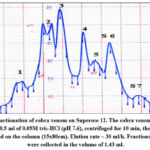 |
Figure 1: Fractionation of cobra venom on Superose 12. The cobra venom (50mg) was dissolved in 0.5 ml of 0.05M tris-HCl (pH 7.6), centrifuged for 10 min, the supernatant was applied on the column (15х80сm). Click here to view Figure |
Electrophoretic analysis of the fractions demonstrated that in the first protein peak there were two main by mass components with molecular mass ranging from 55 to 65 kDa and some minor components (of < 94 and 30 kDa). The other peak fractions were found to contain mainly low molecular mass proteins and peptides with molecular mass ranging from 6.5 to 15 kDa (Figure 2).
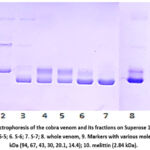 |
Figure 2: SDS electrophoresis of the cobra venom and its fractions on Superose 12. 1. S-1; 2. S-2; 3. S-3; 4. S-4; 5. S-5; 6. S-6; 7. S-7; 8. whole venom, 9. Markers with various molecular masses in kDa (94, 67, 43, 30, 20.1, 14.4); 10. melittin (2.84 kDa).Click here to view Figure |
Problems in study on pain and nociception, as well as on medical analgesia are the topical directions in up-to-date biomedicine.2, 3, 4, 7 Components with analgesic activity were obtained from venom of cobras inhabiting various regions of the world,9 but the components with similar activity in the venom of the Central Asian cobra were not studied ever. That is why, next stage aimed at studying potential antinociceptive activity of the venom and fractions S-1 – S-7 obtained. Antinociceptive effects were assessed in accordance with appropriate recommendations2-3 on the models of thermal and chemical pain stimulation in laboratory mice.7 In hot plate test (thermal model) nociceptive response manifested in the hind paw-licking and jumping, while the prolongation of jump latent period at high temperature of the plate (54°C) was the evidence for effect of agents with lower analgesic potential.10
The materials were used in low doses (0.4 μg/kg) were dissolved in the physiological solution and administered to mice intraperitoneally in the volume of 150 mcL per animal. Responses of animals were registered at 30, 120 and 180 min after administration (Table 1). The cobra venom (S-0) and fractions S-1 – S-7 can be seen to produce approximately equal analgesic effects in 30 min after administration increasing the latent time of response two times more than the one for the control; effectivity of the venom remains practically unchanged during the experiment. Among fractions under study, S-4 – S-7 peptide fractions were of the greatest interest as their effect was progressing by time (S-4, S-5 and S-7); the maximum target effect could be seen for S-7 fraction. In prospect, more detailed study on S-6 fraction similar to S-7 fraction by composition (Figure 2, lanes 6 and 7) is needed, as the dynamics of its effect was quite different.
Study on antinociceptive action of cobra venom and fractions obtained by chromatographic separation continued on the model of chemical stimulation widely used for screening. Its selectivity is relatively low, but there was positive correlation between effective doses of analgesics in the model and doses of medications producing the desired effect in the clinical settings.11
Table 1: Analgesic activity of N. oxiana Eichwald venom and its fractions, including ketoprofen in the dose of 20 mg/kg and S-0 – S-7 in the dose of 0.4 μg/kg in 30, 120 and 180 min after administration in the hot plate test. (М±m; n=6).
| Agents | Animals (n) | Dose (μg/kg)/ mg/kg | Latent time (s) | ||
| In 30 min | In 120 min | In 180 min | |||
| Control | 6 | 9.3±0.7 | 9.3±0.7 | 9.3±0.7 | |
| Ketoprofen | 6 | 20 | 18.3±2.0* | 17.6±1.0* | 20.0±1.6* |
| S-0 | 6 | 0.4 | 16.4±1.2* | 18.0±1.2* | 11.0±1.0* |
| S-1 | 6 | 0.4 | 18.0±1.4* | 37.0±1.4* | 22.0±1.4* |
| S-2 | 6 | 0.4 | 40.0±3.0* | 35.0±3.0* | 35.3±3.0* |
| S-3 | 6 | 0.4 | 20.3±1.7* | 58.0±1.7** | 54.0±1.7** |
| S-4 | 6 | 0.4 | 18.0±1.2* | 29.0±1.2* | 65.0±1.2** |
| S-5 | 6 | 0.4 | 22.0±1.7* | 58.0±2.3** | 68.0±2.3** |
| S-6 | 6 | 0.4 | 27.0±2.3* | 65.0±2.3** | 72.0±1.2** |
| S-7 | 6 | 0.4 | 19.6±1.8* | 41.0±1.8* | 75.0±2.6** |
Note: *P<0.05; **P<0.01
The whole venom (S-0) reduced number of writhings in 30 and 120 minutes while in 180 minutes the effect was not registered, that is, the analgesic effect of low venom doses is the short-term one (120 min) (Table 2). Fractions S-1 – S-3 demonstrated the tendency towards the suppression of responses to the pain stimulant, but the significant reduction in writhings by 2 and more times, as the criterion of analgesic effect,4 was registered only after administration of S-6 at 30 and 120 minute and of S-7 at 120 and 180 minute. Intensity of writhings is known to reduce by time, according to some opinion,12 serving as the obstacle for assessment of effect duration of the analgesic under study. Data in Table 2 for fraction S-7 appear all the more interesting as its analgesic effect increased with time.
Table 2: Analgesic activity of N. oxiana Eichwald venom and its fractions, including ketoprofen in the dose of 20 mg/kg and S-0 – S-7 in the dose of 0.4 μg/kg in 30, 120 and 180 min after administration in the acetic acid-induced writhing test. (M ± m; n=6).
| Agents | Animals (n) | Dose (μg/kg)/ mg/kg | Number of writhings within 15 min | ||
| In 30 min | In 120 min | In 180 min | |||
| Control | 6 | 32.0±1.2 | 32.0±1.2 | 32.0±1.2 | |
| Ketoprofen | 6 | 20 | 31.0±0.7* | 26.0±1.0* | 19.0±2.4* |
| S-0 | 6 | 0.4 | 27.0±1.0* | 22.0±2.0* | 32.0±2.0* |
| S-1 | 6 | 0.4 | 21.0±1.0* | 29.0±1.0* | 23.0±1.0* |
| S-2 | 6 | 0.4 | 22.7±1.0* | 22.0±1.0* | 25.0±1.0* |
| S-3 | 6 | 0.4 | 23.0±1.0* | 21.0±1.0* | 23.0±1.0* |
| S-4 | 6 | 0.4 | 18.0±1.2* | 17.0±1.0* | 22.0±1.0* |
| S-5 | 6 | 0.4 | 18.0±1.0* | 17.0±1.0* | 16.0±1.0* |
| S-6 | 6 | 0.4 | 15.7±1.0* | 15.5±1.0** | 16.5±1.0* |
| S-7 | 6 | 0.4 | 16.5±1.0* | 15.5±1.1** | 13.0±1.0** |
Note: *P<0.05; **P<0.01
To sum up, fractions S-6 and S-7 arguably demonstrated the greatest analgesic action among materials under study. This action was accomplished due to the prolongation of the latent time for pain response development (by 4-5 times as compared to the control group) and reduction in number of writhings in both models used (Table 1 and Table 2, respectively). Acute toxicity for fractions S-6 and S-7 was determined using the probit analysis by Litchfield and Wilcoxon.13 LD50 of S-6 and S-7 was determined to be 2.05 and 10.3 mg/kg, respectively.
Thus, fraction S-7 demonstrating the highest analgesic activity in both models turned out the least toxic one. It is pertinent to note that LD50 of the whole venom from the Central Asian cobra and particular neurotoxins NT-1 and NT-2 isolated from the venom is 0.48, 0.56 and 0.9 mg/kg, respectively. The findings suggest that fractions S-6 and S-7 possess low cytotoxicity as well. The suggestion was checked up in the experiments in suspension of the washed erythrocytes from donor human blood. Thus, fractions S-6 and S-7 towards the end of the 3rd hour (maximum time period recommended for determination of analgesic activity in the models used3-4) demonstrated moderate hemolytic activity. Similarly low hemolytic activity was demonstrated by fractions S-1 and S-5 (data not presented), while the whole venom under the similar conditions demonstrated the laky blood effect, that is, caused the 100% lysis of erythrocytes.14
Upon testing of the materials under study for activity of phospholipase A2 in the egg yolk coagulation test it was found in fractions S-1 and S-2 (Figure 1). Upon introduction of fraction with the highest phospholipase activity (S-2, 10μg) into the incubation medium only S-6 and S-7 caused practically complete hemolysis (data not presented) demonstrating the synergic effect characteristic of cytocardiotoxins from cobra venom.
Neural networks involved into the reception and transfer of pain signal, as well as in processing and formation of response in the brain are still underexplored. Synaptic (sensor) connections of the spinal cord (nociceptive pathway) were identified and studied using neuro- , cytocardiotoxins and “short” peptides from the venoms of cobra and rattlesnakes interacting with one of 8 known types of alfa-subunits of nicotine acetylcholine receptors or cationic channels of synapses.15 Thus, polypeptide with molecular mass of 6,714 Da and LD50 2.69 mg/kg called najanalgesin demonstrating analgesic effect in both thermal and chemical models of pain was generated from the venom of Naja atra.16
To assess potential mechanisms underlying analgesic action of S-6 and S-7, fractions from the Central Asian cobra, blockers of pain opioid receptors (naloxone) and pain cholinergic receptors (atropine) were used.
The data summed up in Figure 3A demonstrated that naloxone administered to animals in the dose of 3 mg/kg increased the latent time for responses in the hot plate test insignificantly, while under conditions of the experiment S-6 and S-7 fractions increased it by 2.6 and 3.6 times on average, respectively. Administration of naloxone to mice suppressed analgesic effect of S-6 and S-7 (nearly by 29%) indicating the moderate contribution of opioid receptors to their antinociceptive action.
Administration of atropine, a blocker of cholinergic pain receptors, resulted in significant prolongation of latent time (Figure 3B) of response; effect of atropine reduced the parameter for S-6 by 1.6 times in 1 hour, while in 3 hours there was no effect of atropine registered. Administration of atropine and S-7 produced no effect on the action of the latter in 1 hour, while in 3 hours their total effect increased by 1.7 times.
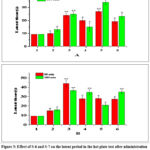 |
Figure 3: Effect of S-6 and S-7 on the latent period in the hot plate test after administration of naloxone (A) and atropine (B). A1 – Control; A2 – naloxone; A3- S-6; A4 – S-6+ naloxone; A5 – S-7; A6 – S-7+ naloxone; B1 – Control; B2 – atropine; B3 – S-6; B4 – S-6+ atropine; B5 – S-7; B6 – S-7+ atropine. Click here to view Figure |
Similar data were obtained in the acetic acid-induced writhing test (Figure 4A); naloxone produced no marked effect. Atropine reduced number of writhings in 3 hours increasing the effect of S-6 in 1 hour but producing practically no effect in 3 hours; while it produced no significant effect on the effect of S-7 at all (Figure 4B).
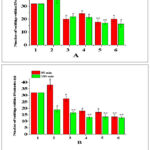 |
Figure 4: Effect of S-6 and S-7 on number of the acetic acid-induced writhings after administration of A1 – Control; A2 – naloxone; A3- S-6; A4 – S-6+ naloxone; A5 – S-7; A6 – S-7+ naloxone; B1 – Control; B2 – atropine; B3 – S-6; B4 – S-6+ atropine ; B5 – S-7; B6 – S-7+ atropine.Click here to view Figure |
Discussion
Thus, our findings suggest that analgesic effects of fractions under study could be accomplished by various mechanisms. For example, in the venom of the Chinese cobra (Naja atra) several peptides with analgesic activity were identified, to name najalgesin with antinociceptive effect by inhibition of c-Jun NH₂-terminal kinase4, 17 and a “short” neurotoxin producing central analgesic action in low doses (25 μg/kg), but effect of hyperalgesia in high doses (100 μg/kg) interacting with adenosine receptors A1 and A2a.18 Participation of other mechanisms differing from the receptor ones, including those of ionic channels (mambalgin 1 and 2, producing effect on H+-sensitive channels (ASICs)) of neurons18, 20 or direct effect on some links of nociceptive signaling pathways cannot be excluded.16 Our findings suggest participation of central and peripheral nociceptive pathways in accomplishment of analgesic action of fractions S-6 and S-7. However, the precise mechanisms underlying the analgesic effects of S-6 and S-7 fractions remain to be fully elucidated, and further studies are required to investigate their molecular targets, receptor interactions, and potential involvement of non-opioid and ion channel-mediated pathways.
Conclusion
Our findings demonstrate the presence of peptide components in the venom of the Central Asian cobra, Naja oxiana Eichwald, exhibiting low toxicity and significant antinociceptive action. Acting at low doses (0.4–4.0 μg/kg), peptide-analgesics with molecular masses ranging from 6.5 to 15 kDa show low hemolytic and phospholipase activities and, based on acute toxicity data, exhibit reduced neurotoxicity relative to whole venom. These peptide components with analgesic activity may serve as promising pharmacological agents for the development of next-generation analgesics targeting specific mechanisms involved in pain signaling. Future studies should focus on chronic pain models, detailed mechanism exploration, and translational evaluation in preclinical settings.
Acknowledgement
The authors express their sincere gratitude to the team of the Laboratory of Evolutionary Biochemistry at the Institute of Biophysics and Biochemistry under the National University of Uzbekistan for providing the necessary facilities to carry out this research.
Funding sources
The author(s) received no financial support for the research, authorship, and/or publication of this article.
Conflict of interest
The author(s) do not have any conflict of interest.
Data Availability Statement
This statement does not apply to this article.
Ethics Statement
The experimental protocols complied with the standards and requirements for the humane treatment of animals and the provisions of the Ethical Commission of the IBB at the National University of Uzbekistan. (Protocol No. 7 BEC/ IBB-NUU of 04/07/2022) on the use of laboratory animals.
Informed Consent Statement
This study did not involve human participants, and therefore, informed consent was not required.
Clinical Trial Registration
This research does not involve any clinical trials.
Permission to reproduce material from other sources
Not applicable .
Author Contributions
- Yuldashev Eldor Ilkhomjon ogli: Conceptualization, Methodology, Writing – review & editing, Writing – Original Draft;
- Sadikov Erkin Saodatovich: Conceptualization, Methodology, Writing – review & editing, Supervision, Resources, Funding acquisition;
- Sultanalieva Nadira Murodovna: Data Collection, Analysis, Review & Editing;
- Jovlieva Dilfuza Tilovovna: Data Curation, Formal analysis;
- Temirov Abdumovlon Abduvalievich: Investigation, Formal analysis;
- Mutalov Karimjan Abdurakhimovich: Investigation, Formal analysis;
References
- Van H, Austin S, Khan R, et al. Neuropathic pain in the general population: a systematic review of epidemiological studies. Pain. 2014; 155 (4): 654-662. https://doi.org/10.1016/j.pain.2013.11.013
CrossRef - Gazerani P, Cairns B. Venom-based biotoxins as potential analgesics. Expert Rev. Neurother. Early online. – 2014; 1-14. https://doi.org/10.1586/14737175.2014.962518
CrossRef - King G. Venoms as a platform for human drugs: translating toxins into therapeutics. Expert. Opin. Bio.l Ther. 2011; 11 1469-1484. https://doi.org/10.1517/14712598.2011.621940
CrossRef - Newman D, Cragg G. Natural products as sources of new drugs over the 30 years from 1981 to 2010. J Nat Prod. 2012; 75 (3): 311-335. https://doi.org/10.1021/np200906s
CrossRef - Kapoor V. Natural toxins and their therapeutic potential. Indian J Exp Biol. 2010; 48(3): 228-37.
- Osipov A, Utkin Y. Effects of snake venom polypeptides on central nervous system. Cent.nerv Syst Agents Med Chem. 2012; 12(4): 315-328. https://doi.org/10.2174/187152412803760618
CrossRef - Pal S, Gomes A, Dasgupta S, et al. Snake venom as therapeutic agents: from toxin to drug development. Indian J Exp Biol. 2002; 40(12): 1353-1358.
- Koh D, Armugam A, Jeyaseelan K. Snake venom components and their applications in biomedicine. Cell Mol Life Sci. 2006; 63(24): 3030-3041. https://doi.org/10.1007/s00018-006-6315-0
CrossRef - Chen Z, Zhang H, Gu Z, et al. A long-form alpha-neurotoxin from cobra venom produces potent opioid-independent analgesia. Acta Pharmacol Sin. 2006; 27(4): 402-408. https://doi.org/10.1111/j.1745-7254.2006.00293.x
CrossRef - Sampaio S, Hyslop S, Fontes M, et al. Crotoxin: novel activities for a classic beta-neurotoxin. Toxicon. 2010; 55(6): 1045-1060. https://doi.org/10.1016/j.toxicon.2010.01.011
CrossRef - Cura J, Blanzaco D, Brisson C, et al. Phase I and pharmacokinetics study of crotoxin (cytotoxic PLA(2), NSC-624244) in patients with advanced cancer. Clin Cancer Res. 2002; 8(4): 1033-1041.
- Lopez M. Natural products as sources of new drugs. A general overview. An Real Acad Nac F. 2011; 77 (1): 12-26.
- Laemmli U. Cleavege of structural proteins during the assembly of the head of the bacteriophage T4. Nature. 1970; 227: 680-685. https://doi.org/10.1038/227680a0
CrossRef - Lavich T, Cordeiro R, Silva P, et al. A novel hotplate test sensitive to hyperalgesic stimuli and nonopioid analgesics. Braz. J. Med. Biol. Res. 2005; 38 (3): 445–451.
CrossRef - Mironov A, Grif K. Methodic recommendation for study on analgesic activity of medicines. A practical guide to preclinical trials of medicines. Part I. Ed. Moscow 2012: 197-219.
- Bondarenko D, D’yachenko I, Scobtsov D, et al. In vivo models for study on analgesic activity. Biomedicine (Moscow). 2011; 2: 84-94.
- Liang Y, Zhang Z, Zhang R. Antinociceptive effect of najanalgesin from Naja naja atra in a neuropathic pain model via inhibition of c-Jun NH2-terminal kinase. Chin. Med. J. 2015; 128: 2340-45. https://doi.org/10.4103/0366-6999.163397
CrossRef - Zhao С, Zhao J, Yang Q, et al. Cobra neurotoxin produces central analgesic and hyperalgesic actions via adenosine A1 and A2a receptors. Mol. Рain. 2017; 13: 1-11. https://doi.org/10.1177/1744806917720336
CrossRef - Yuldashev E. Comparative study on the analgesic potential of Central Asian snake venoms. West. Eur. J. Med. Med. Sci.online. 2025; 3(06): 17-22.
- Yuldashev E, Sadikov E, Jumayev I, et al. Characterization of the mechanism of action of naja oxiana eichwald poison fractions on cardiac and smooth muscle contractile activity. // Eur. J. Res. online. 2024; 9(1): 25-32.
 PlumX:
 Views: 900
  PDF Downloads:
279
PDF Downloads:
279 
Accepted on: 17-03-2026
Second Review by: Dr. Abeer Gatea
Final Approval by: Dr. Hanefi ÖZBEK