The Effect of Extraction Temperature on the Yield of Phenolic, Flavonoid, and α-Tocopherol Contentsof Passion Seed Oil in Microwave-Assisted Extraction
 , Muh. Alif Noor Fauzan2, Harti Widiastuti2, Virsa Handayani2, Rais Razak2and Aktsar Roskiana Ahmad1
 1Faculty of Pharmacy, Universitas Muslim Indonesia, Makassar, Indonesia.
2Department of Pharmacy, Faculty of Pharmacy, Universitas Muslim Indonesia, Makassar, Indonesia.
Corresponding Author E-mail:abd.malik@umi.ac.id
DOI : http://dx.doi.org/10.13005/bpj/3297
Download this article as:

Passion tree (Passiflora edulis Sims.) is a plant widely cultivated in Southeast Asia, including Indonesia, particularly in South Sulawesi. The plant belongs to the genus Passiflora within the Passifloraceae family. Passion fruit is commonly consumed and made into a nutritious beverage, while its seed has been known as a source of natural oil in traditional medicine for antioxidant, anti-inflammatory, analgesic, and antipyretic properties. Passiflora Seed Oil (PSO) contains various bioactive natural products such as fatty acids, phenolics, flavonoids, and a-tocopherol. The efficiency of extracting these bioactive constituents depends on the extraction process. This study aims to determine the optimal extraction method of chemical constituents in passion fruit seed oil of phenolic, flavonoid, and a-tocopherol, focusing on variation of temperature and extraction time. The method used was a modern or green extraction, namely Microwave-Assisted Extraction (MAE). The extraction was performed using n-hexane as the solvent under three temperature settings: low (20°C), medium-low (36°C), and high (95°C), with extraction durations of 10 and 20 minutes. The contents of phenolic, flavonoid, and a-tocopherol were quantified using a UV-Visible Spectrophotometer at wavelengths ranging from 200 to 800 nm, specifically detecting these compounds at 432, 777, and 230 nm, respectively. The phenolic content ranged from 25.29 to 33.28 mg GAE/mL, flavonoid content ranged from 8.57 to 21.94 mg QE/mL, and a-Tocopherol content ranged from 0.27 to 1.56 mg a-TE/mL across the tested conditions. The results indicate that temperature and extraction time affect the levels of flavonoids and a-tocopherol content, while the phenolic content remains relatively unaffected.
KEYWORDS:Flavonoid; Microwave-assisted extraction; Passion seed oil; Phenolic; a-Tocopherol.
Introduction
The passion tree (Passiflora edulis Sims) contains various natural bioactive constituents. This plant species belongs to the Passifloraceae family, and includes different varieties, such as purple and yellow types.1 Its fruit is widely known to be edible and is commonly processed into a beverage. In Makassar, Passion fruit is frequently used to make “Markisa juice” as well as for other food and drink purposes.2 The seeds of the passion fruit have been known as a source of natural oil,3 which offers medicinal benefits, including promoting skin health and slowing the aging process.4
PSO has long been utilized in traditional medicine, particularly the seeds of purple passion fruit (P. edulis Sims), which are known in traditional medicine for their antioxidant, anti-inflammatory, antipyretic, analgesic, sedative, and hypotensive activities. P. edulis Sims, or purple passion fruit, is a creeping plant found in tropical and subtropical regions,1 including Indonesia, especially in South Sulawesi. This plant typically grows in specific locations such as the highlands of South Sulawesi. The main character of the fruit is oval in shape and yellow. The PSO contains several bioactive compounds with potential antioxidant properties, including carotenoids, anthocyanins, flavonoids, and vitamin C. 5
According to a previous PSO study by Malik et al.,5 the antioxidant activity of passion fruit seed oil extract was investigated using various extraction methods and solvents. These extracts contain chemical compounds that are used for cosmetics and pharmaceutical products. Nevertheless, exposure to factors such as oxygen, heat, and light can cause the loss or reduction of the extract’s bioactivity. Malik et al.,5 emphasized that PSO has potential as an antioxidant and source of phenolic and flavonoid constituents.5 The extraction process is affected by temperature when obtaining the chemical compounds contained in the PSO.
Microwave-assisted extraction (MAE) is a technique that applies heat generated by the interaction between magnetic and electric fields.6 This technique has several advantages, including the use of a water-based solution and its low cost. However, the high internal temperature can destroy bioactive compounds. Therefore, the temperature degree and extraction time need to be optimized for each particular compound.
Materials and Methods
Chemicals
Chemicals and reagents were of analytical grade and purchased from Merck and Sigma-Aldrich companies. The chemicals used in this research were toluene, ethyl acetate, n-hexane, AlCl3, Na2CO3, CH3COOK, ethanol, Folin-Ciocalteu reagent, iodine, potassium iodide, chloroform, quercetin, gallic acid, and a-tocopherol.
Sample material
The passion seeds were obtained from the local factory, a waste of the “Markisa syrup” production process in Makassar. The seed waste was prepared in the Laboratory Pharmacognosy-Phytochemistry, Faculty of Pharmacy, UMI, according to Malik et al.,5 This experiment was performed using standard laboratory equipment. The chemical analysis used spectroscopy UV-Vis (Shimadzu UV-Vis Genesys 10-S), and a rotary vacuum evaporator (Buchi®, Rotavapor R-220).
Extraction
The extraction processes were performed using microwave-assisted extraction (MAE) with n-hexane solvent. Temperature and time were optimized. About 100 g of Passion seed was ground to get a seed powder. Afterward, the sample was placed in a glass beaker, and 300 mL of n-hexane was added. The mixture was then extracted at different temperatures: low (20°C), medium-low (36°C), and high (95°C) for 10 and 20 minutes. The extraction results are filtered and evaporated using a Rotary Vacuum Evaporator (Rotavapor) and a water bath to obtain Passion Seed Oil (PSO).
Preparation of α–tocopherol reagent
The a-tocopherol reagent was prepared by dissolving 1 mL in n-hexane to a final volume of 10 mL, resulting in a concentration of 100 ppm. The solution was divided into variations of 0.1 ppm, 0.2 ppm, 0.3 ppm, 0.4 ppm, and 0.5 ppm, with each variation being 5 mL. Afterward, the solutions were measured by using UV-Vis spectroscopy.
Determination of phenolic content
The total phenolic content was determined using the method of Malik et al.5 with minor modifications. About 250 mL of PSO was added, followed by 200 mL of Folin-Ciocalteu reagent, 2000 µL of Na2CO3, and purified water up to 5000 µL. The solution was incubated for 2 hours. Absorbance was measured by using UV-Vis spectroscopy.5
Determination of flavonoid content
TFC was determined based on the research of Malik et al.,5 The flavonoid content was determined by adding 250 mL of PSO, followed by AlCl3 µL, CH3COOK 100 µL, and adding up to 5 mL of water. The solution was incubated for 30 minutes. Absorbance was acquired from a UV-Vis spectroscopy.
Determination of α–tocopherol content
PSO 0.5 mL was dissolved in 5.0 mL of chloroform, followed by 1.0 mL of 0.1% iodide solution, and shaken for a few minutes to obtain a homogeneous solution. Maximum absorbance was scanned. The maximum absorbance was plotted against the linear regression of the a-tocopherol standard. The a-tocopherol content was determined by linear regression.
Results
Passion seed oil (PSO) was obtained by several extraction methods with n-hexane as a solvent. The extraction results are shown in Table 1.
Table 1: Extraction result
| Sample in various temperature and extraction time | Amount (%) |
| Low 10 | 17.21 |
| Low 20 | 18.28 |
| Medium-Low 10 | 17.93 |
| Medium-low 20 | 18.32 |
| High 10 | 17.90 |
| High 20 | 16.70 |
Table 2: Phenolic
| Temperature (oC) and duration (min) | Abs. (A=S) | Linearity | Content (mg GAE/g) |
| Low 10 | 1.852 | y = 0.0695x + 0.0938 | 25.29 |
| Low 20 | 2.407 | 33.28 | |
| Medium-Low 10 | 2.063 | 28.33 | |
| Medium-low 20 | 2.37 | 32.75 | |
| High 10 | 2.195 | 30.23 | |
| High 20 | 1.879 | 25.68 |
Low= 20oC, Medium-low= 36oC, High= 95oC
Table 3: Flavonoid
| Temperature (oC) and duration (min) | Abs. (A=S) | Linearity | Content (mg QE/g) |
| Low 10 | 0,051 | y = 0,1047x + 0,0443 | 13.01 |
| Low 20 | 0,057 | 8.57 | |
| Medium-Low 10 | 0,049 | 12.77 | |
| Medium-low 20 | 0,078 | 19.56 | |
| High 10 | 0,116 | 16.26 | |
| High 20 | 0,170 | 21.94 |
Low= 20oC, Medium-low= 36oC, High= 95oC
Table 4: a-Tocopherol
| Temperature (oC) and duration (min) | Abs. (A=S) | Linearity | Content (mg a-TE/g) |
| Low 10 | 0.051 | y = 4,853x-1.475 | 0.74 |
| Low 20 | 0.057 | 0.94 | |
| Medium-Low 10 | 0.049 | 1.56 | |
| Medium-low 20 | 0.078 | 1.17 | |
| High 10 | 0.116 | 0.43 | |
| High 20 | 0.170 | 0.27 |
Low= 20oC, Medium-low= 36oC, High= 95oC
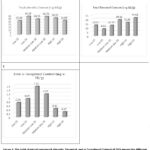 |
Figure 1: The total chemical compound phenolic, flavonoid, and a-Tocopherol Content of PSO among the different extractions process. (A) Total phenolics content; (B) Total flavonoid content; (C) Total a-tocopherol content. |
Discussion
The research was performed to determine the optimization of the extraction process using Microwave-Assisted Extraction (MAE) of Passion Seed Oil (P. edulis Sims.). The research parameters were phenolic, flavonoid, and a-tocopherol levels. MAE is an extraction method that is basically a modification of maceration methods.7 This method has recently been used widely in extracting natural products to optimize the presentation of the extract.
The MAE method has garnered significant attention over the past 15 years due to its high extraction capacity. The major advantage of MAE methods is that they are considered a green technique based on electromagnetic waves, which generate heat within the material matrix, inducing a rise in temperature and water pressure inside the cell walls. It allows increasing the acceleration of the solvent to release the compound from the cell.8
The MAE was evaluated for its performance compared to Soxhlet extraction methods in the preparation of piceatannol. The MAE method acquired more piceatannol than the Soxhlet extraction method. 7 The organic solvents were selected based on their ability to extract potential compounds. The purpose of using n-hexane solvent was based on the chemical properties of PSO, which is dominated by low-polarity compounds. Variations in time and temperature optimized the extraction process.9 Time variations were 10 minutes and 20 minutes, and then temperature variations were low-temperature (20°C), medium-low (36°C), and high-temperature (95°C).
Passion seed waste was transferred into the laboratory for preparation. The seed waste was cleaned under tap water and dried in the oven. After drying, the seeds were ground into a fine powder.
Extraction was carried out using the MAE method. This extraction method was used because the MAE method is a separation that utilizes microwaves to accelerate the extraction process by heating the solvent quickly and efficiently.3 The extract was evaporated using a Rotary Vacuum Evaporator (Rotavapor) at 60°C, and then passion fruit seed oil was obtained. The extract yield of passion fruit seed oil at low temperatures for 10 and 20 minutes was 17.21% and 18.28%, respectively; at medium-low temperatures for 10 and 20 minutes, it was 17.93% and 18.32%, respectively; and at medium temperatures for 10 and 20 minutes, it was 17.90% and 16.70%, respectively (Table 1).
This study was conducted to determine the total phenolic, flavonoid, and α-tocopherol contents. Those bioactive compounds were determined, as per Malik et al. (2023), with a few modifications.5 The research confirmed that PSO contains phenolic, flavonoid, and a-tocopherol. Phenolic content ranged from 25.29 to 33.28 mg GAE/mL, Flavonoid content ranged from 8.57 to 21.948 mg QE/mL, and a-Tocopherol content ranged from 0.27 to 1.560 mg a-TE/mL.
Previous researchers 5,10-16 reported the total phenolic content (TPC) of PSO. The phenolic content was generally calculated to GAE found 12.53 μg/g sample 10, 1,314.13 mg GAE/kg),11 3.12 g GAE/100 g seed dry basis,12 2538 mg GAE/100 g of sample,13 7.273 mg GAE/g extract.14 Total Flavonoid Content (TFC) was reported with various levels of TFC by a previous study: 35.40 mg RE/g crude extract,5 517.11 mg QE/g, 15 and 8.36 mg QE/g extract.14 Total a-Tocopherol Content (TTC) was determined and compared with some studies: 499.30 mg/kg,11 0.061 mg/100 g of fresh fruit, and 0.052 mg/100 g of fresh fruit, respectively.16
Conclusion
We concluded that optimizing the passion fruit seed oil extraction method using the green extraction method, Microwave-Assisted Extraction (MAE), resulted in the extraction of phenolic, flavonoid, and α-tocopherol compounds. The highest phenolic, flavonoid, and a-tocopherol content was at low temperature for 20 minutes, 33.283 mg GAE/g, high temperature for 20 minutes, 21.948 mg QE/g, and at medium-low temperature at 10 minutes, 1.560 mg a-TE/g, respectively.
Acknowledgement
The authors acknowledge Rianti Annisa for technical assistance in the experiment and data acquisition.
Funding Source
This research was partly funded by Universitas Muslim Indonesia, Makassar, Indonesia, through grant number 1019/A.03/LP2S-UMI/VII/2023.
Conflict of Interest
The author(s) do not have any conflict of interest.
Data Availability Statement
This statement does not apply to this article.
Ethics Statement
This research did not involve human participants, animal subjects, or any material that requires ethical approval.
Informed Consent Statement
This study did not involve human participants, and therefore, informed consent was not required.
Clinical Trial Registration
This research does not involve any clinical trials
Permission to reproduce material from other sources
Not Applicable
Authors Contributions
- Malik: Planning, Conceptualization, Methodology, Manuscript preparation, Supervision.
- Alif Noor Fauzan: Extraction, Data Collection, Analysis.
- Harti Widiastuti: Review & Editing, Visualization.
- Virsa Handayani: Project Administration, Supervision.
- Rais Razak: Sample collection, Sample preparation, Data Collection
- Aktsar Roskiana Ahmad: Review, Resources, Supervision.
References
- Pereira ZC, Cruz JMdA, Corrêa RF, et al., Passion fruit (Passiflora spp.) pulp: A review on bioactive properties, health benefits and technological potential. Food Research International. 2023;166:112626. doi: https://doi.org/10.1016/j.foodres.2023.112626.
CrossRef - Yuan YV, Baduge SA. Chapter 7 – The Contribution of Phytochemicals to the Antioxidant Potential of Fruit Juices. In: Rajauria G, Tiwari BK, eds. Fruit Juices. Academic Press; 2018:95-128.
CrossRef - Chen P, Zhang X, Yang Q, et al. Extraction and characterization of passion fruit seed oil and investigation of its hypolipidemic activity. Journal of Agriculture and Food Research. 2025;19:101672. doi: https://doi.org/10.1016/j.jafr.2025.101672.
CrossRef - Maruki-Uchida H, Morita M, Yonei Y, Sai M. Effect of Passion Fruit Seed Extract Rich in Piceatannol on the Skin of Women: A Randomized, Placebo-Controlled, Double-Blind Trial. J Nutr Sci Vitaminol (Tokyo). 2018;64(1):75-80. doi:10.3177/jnsv.64.75.
CrossRef - Malik A AR, Zahra V, Ahmad A. R. Antioxidant Activity, Phenolic and Flavonoid Content of Passion Fruit Seed Oil. Biomedical & Pharmacology Journal. 2023;16(2):791-796. doi: https://dx.doi.org/10.13005/bpj/2661.
CrossRef - López-Salazar H, Camacho-Díaz B, Ocampo M, et al., A. Microwave-assisted Extraction of Functional Compounds from Plants: A Review. BioResources. 06/14 2023;18doi:10.15376/biores.18.3.Lopez-Salazar.
CrossRef - Silva GC, Rodrigues RAF, Bottoli CBG. Passion fruit seed extract enriched in piceatannol obtained by microwave-assisted extraction. Sustainable Chemistry and Pharmacy. 2021;22:100472. doi: https://doi.org/10.1016/j.scp.2021.100472.
CrossRef - Reddy AVB, Moniruzzaman M, Madhavi V, et al., Chapter 8 – Recent improvements in the extraction, cleanup, and quantification of bioactive flavonoids. In: Atta ur R, ed. Studies in Natural Products Chemistry. Elsevier; 2020:197-223.
CrossRef - Kim J-H. Extraction time and temperature affect the extraction efficiencies of coumarin and phenylpropanoids from Cinnamomum cassia bark using a microwave-assisted extraction method. Journal of Chromatography B. 2017;1063:196-203. doi: https://doi.org/10.1016/j.jchromb.2017.08.008.
CrossRef - Da Costa CAR, Machado GGL, Rodrigues LJ, et al., Phenolic compounds profile and antioxidant activity of purple passion fruit’s pulp, peel and seed at different maturation stages. Scientia Horticulturae. 2023;321:112244. doi: https://doi.org/10.1016/j.scienta.2023.112244.
CrossRef - Malacrida CR, Jorge N. Yellow passion fruit seed oil (Passiflora edulis f. flavicarpa): physical and chemical characteristics. Brazilian Archives of Biology and Technology. 2012;55.
CrossRef - De Santana FC, de Oliveira Torres LR, Shinagawa FB, et al. Optimization of the antioxidant polyphenolic compounds extraction of yellow passion fruit seeds (Passiflora edulis Sims) by response surface methodology. J Food Sci Technol. Oct 2017;54(11):3552-3561. doi: https://doi.org/10.1007/s13197-017-2813-3.
CrossRef - Reis CC, Freitas SP, Lorentino CMA, et al. Bioproducts from Passiflora cincinnata Seeds: The Brazilian Caatinga Passion Fruit. Foods. 2023;12(13):2525.
CrossRef - Ramli ANM, Manap NWA, Bhuyar P, et al., Passion fruit (Passiflora edulis) peel powder extract and its application towards antibacterial and antioxidant activity on the preserved meat products. SN Applied Sciences. 2020;2(10):1748. doi: https://doi.org/10.1007/s42452-020-03550-z.
CrossRef - Sari DK, Ibrahim N, Herlina N, et al. The Effects of Red Palm Oil, Koja Bay Leaves, and Passion Fruit Seeds Formulation on Antioxidant Activity, Antihyperlipidemia, BDNF, and Lipase Enzyme Activity on Sprague-Dawley Rats. Journal of Experimental Pharmacology. 2024;16(null):271-284. doi: https://doi.org/10.2147/JEP.S466494.
CrossRef - Pertuzatti PB, Sganzerla M, Jacques AC, et al., Carotenoids, tocopherols and ascorbic acid content in yellow passion fruit (Passiflora edulis) grown under different cultivation systems. LWT – Food Science and Technology. 2015;64(1):259-263. doi: https://doi.org/10.1016/j.lwt.2015.05.031.
CrossRef
 PlumX:
 Views: 804
  PDF Downloads:
357
PDF Downloads:
357 
Accepted on: 19-11-2025
Second Review by: Dr. Murali Krishna Prasad Vallabhaneni
Final Approval by: Dr. Anton R Keslav