Enhancing Public Health with Pharmacovigilance: Tools, Strategies, and Impacts
 , Yashvanthan Vinjmur Ragavan 2, Angeline Grace Pandian1 Ajith Kumar Kumaraguru 1and Kiran Kartheep Subramanian1
 1Department of Community Medicine, Sree Balaji Medical College and Hospital, Chennai, India.
2Department of Pharmacology, Saveetha Medical College and Hospital, SIMATS, Chennai, India
Corresponding Author E-mail: sujithapandian92@gmail.com
DOI : http://dx.doi.org/10.13005/bpj/3158
Download this article as:

Pharmacovigilance, which includes the identification, evaluation, comprehension, and avoidance of adverseor other drug-related issues, is essential to public health since it guarantees the safety, effectiveness, and responsible use of medications and vaccines. This article explores the various dimensions and applications of pharmacovigilance in public health, highlighting its role in drug safety monitoring, policy integration, pandemic preparedness, maternal and child health, chronic disease management, immunization programs, and its intersection with technological innovations. It operates at the intersection of clinical care, epidemiology, and public health policy, aiming to minimize harm while maximizing therapeutic benefits. The complexity of medication therapy and the rising demands for safety in healthcare systems are reflected in the development of pharmacovigilance. Its foundation lies in the Thalidomide disaster of the 1960s, which highlighted the catastrophic effects of inadequate drug safety monitoring. Over the past five years (2020–2025), pharmacovigilance has undergone significant advancements, enhancing drug safety and public health outcomes like adoption of artificial intelligence, utilisation of real world data, emphasising patient centric reporting, addressing emerging challenges etc.Today, pharmacovigilance is an essential component of regulatory frameworks and healthcare practices worldwide, integrating real-world evidence to address emerging challenges in drug safety. A key component of public health is pharmacovigilance, which guarantees the safe and efficient use of medications and vaccines. Its applications span drug safety monitoring, policy integration, pandemic preparedness, maternal and child health, chronic disease management, immunization programs, and technological innovations. By prioritizing pharmacovigilance, public health authorities can build safer, more resilient healthcare systems, ultimately improving outcomes for populations worldwide.
KEYWORDS:Chronic diseases; Healthcare; Maternal health; Pandemic; Pharmacovigilance
Introduction
Public health greatly benefits from pharmacovigilance (PV), the research and practices pertaining to the identification, evaluation, comprehension, and avoidance of side effects or other drug-related issues. By systematically monitoring the safety of medicines, pharmacovigilance ensures that public health policies are based on accurate data, ultimately protecting populations from preventable drug-related harm.1 Its integration into healthcare systems has transformed drug safety management and facilitated informed decision-making. Pharmacovigilance (PV) is a vital scientific discipline focused on the detection, assessment, understanding, and prevention of adverse effects or any other drug-related problems. It represents an integral part of modern healthcare systems, aiming to ensure the safety, efficacy, and rational use of medicines, ultimately contributing to improved patient and public health outcomes. The term originates from the Greek word “pharmakon” (meaning drug) and the Latin word “vigilare” (meaning to keep watch), reflecting its core mission of safeguarding public health through vigilant monitoring of medicinal products.2
Pharmacovigilance emerged as a response to significant public health crises caused by unsafe medicines. The most notable example is the thalidomide tragedy of the late 1950s and early 1960s, which resulted in thousands of birth defects worldwide due to inadequate drug safety monitoring. This catastrophic event spurred global efforts to establish robust pharmacovigilance systems and regulatory frameworks. Today, pharmacovigilance is central to healthcare policy, bridging clinical practice, regulatory science, and public health strategies.
In public health, pharmacovigilance plays a critical role by providing the evidence needed to address both individual and population-level health challenges. 3 Its activities encompass not only the detection of adverse drug reactions (ADRs) but also the identification of drug interactions, prescription mistakes, and off-label use concerns. By ensuring the safe use of medicines, pharmacovigilance supports the broader goals of public health, such as reducing morbidity and mortality, optimizing healthcare resource allocation, and fostering trust in health systems.3
The applications of pharmacovigilance in public health are vast and multifaceted. At the heart of these applications is post-marketing surveillance, a process that monitors the safety of medicines after they have been approved for public use. This stage of a drug’s lifecycle is critical, as clinical trials often cannot capture the full spectrum of potential adverse effects due to limitations in sample size, duration, and diversity of the study population. Pharmacovigilance addresses these gaps by gathering and analyzing real-world data, enabling early detection of safety signals and guiding regulatory actions such as drug recalls, labeling changes, or market withdrawals. Furthermore, pharmacovigilance is indispensable in addressing emerging public health challenges.4
Defining Pharmacovigilance
Pharmacovigilance (PV) is the scientific discipline concerned with the safety of medicines, encompassing actions pertaining to the identification, evaluation, comprehension, and avoidance of side effects or other issues associated with drugs. It is essential to healthcare since it guarantees the safe and efficient use of medications., thus reducing the risk of harm to individuals and populations.5 The need for pharmacovigilance was underscored by historical events where inadequate monitoring of drug safety led to widespread harm. The thalidomide disaster of the late 1950s and early 1960s remains one of the most significant milestones in the evolution of pharmacovigilance. Thalidomide, prescribed as a sedative and anti-nausea medication caused serious birth abnormalities in hundreds of babies born to pregnant women. This tragedy catalyzed the establishment of more rigorous drug safety regulations worldwide, including the formation of pharmacovigilance systems. Subsequently, the World Health Organization (WHO) initiated global efforts to standardize and strengthen pharmacovigilance practices. 6 The establishment of the WHO Programme for International Drug Monitoring in 1968, and its associated database, VigiBase, marked significant progress in the systematic collection and analysis of adverse drug reaction (ADR) data. These developments laid the foundation for modern pharmacovigilance systems that operate at national, regional, and global levels.7
Pharmacovigilance is guided by several core objectives, all of which align with the broader goal of safeguarding public health. These include: 8, 9
Detection of Adverse Drug Reactions (ADRs)
Identifying and documenting unexpected or harmful effects of medications, especially those that were not evident during clinical trials.
Assessment of Drug Safety
Assessing the risk-benefit profile of medications using empirical data, considering individual and population-level factors.
Understanding Drug Risks
Investigating the mechanisms of adverse effects, potential drug interactions, and risk factors that contribute to harmful outcomes.
Prevention of Drug-Related Harm
Implementing strategies to minimize risks associated with medicine use, including regulatory actions, public awareness campaigns, and healthcare professional training.10
Pharmacovigilance and Public Health
Pharmacovigilance is deeply intertwined with public health. It serves as a critical tool for protecting populations from preventable harm related to medicines, thereby contributing to the overall safety, efficacy, and rational use of drugs. This relationship can be understood through several key aspects:4
Evidence Generation for Public Health Policy
Pharmacovigilance generates data on drug safety and effectiveness, which informs public health decisions. Regulatory bodies rely on pharmacovigilance findings to approve new drugs, modify existing ones, or withdraw unsafe products from the market.
Support for Safe Medication Practices
By identifying patterns of adverse effects or misuse, pharmacovigilance helps healthcare professionals and patients make informed choices about medication use, ultimately promoting better health outcomes.
Response to Public Health Crises
During health emergencies, pharmacovigilance systems are instrumental in monitoring the safety of treatments or vaccines, ensuring that risks are promptly identified and mitigated.
Scope of Pharmacovigilance Activities 11
The scope of pharmacovigilance has expanded significantly since its inception. Initially focused on detecting and reporting ADRs, it now encompasses a wide range of activities which are depicted in Figure 1.
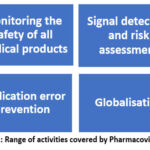 |
Figure 1: Range of activities covered by PharmacovigilanceClick here to view Figure |
Monitoring the Safety of All Medical Products
Pharmacovigilance extends beyond traditional medicines to include biologics, vaccines, herbal remedies, medical devices, and even cosmetic products.12
Signal Detection and Risk Assessment
Advanced methods, like machine learning and data mining, enable the identification of safety signals from large datasets, facilitating early intervention to prevent harm.13
Medication Error Prevention
Pharmacovigilance systems track and analyze medication errors, helping to design safer prescribing practices and reduce errors in healthcare settings.14
Global Collaboration
The interconnected nature of modern healthcare has led to the globalization of pharmacovigilance. International collaboration ensures that safety signals are shared across borders, benefiting patients worldwide.15
The diverse field of pharmacovigilance has developed to meet the demands of contemporary public health and medicine. Pharmacovigilance guarantees that medications continue to be a vital component of efficient and secure healthcare delivery by methodically assessing the safety of pharmaceuticals and mitigating possible hazards. Its alignment with public health goals makes it indispensable for reducing drug-related harm, improving treatment outcomes, and fostering trust in healthcare systems. The subsequent sections of this article will explore the diverse applications of pharmacovigilance in public health, highlighting its critical role in ensuring the safety and efficacy of medicines on a global scale.16
Pharmacovigilance and Drug Safety Monitoring
Drug safety monitoring lies at the heart of pharmacovigilance, ensuring that medicines remain safe and effective throughout their lifecycle. Although pre-approval clinical trials are necessary to prove a drug’s safety and effectiveness, they are inherently limited in scope, duration, and participant diversity. Pharmacovigilance addresses these limitations by monitoring drug safety in real-world settings, identifying adverse drug reactions (ADRs), and providing data to guide regulatory decisions and clinical practice. This section delves into the mechanisms, tools, and significance of drug safety monitoring in the broader context of pharmacovigilance.17
A dangerous or unexpected reaction to a medication that happens at standard dosages used for prevention, diagnosis, or treatment is known as an adverse drug reaction (ADR). Worldwide, ADRs constitute a major contributor to morbidity and mortality, making their identification and mitigation a public health priority. Clinical trials, though essential, may fail to detect rare or long-term ADRs due to the limited number of participants and controlled settings. Real-world pharmacovigilance systems extend surveillance to larger, more diverse populations, capturing ADRs that only emerge after widespread use. Post-marketing surveillance is crucial for detecting delayed or cumulative adverse effects, as seen in drugs like rofecoxib (Vioxx), which was withdrawn after widespread reports of cardiovascular events.18
Types of ADRs Monitored: 19
Type A (Augmented): Predictable reactions related to a drug’s known pharmacological properties, such as bleeding with anticoagulants.
Type B (Bizarre): Unpredictable and rare reactions, such as severe allergic reactions to vaccines or biologics.
Type C (Chronic): Reactions associated with long-term use, such as nephrotoxicity from analgesics.
Type D (Delayed): Reactions occurring long after treatment, such as secondary cancers from chemotherapy.
Type E (End-of-Use): Reactions due to withdrawal, such as withdrawal syndromes from opioids.
Importance of Drug Safety Monitoring for Public Health
Drug safety monitoring is essential not only for individual patient care but also for broader public health objectives: 14
Protecting Population Health
Early detection of ADRs prevents widespread harm and ensures safer therapeutic options for patients.
Enhancing Healthcare Quality
Reducing medication-related adverse events leads to better treatment outcomes and lower healthcare costs.
Supporting Regulatory Confidence
Transparent pharmacovigilance practices build trust in regulatory systems, fostering public confidence in medicines and vaccines.
Pharmacovigilance and drug safety monitoring are indispensable components of healthcare systems. They ensure that medicines remain safe and effective throughout their lifecycle, protecting individual patients and promoting public health. By leveraging advanced technologies, global collaboration, and proactive surveillance, pharmacovigilance systems can address current and emerging challenges in drug safety, paving the way for a healthier and more informed society. 20
Key developments
Integration of Advanced Technologies:
The adoption of artificial intelligence (AI) and machine learning (ML) has transformed pharmacovigilance by enabling real-time monitoring and efficient analysis of vast datasets. These technologies assist in early detection of adverse drug reactions (ADRs), improving patient safety.
Utilization of Real-World Data:
The use of electronic health records and social media monitoring has expanded the scope of pharmacovigilance. Real-world data provides valuable insights into long-term drug safety and effectiveness, complementing traditional clinical trial data.
Strengthening Regulatory Frameworks
Regulatory agencies have enhanced pharmacovigilance systems to ensure comprehensive monitoring of pharmaceutical products. For instance, the European Medicines Agency (EMA) played a pivotal role during the COVID-19 pandemic by expediting the development and approval of vaccines, while also addressing challenges such as cyberattacks that exposed internal concerns about vaccine production quality.
Emphasis on Patient-Centric Reporting
Digital health tools, including mobile applications and electronic patient-reported outcomes (ePRO) platforms, have empowered patients to directly report ADRs. This approach has led to real-time safety data collection, enhancing data accuracy and patient engagement in pharmacovigilance processes.
Addressing Emerging Challenges
The rise of innovative therapeutics, such as advanced therapy medicinal products and digital therapeutics, has necessitated specialized pharmacovigilance monitoring. Additionally, the COVID-19 pandemic highlighted the importance of effective risk communication and the need to adapt pharmacovigilance strategies during public health emergencies.
These developments underscore a dynamic and evolving pharmacovigilance landscape, where technological innovations and strengthened regulatory frameworks collaboratively enhance drug safety and public health.
Integration into Public Health Policy
A crucial first step in guaranteeing the safety, effectiveness, and prudent use of medications on a population-wide basis is the incorporation of pharmacovigilance into public health policy. By incorporating pharmacovigilance systems into public health frameworks, governments and health organizations can proactively address drug-related risks, reduce morbidity and mortality, and enhance overall healthcare quality. Pharmacovigilance aligns closely with public health goals, as both disciplines aim to protect and promote population health. By monitoring drug safety and addressing potential risks, pharmacovigilance contributes to several public health objectives:14
Reducing Preventable Harm
Adverse drug reactions (ADRs) are a leading cause of preventable morbidity and mortality. Pharmacovigilance identifies and mitigates these risks, ensuring safer therapeutic options.
Enhancing Drug Access and Equity
Public health policies informed by pharmacovigilance data help prioritize the accessibility of secure and efficient medications, particularly for marginalised groups.
Promoting Rational Drug Use
Pharmacovigilance provides evidence to guide appropriate prescribing, dispensing, and consumption of medicines, reducing the risk of misuse or overuse.
Improving Health Outcomes
By minimizing drug-related harm and optimizing therapy, pharmacovigilance improves patient outcomes and supports broader public health initiatives.
Pharmacovigilance plays distinct yet complementary roles for clinicians and the general population, each contributing to drug safety and public health from different perspectives.
Role of Pharmacovigilance for Clinicians
Clinicians are responsible for ensuring patient safety when prescribing medications, and pharmacovigilance helps them in several key ways.Clinicians are often the first to observe and report ADRs in patients. Pharmacovigilance systems allow them to monitor drug safety continuously and identify potential risks early. Pharmacovigilance provides clinicians with updated safety information about the drugs they prescribe. This allows for adjustments in treatment plans based on the latest data, such as avoiding certain drugs that have been associated with serious ADRs. Risk Communication and Management: Pharmacovigilance helps clinicians communicate the potential risks of medications to patients, enhancing informed consent processes. This is especially important when prescribing new or high-risk medications. Evidence-Based Practice: Data from pharmacovigilance systems support evidence-based practices, giving clinicians access to real-world safety data that may not have been evident in pre-market clinical trials.21
Role of Pharmacovigilance for the General Population
For the general population, pharmacovigilance plays a crucial role in ensuring drug safety at a broader level.Pharmacovigilance protects the general population by monitoring drugs in use, detecting widespread safety issues that may not have been apparent during clinical trials (due to limited sample sizes or trial conditions).In many systems, individuals can report ADRs, contributing to real-time surveillance. This provides essential data to regulatory bodies and pharmaceutical companies, influencing safety guidelines and product labelling. Pharmacovigilance initiatives help educate the public about the potential risks associated with medications, empowering people to report adverse effects and make informed choices about their health care. When new risks are detected, pharmacovigilance systems may trigger regulatory actions such as drug recalls, safety warnings, or changes to drug labeling, which directly protects the population from harm.22
Applications in Public Health Programs
Pharmacovigilance is integral to several public health programs, ensuring the safe and effective implementation of health interventions. The implementation of Pharmacovigilance across various disciplines of Public health is given in Table 1.
Table 1: Application of Pharmacovigilance in Public health programmes
| Public health programme | Application of Pharmacovigilance |
| Immunization Programs 23 | Monitoring vaccine safety through pharmacovigilance prevents adverse events from undermining public trust in immunization efforts.Example: The COVID-19 vaccination rollout relied on pharmacovigilance systems to monitor rare but serious adverse events like myocarditis and thrombosis. |
| Disease Management and Control 24 | Pharmacovigilance ensures the safety of drugs used in public health programs targeting diseases such as tuberculosis, malaria, and HIV/AIDS.Example: Safety monitoring of antiretroviral therapy (ART) in HIV programs has guided treatment protocols to minimize toxicity. |
| Maternal and Child Health25 | Monitoring the safety of drugs used during pregnancy and in pediatric populations helps address unique risks in these vulnerable groups. |
| Chronic Disease Management26 | Pharmacovigilance supports safe long-term use of medications for chronic conditions like diabetes, hypertension, and mental health disorders, addressing risks such as cumulative toxicity or drug-drug interactions. |
Conclusion
Pharmacovigilance serves as a cornerstone of public health by ensuring the safe use of medicines and promoting informed healthcare decisions. Through its diverse applications, pharmacovigilance addresses both immediate and long-term challenges in global health, contributing to improved population outcomes. Ongoing advancements in technology, regulatory frameworks, and international collaboration will further enhance its role in safeguarding public health. In summary, pharmacovigilance is an essential yet under-recognised component of public health, contributing significantly to the creation of efficient health policy and the safe use of medications .By continuously monitoring the safety of drugs, pharmacovigilance provides clinicians with updated data to inform their prescribing decisions and helps protect the general public from unforeseen drug risks. Effective pharmacovigilance requires a collaborative effort between clinicians, regulatory agencies, pharmaceutical companies, and the public, with each stakeholder contributing to the collection and analysis of safety data. As new therapies and health challenges emerge, pharmacovigilance practices are evolving, incorporating advanced technologies such as AI and real-world data. This adaptability ensures that pharmacovigilance remains a dynamic and essential part of modern healthcare, helping to address complex medical issues and continue protecting public health. Its applications extend from individual patient care to large-scale public health initiatives, highlighting its importance in addressing the complex and evolving challenges of global health.
Acknowledgement
The authors would like to thank the Faculty, Department of Community Medicine, for their continuous support in writing this manuscript. We also would to extend our gratitude to the College Management for supporting us in the field of research.
Funding Sources
The author(s) received no financial support for the research, authorship, and/or publication of this article.
Conflict of Interest
The author(s) do not have any conflict of interest.
Data Availability Statement
This statement does not apply to this article.
Ethics Statement
This research did not involve human participants, animal subjects, or any material that requires ethical approval.
Informed Consent Statement
This study did not involve human participants, and therefore, informed consent was not required.
Clinical Trial Registration
This research does not involve any clinical trials
Permission to reproduce material from other sources
Not Applicable
Author Contributions
- Sujitha P * – Conceptualization and planning
- Yashvanthan VR – Literature search, writing
- Angeline Grace G – writing, critical interpretation
- Ajith Kumar K – Revisions and editing
- Kiran Kartheep S – Literature search, critical evaluation
References
- Fornasier G, Francescon S, Leone R, Baldo P. An historical overview over Pharmacovigilance. Int J Clin Pharm. 2018;40(4):744-747. doi:10.1007/s11096-018-0657-1
CrossRef - 92. A Textbook of Pharmacovigilance and Clinical Research (1).pdf. Accessed January 3, 2025. https://cpur.in/library/Books/92.%20A%20Textbook%20of%20Pharmacovigilance%20and%20Clinical%20Research%20(1).pdf
- Kim JH, Scialli AR. Thalidomide: the tragedy of birth defects and the effective treatment of disease. Toxicol Sci. 2011;122(1):1-6. doi:10.1093/toxsci/kfr088
CrossRef - Hamid AAA, Rahim R, Teo SP. Pharmacovigilance and Its Importance for Primary Health Care Professionals. Korean J Fam Med. 2022;43(5):290-295. doi:10.4082/kjfm.21.0193
CrossRef - Jeetu G, Anusha G. Pharmacovigilance: A Worldwide Master Key for Drug Safety Monitoring. J Young Pharm. 2010;2(3):315-320. doi:10.4103/0975-1483.66802
CrossRef - Pharmacovigilance. Accessed January 3, 2025. https://www.who.int/teams/regulation-prequalification/regulation-and-safety/pharmacovigilance
- Centre UM. About VigiBase. Accessed January 3, 2025. https://who-umc.org/vigibase/
- Centre UM. The WHO Programme for International Drug Monitoring. Accessed January 3, 2025. https://who-umc.org/about-the-who-programme-for-international-drug-monitoring/
- Raikar SR, Sneha S, G S, R J. Awareness and Knowledge of Adverse Drug Reactions and Pharmacovigilance Among Medical and Nursing Students and Staff in a Tertiary Care Hospital. Cureus. 2024;16(9):e69981. doi:10.7759/cureus.69981
CrossRef - Rohilla A, Singh N, Kumar V, Kumar M, Dahiya A, Kushnoor A. Pharmacovigilance: Needs and Objectives. 2012;2(4).
- Caron J, Rochoy M, Gaboriau L, Gautier S. The history of pharmacovigilance. Therapie. 2016;71(2):129-134. doi:10.1016/j.therap.2015.12.007
CrossRef - Wal P, Wal A, Gupta S, Sharma G, Rai A. Pharmacovigilance of Herbal Products in India. J Young Pharm. 2011;3(3):256-258. doi:10.4103/0975-1483.83780
CrossRef - Lee JE, Kim JH, Bae JH, Song I, Shin JY. Detecting early safety signals of infliximab using machine learning algorithms in the Korea adverse event reporting system. Sci Rep. 2022;12:14869. doi:10.1038/s41598-022-18522-z
CrossRef - Mutair AA, Alhumaid S, Shamsan A, et al. The Effective Strategies to Avoid Medication Errors and Improving Reporting Systems. Medicines (Basel). 2021;8(9):46. doi:10.3390/medicines8090046
CrossRef - Weltgesundheitsorganisation and Collaborating Centre for International Drug Monitoring – 2002 – The importance of pharmacovigilance safety monito.pdf. Accessed January 3, 2025. https://iris.who.int/bitstream/handle/10665/42493/a75646.pdf?sequence=1
- Organization WH. Handbook of Resolutions and Decisions of the World Health Assembly and the Executive Board. World Health Organization; 1973. Accessed January 3, 2025. https://iris.who.int/handle/10665/79012
- Connie. Drug Safety Monitoring. PharmOut. August 29, 2021. Accessed January 3, 2025. https://www.pharmout.net/drug-safety-monitoring/
- Ross JS, Madigan D, Hill KP, Egilman DS, Wang Y, Krumholz HM. Pooled Analysis of Rofecoxib Placebo-Controlled Clinical Trial Data: Lessons for Post-Market Pharmaceutical Safety Surveillance. Arch Intern Med. 2009;169(21):1976-1985. doi:10.1001/archinternmed.2009.394
CrossRef - Coleman JJ, Pontefract SK. Adverse drug reactions. Clin Med (Lond). 2016;16(5):481-485. doi:10.7861/clinmedicine.16-5-481
CrossRef - Chandler RE, McCarthy D, Delumeau JC, Harrison-Woolrych M. The Role of Pharmacovigilance and ISoP During the Global COVID-19 Pandemic. Drug Saf. 2020;43(6):511-512. doi:10.1007/s40264-020-00941-4
CrossRef - Role of Pharmacovigilance in India: An overview – PMC. Accessed March 11, 2025. https://pmc.ncbi.nlm.nih.gov/articles/PMC4576445/
- Pharmacovigilance: Overview | European Medicines Agency (EMA). Accessed March 11, 2025. https://www.ema.europa.eu/en/human-regulatory-overview/pharmacovigilance-overview
- Hodel KVS, Fiuza BSD, Conceição RS, et al. Pharmacovigilance in Vaccines: Importance, Main Aspects, Perspectives, and Challenges—A Narrative Review. Pharmaceuticals. 2024;17(6):807. doi:10.3390/ph17060807
CrossRef - Weltgesundheitsorganisation, Collaborating Centre for International Drug Monitoring, eds. The Importance of Pharmacovigilance: Safety Monitoring of Medicinal Products. WHO [u.a.]; 2002.
- Shafi J, Virk MK, Kalk E, et al. Pharmacovigilance in Pregnancy Studies, Exposures and Outcomes Ascertainment, and Findings from Low- and Middle-Income Countries: A Scoping Review. Drug Saf. 2024;47(10):957-990. doi:10.1007/s40264-024-01445-1
CrossRef - Khan Z, Ahmed A, Ilyas U. The crucial role of pharmacovigilance in managing infectious diseases in lower and middle-income countries. Ther Adv Drug Saf. 2024;15:20420986241251593. doi:10.1177/20420986241251593
CrossRef
 PlumX:
 Views: 2546
  PDF Downloads:
915
PDF Downloads:
915