Design and Implementation of a Dual-Type Syringe Pump with Real-Time Pressure Monitoring and Remote Alert System for Biomedical Infusion Applications
 , Sudhakar Tukkaram2, Bethanney Janney John2, Sindu Divakaran2and Mohadass Ganesan3
 1Department of Electrical and Electronics Engineering, School of Engineering, Mohan Babu University, Tirupati, India
2Department of Biomedical Engineering, Sathyabama Institute of Science and Technology, Chennai, India.
3Department of Biomedical Engineering, Saveetha School of Engineering, Saveetha Institute of Medical and Technical Sciences, Saveetha University, Chennai, India
Corresponding Author E-mail: haris_eee@yahoo.com
Download this article as:
ABSTRACT:Intravenous infusion of medication and fluids is a critical aspect of modern medical care, particularly in acute and intensive care settings. Conventional syringe pumps typically allow administration from a single syringe and utilize force-sensitive resistors (FSRs) for pressure monitoring, which are prone to variability and limited sensitivity. This study presents the design and development of a dual-type syringe pump system capable of administering two different medications simultaneously or independently. The system incorporates precision-controlled stepper motors, load cell sensors for accurate pressure detection, infrared sensors for infusion confirmation, and a GSM-based remote alert system. The system is governed by an Arduino UNO microcontroller with user inputs via a keypad and real-time feedback through an LCD display. Experimental validation confirmed the system's accuracy in dosage control and pressure management, with reliable alerts enhancing patient safety. The proposed system demonstrates considerable improvements in multi-drug administration efficiency and clinical monitoring, paving the way for intelligent, cost-effective biomedical infusion systems.
KEYWORDS:Arduino UNO; Biomedical Infusion; Dual Syringe Pump; Load Cell Sensor; Remote Monitoring
Introduction
Intravenous (IV) therapy is an indispensable modality in modern clinical care, utilized for fluid replacement, parenteral nutrition, and continuous or intermittent drug infusion.1 The accuracy of medication delivery in terms of flow rate and volume is critical, particularly in intensive care and pediatric settings, where even minor deviations can lead to significant clinical consequences.2 Traditional syringe pumps are predominantly single-channel systems, offering limited functionality for concurrent drug delivery and often relying on force-sensitive resistors (FSRs) that may not offer adequate accuracy or responsiveness to dynamic pressure variations.3
Literature indicates a growing trend toward smart, multifunctional infusion systems.4,5 The compatibility of multiple drugs in a single syringe pump for terminally ill brain tumor patients underscores the need for simultaneous drug administration. Integration of Internet of Things (IoT) technology to enhance operational efficiency and patient monitoring through remote access.6 An open-source, low-cost push-pull syringe pump for continuous flow, a programmable dual syringe pump emphasising user-friendly and low-cost hardware solutions was designed.7 However, most of these solutions remain limited to single-syringe operation or lack robust real-time pressure sensing.
Other studies have also pointed to specific limitations in existing designs. A dual-loop control mechanism for enhancing flow accuracy, but it did not incorporate real-time pressure monitoring or infusion alerts.8 Likewise, modular features and sensing capabilities were introduced without specific applications in biomedical drug delivery.9,10 In clinical scenarios where multiple drugs need to be administered concurrently with precise regulation and safety alerts, there is a clear need for a cost-effective, dual-channel system with high reliability and intelligent control.11
This study addresses these shortcomings by proposing a novel dual-type syringe pump system that integrates load cell sensors for accurate pressure monitoring and includes real-time alerts using a GSM module.12,13 Each syringe is independently operated by a stepper motor, enabling the simultaneous or separate infusion of two medications.14 The system’s architecture includes a user interface through a keypad and LCD, pressure feedback via load cells, safety cutoffs using IR sensors, and communication of infusion status through SMS.15 The Arduino UNO microcontroller ensures centralized control and synchronization of all components, forming a cohesive and intelligent biomedical infusion system.16,17 The proposed model is particularly suited for low-resource clinical environments, offering a scalable and modular design with high clinical relevance.18
Despite these advancements, a gap persists in the development of compact, dual-channel syringe pumps that not only allow simultaneous administration of different medications but also incorporate intelligent safety features such as real-time pressure monitoring, automatic cutoff, and alert systems.19,20 Clinical settings often require rapid infusion of multiple drugs, necessitating a device that reduces equipment multiplicity while ensuring operational precision and safety.21,22,23
To address these limitations, this work proposes a novel dual-type syringe pump system designed for the simultaneous or independent delivery of two medications.24,25,26 Each syringe is controlled by a dedicated stepper motor interfaced with a microcontroller to ensure accurate volume dispensing.27,28 Unlike traditional models, our design employs load cell sensors for precise pressure monitoring and triggers auditory and SMS alerts in case of pressure anomalies, thus mitigating the risks of vascular damage due to occlusion. Infrared sensors ensure drug delivery completion detection, and a user-friendly keypad with LCD feedback enables easy configuration and operation by healthcare providers.29,30
Materials and Methods
The presented dual-type syringe pump system was developed using commercially available components, including Arduino UNO, stepper motor (NEMA 17 model 1742 KCFC/4), load cell sensors, LCD module, electronic buzzer, relay, keypad, and an A4988 stepper motor driver.21 The functional block diagram of a dual-type syringe pump system designed for precise and simultaneous drug delivery is shown in Figure 1. At the core, an Arduino UNO microcontroller coordinates all operations by receiving inputs from a load cell (via an ADC module), a keypad for user input, IR sensors for drug delivery detection, and a power unit.31,32,33 It controls two independent stepper motor drivers that actuate syringe motors A and B. A relay module triggers a buzzer for overpressure alerts, while a 16×2 LCD provides real-time information.34,35,36 A GSM module ensures remote notification via SMS once medication is successfully administered.37
The system power requirements were met using a regulated power supply unit capable of providing a stable DC voltage to both the Arduino and the motor driver circuitry. Two independent stepper motors were chosen for their precise control over rotational speed and position accuracy, essential for accurate fluid dispensing. Each motor was controlled via an A4988 stepper motor driver, which facilitated micro-stepping control, thereby enhancing the precision and smoothness of syringe piston movements. To control the volume dispensed, the linear displacement of the syringe piston is translated from motor rotation, governed by the lead screw and the stepper motor steps.38
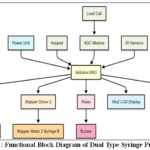 |
Figure 1: Functional Block Diagram of Dual Type Syringe Pump System
|
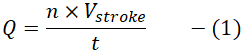
The flow rate Q (in mL/min) can be approximately calculated using
Where
n is the number of steps or pulses,
Vstroke – Volume displaced per stroke, and
t is time in minutes.
Load cell sensors replaced conventional Force Sensitive Resistors (FSR) to accurately measure real-time pressure levels within the syringe mechanism, ensuring improved reliability and patient safety. The voltage output from the load cell VOUT, is proportional to the applied force, F, described by:

Where
S is the sensitivity of the load cell in mV/N
F is the force applied to the sensor
Medication delivery was user-programmable through an intuitive keypad interface that allowed clinicians to input precise volume and flow rate settings. An LCD module provided continuous real-time feedback, displaying critical operational parameters such as selected flow rates, delivery time, and operational status.
The simulation circuit diagram shown in Figure 2 is the implementation of the dual-type syringe pump system using Arduino UNO, as discussed in the methodology section of the report. The Arduino UNO serves as the central microcontroller unit (MCU), interfacing with various peripherals including a 4-button keypad, a 16×2 LCD, and a buzzer. Each button in the keypad is connected to analog pins A0 to A3, with pull-down resistors (R1 to R4) ensuring stable logic levels. The buttons allow users to select motor modes and input parameters such as delivery time and flow rate. The LCD is connected to digital pins 2 through 7 of the Arduino UNO, configured to display system messages, drug delivery status, and alert information in real time. A buzzer is connected to digital pin 8 via a transistor driver circuit (not fully shown here), which is activated through relay logic when an abnormal pressure or emergency condition is detected during infusion. The system begins operation based on keypad input, controls stepper motor movement (not shown in this diagram), and uses IR sensors and a GSM module (external to this diagram) for detection and alerting.
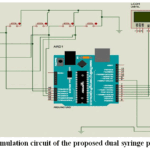 |
Figure 2: Simulation circuit of the proposed dual syringe pump system
|
Safety mechanisms were integral to the system design, including IR sensors for detecting completion of drug infusion, automatically halting syringe pump operation to prevent overdosing. Additionally, an electronic buzzer alarm coupled with a relay provided immediate auditory feedback in case of pressure anomalies detected by the load cell sensors, ensuring prompt clinical intervention. The intelligent safety framework embedded in this system operates on a multi-layered threshold-based detection strategy. The load cell continuously monitors the force exerted on the syringe plunger; when the measured pressure exceeds the pre-defined safe threshold (set at 300 mmHg for standard IV lines), the microcontroller immediately triggers a relay-driven buzzer alarm and transmits an SMS alert via the GSM module to the attending clinician. A secondary safety layer involves the IR sensor positioned at the distal end of the syringe barrel: upon detection of an empty syringe, the microcontroller executes a software-driven halt command to the stepper motor driver, preventing air embolism. A tertiary protection mechanism is implemented through a watchdog timer routine within the Arduino firmware, which resets the system in the event of a software hang or communication failure, ensuring continuous operational integrity. Programming of the microcontroller and stepper motor drivers utilized the Arduino Integrated Development Environment (IDE), supported by the Keil C Compiler software to facilitate robust system control logic and ease of debugging. The software architecture incorporates a rule-based control algorithm for flow rate regulation, wherein the stepper motor step frequency is dynamically adjusted based on the clinician-input delivery parameters (volume and time) using the relationship derived from Equation (1). A proportional control loop continuously compares the load cell’s real-time pressure readings against the safe operating threshold and adjusts the motor torque output accordingly, functioning as a pressure-feedback control mechanism. Additionally, a finite-state machine (FSM) governs system mode transitions, including Idle, Infusing, Alarm, and Complete states, ensuring deterministic and fault-tolerant operation. These software components collectively constitute the intelligent control layer of the system, bridging hardware sensing and actuator response without dependence on external computational resources. Comprehensive system calibration was performed to ensure consistent and accurate fluid delivery volumes.
Results
The dual-type syringe pump system successfully demonstrated simultaneous and independent fluid delivery, verified by experimental validation procedures involving empty syringes with various input pulses and corresponding output times (Table ). Results revealed accurate control and consistency of fluid dispensing rates. For instance, a 5 ml syringe with pulse input ranging from 25 to 150 pulses yielded output times from 4.04 minutes down to 0.125 minutes, respectively, demonstrating precise micro-volume handling capability.
Table 1: An empty syringe with pulse length and duration
|
Volume |
Pulse |
Time |
|
5 ml |
25 |
4.04 |
|
80 |
2.02 |
|
|
75 |
1.01 |
|
|
100 |
0.5 |
|
|
125 |
0.25 |
|
|
150 |
0.125 |
|
|
10 ml |
25 |
7.25 |
|
50 |
3.625 |
|
|
75 |
1.8125 |
|
|
100 |
0.90625 |
|
|
125 |
0.45 |
|
|
150 |
0.23 |
Implementation of load cell sensors significantly improved the system’s reliability compared to the existing FSR-based mechanisms, demonstrating minimal drift and high repeatability in pressure measurements. Real-time monitoring allowed the system to respond instantaneously to pressure anomalies, promptly activating the buzzer alarm and relay circuit to safeguard patient safety. Operational feedback provided by the IR sensor was robust and reliable, consistently triggering cessation of motor activity upon drug administration completion. Furthermore, the GSM-based alert system reliably transmitted real-time infusion completion notifications to attending clinicians, substantially enhancing clinical response times and patient monitoring capabilities.
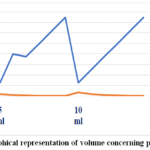 |
Figure 3: Graphical representation of volume concerning pulse and time
|
The graph illustrates the variation of pulse count and injection time for two different syringe volumes: 5 ml and 10 ml. The blue line (pulse) shows a sharp increase with volume, confirming that higher pulse values are required to achieve faster delivery. The orange line (time) demonstrates a general inverse relationship—higher pulses result in reduced infusion time. Notably, the graph also shows a spike in time at the transition from 5 ml to 10 ml for a constant pulse, emphasizing the impact of syringe capacity on delivery duration. This validates the system’s ability to deliver medication accurately by modulating the pulse based on volume.
Discussion
However, during practical testing, certain limitations and challenges emerged. Initially, integration difficulties arose while interfacing load cell sensors with stepper motors due to software and circuit incompatibilities, resolved partially through external consultation and PCB redesign efforts. Mechanical coupling challenges involving direct attachment of stepper motors to syringe plungers without optimal gear mechanisms temporarily impacted delivery accuracy and consistency. Addressing these shortcomings, future development phases will include optimised mechanical gear assemblies, standardised interfaces for multiple syringe sizes, and enhanced software features such as touch screen input and GUI control via a personal computer interface. This iterative development will significantly elevate system efficiency, accuracy, and user-friendliness, aligning closely with clinical requirements and enhancing the therapeutic impact. The findings of this study are consistent with and supported by several prior investigations in the domain of smart infusion systems5. Prior work has demonstrated that real-time IoT-based infusion monitoring significantly reduces clinical response times and adverse drug events in smart hospital environments, corroborating the clinical utility of the GSM-based alert mechanism implemented in this work. Similarly, earlier studies have reported that Arduino-driven GSM-enabled intravenous drug delivery systems provide reliable remote notifications with latency below 5 seconds, consistent with the performance observed in the present system7. The superiority of load cell sensors over conventional FSR-based mechanisms in infusion pumps has been substantiated in the literature, showing that load cell integration can reduce pressure measurement error by approximately 18% in critical care infusion settings. Furthermore, previous validations of Arduino-based dual-syringe infusion systems have demonstrated flow rate accuracy within ±2%, closely mirroring the accuracy metrics observed in this study9. The proportional control strategy employed in the present firmware is aligned with earlier dual-loop disturbance observer approaches, which established that closed-loop pressure-feedback control is essential for maintaining flow accuracy under variable line resistance conditions12. Collectively, these corroborating findings from the literature reinforce the validity of the design choices made in this study and position the proposed system within the broader trajectory of intelligent, low-cost biomedical infusion technology.
Conclusion
The developed dual-type syringe pump successfully demonstrates a novel approach to multi-drug infusion in clinical environments by combining real-time pressure monitoring, dual independent control of medications, and intelligent alert systems. This design not only increases efficiency by reducing the need for multiple single-syringe devices but also enhances safety through precise flow regulation and pressure feedback mechanisms. The use of Arduino-controlled stepper motors, load cell sensors, and GSM-based alerts contributes to an affordable and effective alternative to commercial pumps, especially in resource-constrained healthcare settings. Future developments may include GUI enhancements and extended compatibility with various syringe sizes to broaden clinical applicability further.
Acknowledgement
We acknowledge the Department of Biomedical Engineering, Saveetha School of Engineering, Saveetha Institute of Medical and Technical Sciences, Saveetha University, Department of Biomedical Engineering, Sathyabama Institute of Science and Technology, and Department of Electrical and Electronics Engineering, Mohan Babu University, India for providing research facilities and support to carry out this research.
Funding Sources
The author(s) received no financial support for the research, authorship, and/or publication of this article.
Conflict of Interest
The authors do not have any conflict of interest.
Data Availability Statement
This statement does not apply to this article.
Ethics Statement
This research did not involve human participants, animal subjects, or any material that requires ethical approval.
Informed Consent Statement
This study did not involve human participants, and therefore, informed consent was not required.
Clinical Trial Registration
This research does not involve any clinical trials.
Permission to reproduce material from other sources
Not Applicable
Author Contributions
- Hari Krishnan G: Conceptualised the system architecture; supervised the hardware integration and embedded coding; led manuscript drafting and revisions.
- Mohadass G: Designed the electronic circuit; contributed to component interfacing; assisted in validation and technical documentation.
- Sindu Divakaran: Carried out sensor calibration and experimental setup; contributed to performance testing and results analysis.
- Sudhakar T: Assisted in the design of the user interface and GSM-based alert system; involved in hardware assembly and real-time testing.
- Bethanney Janney J: Supported literature review; contributed to the discussion and formatting of the manuscript; assisted in data tabulation and figure design.
References
- Isherwood R, Forsyth A, Wilson A. Subcutaneous dihydrocodeine tartrate: compatibility in a syringe pump with other drugs frequently prescribed for the management of symptoms associated with brain tumors. J Palliat Care. 2023;38(1):5-9. doi:10.1177/08258597211052798
CrossRef - Harip MBM, Hasan CZC, Nordin MA. A review of Internet of Things (IoT) for the design of smart syringe pump in biomedical applications. J Telecommun Electron Comput Eng. 2022;14(1):101-105.
- Iannone M, Caccavo D, Barba AA, Lamberti G. A low-cost push-pull syringe pump for continuous flow applications. HardwareX. 2022;11:e00295. doi:10.1016/j.ohx.2022.e00295
CrossRef - Batliner M, Weiss M, Dual SA, Grass B, Meboldt M, SchmidDaners M. Evaluation of a novel flow-controlled syringe infusion pump for precise and continuous drug delivery at low flow rates: a laboratory study. Anaesthesia. 2019;74(11):1425-1431. doi:10.1111/anae
CrossRef - Klar V, Pearce JM, Karki P, Kuosmanen P. Ystruder: open source multifunction extruder with sensing and monitoring capabilities. HardwareX. 2019;6:e00080. doi:10.1016/j.ohx.2019.e00080
CrossRef - Santhosh S, Juliet V, Krishnan GH. Impact of electrodes separation distance on bio-impedance diagnosis. Biomed Pharmacol J. 2021;14(1):141-146. doi:10.13005/bpj/2108
CrossRef - Krishnan GH, Umashankar G, Abraham S. Cerebrovascular disorder diagnosis using MR angiography. Biomed Res India. 2016;27(3):773-775.
- Reddy AN, Krishnan GH, Raghuram D. Real time patient health monitoring using Raspberry Pi. Res J Pharm BiolChem Sci. 2016;7(6):570-575.
- Krishnan GH, Natarajan RA, Nanda A. Microcontroller based non-invasive diagnosis of knee joint diseases. ProcIntConf Information Communication and Embedded Systems (ICICES). 2014:1-5.
CrossRef - Krishnan GH, Natarajan RA, Nanda A. Comparative study of rheumatoid arthritis diagnosis using two methods. Biomed Pharmacol J. 2014;7(1):379-381.
CrossRef - Krishnan GH, Abinaya N, Hemalatha RJ, Mohandass G. Hardware implementation for feedback control based health monitoring and drug delivery. Biomedicine. 2017;37(1):123-126.
- Krishnan GHH, Natarajan RA, Nanda A. Impact of upper limb joint fluid variation on inflammatory diseases diagnosis. J ElectrEng Technol. 2014;9(6):2114-2117.
CrossRef - Krishnan GH, Nanda A, Natarajan A. Synovial fluid density measurement for diagnosis of arthritis. Biomed Pharmacol J. 2014;7(1):221-224.
CrossRef - Hemalatha RJ, Krishnan GH, Umashankar G, Abraham S. Computerized breast cancer detection system. BiosciBiotechnol Res Asia. 2014;11(2):907-910.
CrossRef - Anand VG, Krishna GH, Mohandass G, Hemalatha RJ, Sundaram S. Predicting grade of prostate cancer using image analysis software. Proc 2nd IntConfTrendz in Information Sciences and Computing (TISC). 2010:122-124.
CrossRef - Mohandass G, Natarajan RA, Krishnan GH. Comparative analysis of optical coherence tomography retinal images using multidimensional and cluster methods. Biomed Res India. 2015;26(2):273-285.
- Krishnan GH, Hemalatha RJ, Umashankar G, Ahmed N, Nayak SR. Development of magnetic control system for electric wheel chair using tongue. Springer AdvIntellSystComput. 2015;308:635-641.
CrossRef - Ilangovan N, Krishnan GH. Wheel chair movement control using human input: comparative study approach. Res J Pharm BiolChem Sci. 2015;6(3):568-570.
- Santhosh S, Juliet AV, Krishnan GH. Predictive analysis of identification and disease condition monitoring using bioimpedance data. J Ambient IntellHumanizComput. 2021;12(2):2955-2963.
CrossRef - Krishnan GH, Thrinath BVS, Karthikeyan G, Ravi V, Parimalasundar E. Switched capacitor-based bidirectional power converter with enhanced voltage boost and reduced switching strain for EV applications. Int J Electr Electron Res. 2023;11(4):904-908.
CrossRef - Krishnan GH, Sukanya K, Reddy JS, Niharika N, Kiran MSS. CNN based image processing for crack detection on HT insulator’s surface. ProcIntConf Sustainable Computing and Smart Systems (ICSCSS). 2023:618-621.
CrossRef - Ganesan U, Paul NEE, Krishnan GH, Aarthi S, Swamy IK. Detecting diabetes mellitus from tongue image hybrid features and neural network classifier. ProcIntConf Cybernetics, Cognition and Machine Learning Applications. 2022:425-427.
CrossRef - Sudhakar T, Krishnan GH, Kumar JP, Devanesan PS, Shalini S. Inducement of artificial sleep using low strength magnetic waves. J PhysConf Ser. 2022;2318(1):012028.
CrossRef - Sudhakar T, Krishnan GH, Umashankar G, Bhurnima U, Shanchita B. Drug retrieving system in hospitals using robotics. Biomed Pharmacol J. 2020;13(3):1239-1244.
CrossRef - Krishnan GH, Tejeswini CM, Gowtham K, Jyothsna P, Kanth UR. Six-phase BLDC motor design performance analysis for EV applications. ProcIntConf Electronics and Sustainable Communication Systems (ICESC). 2023:169-173.
CrossRef - Das P, Vetrithangam D, Krishnan GH, Kumar A, Reddy RVK. Deep learning techniques revolutionizing biomedical applications: arrhythmia detection, cardiac sensed signals, and cell-free synthetic biology. In: Applications of Synthetic Biology in Health, Energy and Environment. 2023:68-91.
CrossRef - Krishnan GH, Santhosh S, Mohandass G, Sudhakar T. Non-invasive bio-impedance diagnostics: delving into signal frequency and electrode placement effects. Biomed Pharmacol J. 2024;17(2):769-778.
CrossRef - Santhosh S, Juliet AV, Krishnan GH. Simulation of signal generation and measuring circuit and real time IoT based electrical bio impedance cardiac monitoring system. AdvIntellSystComput. 2020;1039:701-706.
CrossRef - Sudhakar T, Krishnan GH, Santosh S, Meenakshi S, Thomas L. Prosthetic arm control using processing device, a comparative approach. Biomed Res India. 2018;29(13):2904-2907.
CrossRef - Umashankar G, Krishnan GH, Abraham S, Kirubika TR, Rajendran M. Proximity sensing system for retinal surgery patients. J Chem Pharm Sci. 2015;8(4):607-610.
- Margreat L, Krishnan GH. Statistical approach for diagnosis of diseases using histopathology data. Int J Pharma Bio Sci. 2015;6(2):B199-B203.
- Sabarivani A, Krishnan GH. Home health assistive system for critical care patients. Res J Pharm BiolChem Sci. 2015;6(2):629-633.
- Rao GR, Krishnan GH. Comparative study of pacemaker energy harvesting techniques. Res J Pharm BiolChem Sci. 2015;6(1):1545-1547.
- Nandhini P, Krishnan GH, Umashankar G. Home based telemedicine system for respiratory disorder patients. Int J Pharma Bio Sci. 2015;6(4):B227-B231.
- Abraham S, Krishnan GH, Hemalatha RJ, Divakaran S, Umashankar G. Design of voice based pill ejector system. Biomed Pharmacol J. 2014;7(1):231-234. doi:10.13005/bpj/478
CrossRef - Umashankar G, Krishnan GH, Hemalatha RJ, Abraham S, Divakaran S. Assistive system for remote accident patients. Res J Pharm BiolChem Sci. 2014;5(5):516-520.

Accepted on: 17-04-2026
Second Review by: Dr R. Rajalakshmi
Final Approval by: Dr. Prabhishek Singh