Phenolic and Flavonoid Contents and Anti-Inflammatory Effects of Lish-6 Tablet in a Carrageenan-Induced Acute Paw Model
 , Dejidmaa Buyantogtokh2, Erdenechimeg Chuluunbaatar3*, Myadagbadam Urtnasan4, Chimedragchaa Chimedtseren2and Tsend-Ayush Damba5
1Department of Traditional Prescriptionology, International School of Mongolian Medicine, Mongolian National University of Medical Sciences, Ulaanbaatar, Mongolia
2Department of Pharmacology, Research Center, Institute of Traditional Medicine and Technology, Ulaanbaatar, Mongolia
3Department of Clinical Pharmacy and Pharmaceutical Management, School of Pharmacy, Mongolian National University of Medical Sciences, Mongolia
4Department of Chemistry and Technology, Research Center, Institute of Traditional Medicine and Technology, Ulaanbaatar, Mongolia
5Department of Mongolia Medicine Study, Institute of Traditional Medicine, Mongolian National University of Medical Sciences, Ulaanbaatar, Mongolia
Corresponding Author E-mail: erdenechimeg.ch@mnums.edu.mn
Download this article as:
ABSTRACT:In Mongolian traditional medicine, Lish-6 has been commonly used for acute upper respiratory tract infections. This Lish-6 drug consists of six ingredients and includes Eugenia caryophylla (Thumb), Saussurea lappa (C.B. Clark), Calcio sinter, Glycyrrhiza uralensis (Fisch), Gentiana algida (Pall) herbs, and Terminalia chebula (Retz). This study aimed to investigate the phytochemical properties of Lish-6 and its effects in a carrageenan-induced acute inflammation model. TLC was used to identify biologically active compounds, while the total flavonoid and total polyphenol contents were quantified by UV-Vis spectrophotometry. Gallic acid and isoorientin were identified in Lish-6 tablets by thin-layer chromatography (TLC). UV-Vis spectrophotometric analysis revealed that the tablets contained 6.94 ± 1.04 mg of total flavonoids and 4.06 ± 0.35 mg of total polyphenolic compounds. In Wistar rats, acute inflammation in the right hind paws caused edema that progressively increased over time in the control group compared with the healthy group. Compared to the normal group, paw edema in the control group increased by 1.6 and 2.2 at the 1st and 2nd hours and by 2.24, 2.1, and 2.23-fold at the 3rd, 4th, and 5th hours, respectively (p<0.001). Administration of 18 mg/kg Lish-6 produced a 31.1% reduction in paw edema after 1 hour, 22.9% after 3 hours, 26.6% after 2 hours, 20.4% after 4 hours, and 25.5% after 5 hours. In the group treated with 92 mg/kg, paw swelling decreased by 25% after 1 hour and 25.5% after 2 hours, ranged from 18.3% to 21% after 3 to 4 hours and 22.0% after 5 hours (p<0.05). Lish-6 at 18 and 92 mg/kg reduced paw edema over time compared with controls. In the paw edema model, serum PGE2 levels measured 41.0±5.9 ng/L in the normal group and were 1.7 times higher in the control group (p<0.001). Administration of Lish-6 at doses of 18 mg/kg and 92 mg/kg reduced PGE2 levels by 16–22% (p<0.05). The pp38 was 15.2±1.4 pg/mL in normal animals and increased by 32% in controls (p<0.01). Treatment with Lish-6 at 18 mg/kg and 92 mg/kg decreased pp38 by 28% and 25%, respectively (p<0.05). Lish-6 Tablet contains bioactive constituents, including flavonoids and phenolic compounds.
KEYWORDS:Anti-inflammatory effect; Biological activity compound; Calcio sinter; E.caryophylla; G.algida; G.uralensis; S.lappa; T.chebula
Introduction
Mongolia is located entirely in the Northern Hemisphere within a cold-temperate zone, where sub-zero temperatures persist for much of the year. The country has an extreme continental climate, with average annual temperatures varying by region. Extreme seasonal and daily temperature fluctuations create conditions that promote respiratory disease. Respiratory tract infections associated with the cold climate, along with illnesses linked to air pollution, are leading causes of morbidity in Mongolia.1,2
Between 2014 and 2024 in Mongolia, an average of 17,240 respiratory infection cases were detected annually, corresponding to 58 cases per 10,000 population. The distribution of disease types was as follows: acute upper respiratory tract infections (28.2%), pneumonia (6.8%), influenza (6.8%), acute bronchitis (9.3%), and chronic obstructive pulmonary disease (16%). Acute upper respiratory tract infections include nasopharyngitis, sinusitis, pharyngitis, tonsillitis, laryngitis, and tracheitis. Upper respiratory tract infections may be caused by viruses, bacteria, or fungi; however, current evidence indicates that bacterial infections typically occur as secondary complications following viral infections. In Mongolia, climatic conditions and air pollution, particularly from smoke and dust, further elevate the risk of respiratory infections.3-5
In Mongolia, both Western medicine and traditional Mongolian medical practices are commonly used to diagnose, treat, and prevent upper respiratory tract infections. In recent years, extensive research has been undertaken to study and validate traditional medical knowledge and heritage in Mongolia and other countries. This trend aligns with the World Health Organization’s strategic direction.6-11
Lish-6 is among the most frequently utilized formulations in Mongolian traditional medicine for treating upper respiratory tract infections. Scriptural sources attribute to Lish-6 the ability to cure acute pharyngitis, colds, dry cough, hoarseness, shortness of breath, and sore throat. Lish-6 is composed of six medicinal raw materials: Eugenia caryophylla (Thumb) seeds, Saussurea lappa (C.B. Clark) roots, Calcio sinter powder, Glycyrrhiza uralensis (Fisch) roots, Gentiana algida (Pall) herbs, and Terminalia chebula (Retz) fruits.12-14
E.caryophylla is highly valued for its aromatic essential oils. Phenylpropanoids, sesquiterpenes, and phenolic compounds primarily characterize its chemical composition. Essential oil derived from E.caryophylla exhibits antibacterial, antifungal, antiviral, antioxidant, anti-inflammatory, and anticancer activities.15-18 S.lappa has been widely recognized in traditional medicine for its anti-inflammatory, antimicrobial, and antioxidant properties. Its phytochemical composition is characterized by a predominance of volatile oils, sesquiterpene lactones, and flavonoids.19-22 Calcio sinter, also referred to as calcareous sinter in mineralogy or Dzugan in Mongolian and Tibetan traditional medicine, is a freshwater sedimentary rock composed primarily of calcium carbonate (CaCO3).12,23,24 Glycyrrhizin, the primary secondary metabolite found in the root of G. uralensis, is classified as a triterpene compound. Polysaccharides and triterpene saponins also constitute the principal biologically active components of this plant.25-29 G.algida contains a high concentration of biologically active phytochemicals, primarily iridoid and secoiridoid glycosides. These compounds impart a characteristic bitter taste and serve as the basis for the plant’s traditional medicinal applications for treating inflammation, respiratory disorders, and digestive conditions.30-32
T.chebula contains 20-40% hydrolyzable tannins. Its primary constituents are ellagic acid, gallic acid, luteolin glucoside, tannase, sennoside A, and organic acids, including gallic acid, guanic acid, and chebulin, along with various resinous substances. Studies have demonstrated that T.chebula possesses antibacterial activity against Streptococcus mutans. Furthermore, tannin extracts from T.chebula inhibit the in vitro growth of bacteria such as Staphylococcus aureus and Klebsiella pneumoniae.33-36
The present study aimed to quantify the biologically active substances in Lish-6 and to evaluate its anti-inflammatory effects.
Materials and Methods
Ethics Statement
The Research Ethics Review Committee of the MNUMS reviewed the study methodology on (2023/3-04). Approval for animal experimentation was obtained, and all necessary procedures were conducted in accordance with institutional guidelines. This study did not involve human participants, and therefore, informed consent was not required.
Reagent and drug
The experiment employed Isoorientin (Carl Roth – 6002.1), gallic acid (CAS number 149-91-7), Carrageenan (CAS number 9000-07-1; Sigma-Aldrich), ppp38 (№5921990724) and PGE2 (№15921990938) (Shanghai MLBIO Biotechnology Co., Ltd.) the sensitivity by this assay 1.0 pg/ml
ELISA kit. Lish-6 tablets (0.35 g, 40 tablets per package; serial number 01102023) were manufactured at the pharmaceutical factory of the Institute of Traditional Medicine and Technology and utilized in this study.
Chemical Methods
Analytical Method for the Detection of Gallic Acid and Isoorientin in Lish-6 Tablets
A 1 g portion of the powdered sample was weighed and transferred to a 50 ml volumetric flask. Methanol (20 ml) was added, and the mixture was stirred at room temperature for 1 hour. The resulting extract was filtered through filter paper, and 50–100 μl of the filtrate was used for thin-layer chromatography. Standard substances, Isoorientin and Gallic acid, were prepared in methanol at a concentration of 1 mg/ml, and 5–10 μl of each standard solution was used for the TLC. The prepared extract and standard solutions were applied to a silica gel 60 F254 plate. After drying, the plate was placed in a chromatography chamber containing a solvent system of 37
Determination of Total Flavonoid Compound Content
Sample solution preparation: 20 tablets were ground in a pestle. 1 (±0.001 g) of the ground sample was weighed and placed in a 100 ml round-bottomed flask. 50 milliliters of 96% ethanol were added. The mixture was extracted for 30 minutes using an electric heater, magnetic stirrer, and rotary condenser. After extraction, the solution was filtered into a 50 ml volumetric flask and diluted to volume with 96% ethanol (designated as solution A). 2 ml of solution A and 3 milliliters of Isoorientin standard solution were each transferred to separate 25 ml volumetric flasks. 6 milliliters of distilled water and 1 ml of 5% sodium nitrite solution were added to each flask, and the mixtures were shaken for six minutes. 1 ml of 10% aluminum nitrate was then added. After another 6 minutes, 10 milliliters of 4% sodium hydroxide solution were added. The mixtures were diluted with distilled water to achieve a path length of 1 cm. After standing for 15 minutes at room temperature, absorbance was measured in a 1 cm cuvette using a UV-Vis spectrophotometer at 500 nm. Preparation of standard solution: 1 mg (±0.001 g) of Isoorientin was weighed into a 10 ml volumetric flask, dissolved in a small amount of methanol, and diluted to volume with methanol. The total flavonoid content per tablet was determined by converting the measured Isoorientin concentration to milligrams.38
Determination of Total Phenolic Compound Content
Sample solution preparation: 20 tablets were ground in a pestle. 1 g (accurate to 0.001 g) of the resulting powder was weighed and transferred to a 100 ml round-bottomed flask. 50 milliliters of 96% ethanol were added, and the mixture was extracted for 30 minutes using an electric heater equipped with a magnetic stirrer and rotary condenser. Following extraction, the solution was filtered through filter paper into a 50 ml volumetric flask and diluted to volume with 96% ethanol (designated as solution A). A 0.5 ml volume of solution A was transferred into a 25 ml volumetric flask. Subsequently, 10 ml of distilled water and 1 ml of Folin-Ciocalteu solution were added, and the mixture was diluted to volume with 10.75% sodium carbonate solution. After a 30-minute reaction period, the absorbance at 760 nm was measured. Preparation of standard solution: 10 mg of gallic acid was weighed to the nearest 0.0001 g and placed in a 25 ml volumetric flask. A small amount of distilled water was added to dissolve the gallic acid, and the solution was diluted to volume with distilled water to obtain solution A1. A volume of 0.5 ml of solution A1 was transferred into a 25 ml volumetric flask. Then, 10 ml of distilled water and 1 ml of Folin-Ciocalteu solution were added, and the mixture was diluted to volume with 10.75% sodium carbonate solution. After 30 minutes, the absorbance was measured spectrophotometrically at 760 nm. Preparation of reference solution: 0.5 ml of 70% ethanol was transferred to a 25 ml volumetric flask. Subsequently, 10 ml of distilled water and 1 ml of Folin-Ciocalteu solution were added, and the mixture was diluted to volume with 10.75% sodium carbonate solution. Preparation of Folin-Ciocalteu solution: 1 ml of 2N Folin-Ciocalteu solution was diluted with distilled water to a final volume of 10 ml. The amount of total phenolic compounds contained in 1 tablet was converted to gallic acid and expressed in mg.39
Pharmacological methods
Animals
We obtained male Wistar rats weighing 180 to 200 grams from the animal facility at the Institute of Traditional Medicine Technology. Before the experiment, the animals underwent a 7-day acclimatization period under controlled laboratory conditions. They were housed in standard cages maintained at a constant temperature of 20 ± 2°C and a relative humidity of 55 ± 5%, with a 12-hour light/dark cycle. The rats had unrestricted access to standard pelleted feed and water. After the acclimatization period, rats were weighed to determine baseline body weight and randomly assigned to experimental groups using a computer-generated randomization program (SPSS 22.0) to reduce selection bias. Rats were allocated to groups as follows: healthy (n=10), model (n=10), Lish-6 18 mg/kg (n=10), and Lish-6 92 mg/kg (n=10). The paw was immersed in the measurement fluid up to a predetermined mark at the ankle joint. The instrument recorded the initial paw volume (V0), measured before treatment and carrageenan-induced inflammation. After taking the initial measurements, the animals received the corresponding treatment orally. One hour before modeling, the healthy and paw edema groups received distilled water orally, whereas the experimental groups received Lish-6 by oral gavage at 18 or 92 mg/kg. Acute paw inflammation was induced by injecting 0.1 mL of a 1% carrageenan solution in 0.9% sodium chloride into the right paw. The degree of acute inflammation was subsequently measured by Plethysmometer (Ugo Basile) at 1, 2, 3, 4, and 5 hours. Paw edema was assessed by measuring the increase in paw volume after carrageenan injection relative to the initial baseline volume. A laboratory technician measured rat paw edema while blinded to the drug groups. The laboratory technician measured each animal in the induced paw model every hour.
The anti-inflammatory or inhibitory percentage effect was calculated using the following formula:

After 5 hours, the experimental rats were by decapitation sacrificed, and blood was collected for cytokine analysis. Serum levels of cytokines, including pp38 and PGE2, were measured by centrifuging blood samples at 3500 rpm for 20 minutes and quantifying cytokine concentrations using ELISA kits according to the manufacturer’s protocols. We read optical density at 450 nm on a ChroMate-4300 microplate reader (Awareness Technology, USA).40
Statistical analysis
Data are reported as mean ± standard deviation (SD). Statistical analyses were performed using SPSS version 22.0 (SPSS Inc., Chicago, IL, USA). We used one-way, Two-Way Repeated-Measures ANOVA and Tukey post hoc tests to assess differences across time and dose between groups. Statistical significance was defined as p < 0.05.
Results
Results of the determination of biologically active compounds in Lish-6 tablets
The primary constituents of Lish-6 tablets, specifically. G.algida and T.chebula raw materials, comprise a mixture of flavonoids and phenolic compounds, such as Isoorientin and Gallic acid. To ensure a simple and rapid analytical process, the Benzene–Ethyl Acetate–Formic Acid–Acetone (5:5:2:0.5) solvent system was identified as suitable for normal-phase development TLC across multiple solvent systems, enabling simultaneous detection of biologically active substances.
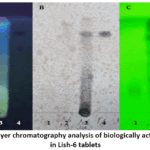 |
Figure 1: Thin-layer chromatography analysis of biologically active compounds in Lish-6 tablets Click here to View Figure |
Chromatogram 1: (A) Detection at 365 nm after applying aluminum solution. (B) Detection under visible light after spraying with ferric chloride solution. (C) Detection at 254 nm. 1: Isoorientin; 2: chloroform extract of Lish-6 tablets after hydrolysis; 3: methanol extract of Lish-6 tablets; 4: gallic acid.
Based on the results, Isoorientin present in G. algida raw material was detected by spraying Lish-6 tablets with an aluminum chloride alcohol solution, followed by drying. Observation at 365 nm revealed a yellow fluorescent spot with an Rf value of 0.2 for Isoorientin. In contrast, Gallic acid from the T. chebula remedy, when treated with ferric chloride solution, produced a dark blue spot under visible light, and the Rf value of Gallic acid was 0.81.
Spectrophotometric Analysis of Biologically Active Substances in Lish-6 Tablets
Total flavonoid content was measured using the aluminum nitrate complex method, while total polyphenolic content was assessed with the Folin- Ciocalteu method. Standard calibration curves were generated using isoorientin and gallic acid as reference compounds. The corresponding results are presented in the figure below.
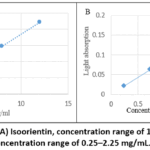 |
Figure 2: Calibration curve, (A) Isoorientin, concentration range of 1–12 µg/mL, (B) Gallic acid, concentration range of 0.25–2.25 mg/mL. Click here to View Figure |
The linear regression equation for the standard substance Isoorientin was y = 0.0185x – 0.0007 (R² = 0.9999), while that for Gallic acid was y = 0.0849x + 0.001 (R² = 0.9994). The spectrophotometric determination results for total flavonoid and phenolic compound content in Lish-6 tablets are presented in the following table.
Table 1: Quantitative analysis of some biologically active compounds in Lish-6 tablets
|
Biologically active substance |
Standard substance | The linear regression equation | Correlation coefficiente
R2 |
per 1 tablet, mg |
| Total flavonoid | Isoorientin | y = 0.0185x – 0.0007 | 0.9999 |
6.94±1.04 |
|
Total polyphenolic compounds |
Gallic acid | y = 0.0849x + 0.001 | 0.9994 |
4.06±0.35 |
Each tablet of Lish-6 contains 6.94 ± 1.04 mg of total flavonoids and 4.06 ± 0.35 mg of total polyphenolic compounds, experiments replicated 3 times (n = 3 independent sample preparations).
Evaluation of lish-6 in a Carrageenan-Induced Acute Inflammatory Paw Model
The results below demonstrate the effects of Lish-6 in a rat model of acute paw inflammation induced by 1% carrageenan.
Table 2: Impact of Lish-6 on Carrageenan-Induced Paw Edema in Acute Inflammation
|
Time |
Groups | The volume of the paw edema (ml) |
| 1 hour | Normal |
2.51±0.38 |
|
Control |
4.11±0.38** | |
| Lish-6 18 mg/kg |
2.83±0.27# |
|
|
Lish-6 92 mg/kg |
3.09±0.41# | |
| 2 hours | Normal |
2.51±0.38 |
|
Control |
5.44±0.25** | |
| Lish-6 18 mg/kg |
3.99±0.50 |
|
|
Lish-6 92 mg/kg |
4.05±0.65 | |
| 3 hours | Normal |
2.51±0.38 |
|
Control |
5.64±1.1** | |
| Lish-6 18 mg/kg |
4.35±0.42# |
|
|
Lish-6 92 mg/kg |
4.47±0.43# | |
| 4 hours | Normal |
2.51±0.38 |
|
Control |
5.25±0.43** | |
| Lish-6 18 mg/kg |
4.18±0.75# |
|
|
Lish-6 92 mg/kg |
4.29±0.43# | |
| 5 hours | Normal |
2.51±0.38 |
|
Control |
5.60±0.44*** | |
| Lish-6 18 mg/kg |
4.17±0.75# |
|
|
Lish-6 92 mg/kg |
4.47±0.43 |
when compared to normal group ***<0.001, **p<0.05;
when compared to control group #p<0.05
Compared to the normal group, paw edema in the control group increased by 1.6 and 2.2 at the 1st and 2nd hours and by 2.24, 2.1, and 2.23-fold at the 3rd, 4th, and 5th hours, respectively (p<0.001). Administration of 18 mg/kg Lish-6 produced a 31.1% reduction in paw edema after 1 hour, 22.9% after 3 hours, 26.6% after 2 hours, 20.4% after 4 hours, and 25.5% after 5 hours. In the group treated with 92 mg/kg, paw swelling decreased by 25% after 1 hour and 25.5% after 2 hours, ranged from 18.3% to 21% after 3 to 4 hours and 22.0% after 5 hours (p<0.05).
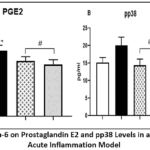 |
Figure 3: Effect of Li sh-6 on Prostaglandin E2 and pp38 Levels in a Carrageenan-Induced Acute Inflammation Model Click here to View Figure |
PGE2 levels measured 41.0±5.9 ng/L in the normal group and 110.1±8.6 ng/L in the control group, representing a 1.7-fold increase (****p<0.001). In the 18 mg/kg and 92 mg/kg dose groups, PGE2 levels decreased to 92.6±7.26 ng/L (16% reduction) and 86.3±7.8 ng/L (22% reduction), respectively (#p<0.05).
The pp38 measured 15.2±1.4 pg/ml in the normal group and 20.0±2.4 pg/ml in the control group, representing a 32% increase (**p<0.01). Administration of Lish-6 at 18 mg/kg resulted in a pp38 signal of 14.45±1.7 pg/ml, while a dose of 92 mg/kg yielded 15.02±1.9 pg/ml, corresponding to decreases of 28% and 25%, respectively (#p<0.05).
Discussion
The 27th chapter of the Four medical tantra, the basic source sutra of Mongolian traditional medicine, discusses the causes, conditions, diagnosis, and treatment of cold and flu fever in the section on treating fever. In ancient traditional Mongolian medicine, colds and influenza are considered infectious diseases caused by “Nyan Khijig,” referring to agents similar to modern bacteria and viruses. Historically, people believed these illnesses spread through the air, contaminated food, dust, particulate matter, smoke, and contact with infected individuals. This view differs from current medical understanding. Additionally, people once thought transmission occurred through droplets expelled by sick individuals.14
Lish-6 medicine has the effect of eliminating local inflammatory or acute anti-inflammatory effect and is one of the main drugs for treating upper respiratory tract inflammation, and was selected to study its chemical pharmacological action.7,12,13, 24
We performed a standardization analysis on Lish-6 tablets manufactured using pharmaceutical technology derived from the traditional “Lish-6 talkh” drug, which is widely used in traditional medicine.7,24 The primary objective was to identify and quantify the principal biologically active substances to ensure product quality and safety.
The herb G.algida and the raw material of T.chebula constitute the primary ingredients of Lish-6 tablets. Isoorientin, a flavonoid compound present in G. algida, and gallic acid, the active constituent of T. chebula, we were identified using thin-layer chromatography. These findings align with previous detections of gallic acid in Lider-7 and Anar-5 tablets by thin-layer chromatography.41,42 The upper part of G.algida, a primary component of Lish-6 tablets, contains 9.2 to 10.6 mg% of flavonoids, including Orientin, Isoorientin, Apigenin, and Saponaretin. It also contains iridoids and triterpene saponins.43
Our analysis determined that the total flavonoid content of Lish-6, measured as isoorientin, is 6.94 ± 1.04 mg per tablet.
According to the G.algida Mongolian national standard MNS 2605-1994, the total C-glycoside content is converted to Isoorientin and standardized to not less than 4.0%.43
Carrageenan is a group of naturally occurring, water-soluble, sulfated polysaccharides extracted from red edible seaweeds. This compound is widely utilized in the food, cosmetics, and pharmaceutical industries. Additionally, it serves as a common anti-inflammatory agent in pharmacological research.40,43
Within 30 to 60 minutes after subplantar carrageenan injection, mast cells and platelets release histamine and serotonin (5-HT), increasing capillary permeability. Early mediators such as bradykinin and complement products dilate vascular endothelial cells and cause edema. The second phase begins 2 to 3 hours post-injection and is driven primarily by the cyclooxygenase/prostaglandin pathway. Carrageenan activates phospholipase A₂ (PLA₂), which degrades cell membrane phospholipids and releases arachidonic acid. Arachidonic acid is then converted to PGE2 (prostaglandin E₂) via PGH₂ following COX-2 (cyclooxygenase-2) activation. In this model, COX-2 activity increases for 1 to 6 hours, and selective COX-2 inhibitors fully block the second phase of edema. During the cellular phase, carrageenan activates macrophages and neutrophils, leading to the release of inflammatory cytokines such as TNF-α, IL-1β, and IL-6. TNF-α promotes inflammation by inducing IL-1β and the neutrophil chemotactic factor CINC/CXCL1. IL-1β stimulates the PLA₂-COX-2-mPGES-1 pathway, further increasing PGE2 synthesis. Nitric oxide (NO) peaks within the first 2 hours of inflammation, while PGE2 levels rise during the second phase and persist for up to 72 hours. NO produced by inducible nitric oxide synthase (iNOS) prolongs COX-2 activity, induces peroxynitrite (ONOO⁻)-mediated lipid peroxidation, and promotes additional arachidonic acid release. Additionally, pp38 mitogen-activated protein kinase (MAPK) maintains COX-2 transcription, sustaining the second phase of inflammation.40,44,45 We conducted anti-inflammatory studies in experimental animals to investigate selected pharmacological actions of the Lish-6 drugs.
We evaluated the acute toxicity of a 3% Lish-6 infusion by intraperitoneal injection in white mice, following the method of V.B. Prozorovsky et al. (1978). The LD50 was 0.92 (0.6–1.04) g/kg. The effective dose, established using the method of I.P. Zapadnyuk et al. (1983), was 36.8 (18.4–92) mg/kg.47,48 Consequently, to assess anti-infammatory activity, Lish-6 tablets were administered to rats at 18 and 92 mg/kg. We selected doses of 18 mg/kg and 92 mg/kg for this study because our previous research showed they provided the highest analgesic activity.49
The anti-inflammatory effect of Lish-6 was evidenced by a significant reduction in edema and inflammatory mediators in a carrageenan-induced paw edema model. Specifically, Lish-6 at 18 and 92 mg/kg reduced paw edema over time compared with controls. In the paw edema model, serum PGE2 levels measured 41.0±5.9 ng/L in the normal group and were 1.7 times higher in the control group (p<0.001). Administration of Lish-6 at doses of 18 mg/kg and 92 mg/kg reduced PGE2 levels by 16–22% (#p<0.05). The pp38 signal was 15.2±1.4 pg/mL in normal animals and increased by 32% in controls (p<0.01). Treatment with Lish-6 at 18 mg/kg and 92 mg/kg decreased pp38 signal by 28% and 25%, respectively (p<0.05).
The results indicate biologically active compounds, including Isoorientin, Eugenol, Glycyrrhizinic acid, and gallic acid. The primary active component of E. caryophylla is essential oil, which constitutes 17–20% of the raw material. Steam-distilled oil contains 70–85% eugenol, along with acetyl eugenol, caryophyllene, and sesquiterpenes. The flower bud also contains 20% volatiles and 13% gallotannin. The oil contains oleic acid, free eugenol, eugenol acetate (2–17%), caryophyllene, and methyl-N-amyl ketone, which contribute to its fragrance. This essential oil demonstrates anti-inflammatory properties by activating the liver detoxification enzyme glutathione-C-transferase, inhibiting the tumorigenic effects of chemicals, and enhancing the protective function of white blood cells.16-18,46 The raw materials of S. lappa contain costunoloid, gallic acid, essential oil, and lactone, which exhibit anti-inflammatory, antioxidant, and antibacterial properties.19-22 The roots and rhizomes of G.uralensis are composed of three terpene saponins, including glycyrrhizin (the calcium salt of glycyrrhizinic acid), as well as glucose, sucrose, pentose, starch, pectin, flavonoids, organic acids (up to 4.6%), alkaloids, coumarins, and tannins. These constituents contribute to anti-inflammatory, antioxidant, and immunomodulatory activities.25-29 The above-ground parts of G.algida contain flavonoids, C-glycosides, iridoids, genthiopicroside, homoorientin, and isoorientin. Its tincture has been shown to increase gastric acid secretion, stimulate mucous membrane production, and reduce appetite, effects attributed to the presence of iridoids and flavonoids.30-32 T.chebula raw material contains 20–40% antioxidants, with ellagic, gallic, luteolinic, and chebulic acids as primary components. This plant demonstrates analgesic, antioxidant, and hypoglycemic effects, is effective in treating arthritis, and exhibits anti-Streptococcus mutans activity. The tannins present inhibit the growth of bacteria such as Staphylococcus aureus and Klebsiella pneumoniae in vitro, and display antimutagenic, cardioprotective, and antifungal properties. Additional effects include anti-inflammatory, antidiabetic, anticancer, and antiallergic activities.33-36 These studies’ results align with the present experimental findings, further supporting the hypothesis that Lish-6 exerts anti-inflammatory effects mediated by its biologically active compounds. However, our study is limited by the absence of a positive control, specifically an anti-inflammatory drug. Including such a positive control in future research would enable direct comparison between the effects of traditional medicines and established pharmaceutical treatments.
Conclusion
The findings indicate that Lish-6 Tablet contains bioactive constituents, including flavonoids and phenolic compounds, and reduces PGE2 and pp38 levels in a rat model of acute inflammation.
Acknowledgment
We thank the Mongolian National Foundation for Science and Technology. We also want to express our respect for the research workers in the Institute of Traditional Medicine and Technology for their assistance in executing this study.
Funding Sources
This project was funded by the Mongolian National Foundation for Science and Technology. The agreement number of the project was ShUTBIKhKhZG-2022/136.
Conflict of Interest
The author(s) do not have any conflict of interest
Data Availability Statement
This statement does not apply to this article.
Ethics Statement
The Research Ethics Review Committee of the MNUMS reviewed the study methodology on (2023/3-04).
Informed Consent Statement
This study did not involve human participants, and therefore, informed consent was not required.
Clinical Trial Registration
This research does not involve any clinical trials
Permission to Reproduce Material from Other Sources
Not Applicable
Author Contributions
- Enkhtungalag Sangidorj: Data collection, Analysis, Writing- Original Draft
- Dejidmaa Buyantogtokh: Data collection, Analysis, review and Editing,
- Erdenechimeg Chuluunbaatar: Data collection, Analysis, Review and Editing, and Project
- Myadagbadam Urtnasan: Data collection, Analysis, Review and Editing
- Chimedragchaa Chimedtseren: Funding Acquisition, Resources, Supervision
- Tsend-Ayush Damba: Visualization, Supervision
References
- Dashtseren A, Temuujin K, Westermann S, Batbold A, Amarbayasgalan Y and Battogtokh D (2021) Spatial and Temporal Variations of Freezing and Thawing Indices From 1960 to 2020 in Mongolia. Earth Sci. 9:713498.
CrossRef - Yembuu, B. (2021). Climate and Climate Change of Mongolia. In: Yembuu, B. (eds) The Physical Geography of Mongolia. Geography of the Physical Environment. Springer, Cham.
CrossRef - Health indicators of Mongolia 2024. Health Development Center. 2024;133-135.
- Do LAH, Tsedenbal N, Khishigmunkh C, et al. Respiratory Syncytial Virus and Influenza Infections in Children in Ulaanbaatar, Mongolia, 2015-2021. Influenza Other Respir 2024;18(5):e13303.
CrossRef - Nakao M, Yamauchi K, Ishihara Y, Omori H, Ichinnorov D, Solongo B. Effects of air pollution and seasons on health-related quality of life of Mongolian adults living in Ulaanbaatar: cross-sectional studies. BMC Public Health. 2017;17(1):594.
CrossRef - Wenfang G, Yi L, Wang P, Wang B, Li M. Assessing the effects of meteorological factors on daily children’s respiratory disease hospitalizations: A retrospective study. 2020;6(8):04657
CrossRef - Guidelines for the Diagnosis and Treatment of Influenza and Influenza-like Illness (Dagshuur) in Traditional Medicine, 2024
- Wang S, Liu L, Liu J, et al. Characteristics of prescriptions and costs for acute upper respiratory tract infections in Chinese outpatient pediatric patients: a nationwide cross-sectional study. BMC Complement Med Ther. 2020;20(1):346. doi: 10.1186/s12906-020-03141-w
CrossRef - Tian Z, Shi L, Cui Y, et al. Jieji Xuanfei Chuyi granules in the treatment of COVID-19: A randomized, open-label, parallel-controlled clinical trial. Medicine (Baltimore). 2025;104(13):e41740.
CrossRef - Guo X, Liu C, Zhao Q, Huang S. Efficacy of five different traditional Chinese medicine injections in acute upper respiratory tract infection in children: a network meta-analysis and systematic review. Front Pediatr. 2024;12:1358639.
CrossRef - Hoenders R, Ghelman R, Portella C, et al. A review of the WHO strategy on traditional, complementary, and integrative medicine from the perspective of academic consortia for integrative medicine and health. Front Med (Lausanne). 2024;11:1395698.
CrossRef - Manag rincheng junai.Ulaanbaatar; 2018;294-295.
CrossRef - Juru dosil. State Publishing House. 1991;23-24.
- Yuteg Youndongombo. The four medical tantra. State Publishing House. 1991;98-99.
- Khalilzadeh E, Hazrati R, Saiah GV. Effects of topical and systemic administration of Eugenia caryophyllata buds essential oil on corneal anesthesia and analgesia. Res Pharm 2016;11(4):293-302.
CrossRef - Batiha GE, Alkazmi LM, Wasef LG, Beshbishy AM, Nadwa EH, Rashwan EK. Syzygium aromaticum (Myrtaceae): Traditional Uses, Bioactive Chemical Constituents, Pharmacological and Toxicological Activities. Biomolecules. 2020;10(2):202. doi: 10.3390/biom10020202.
CrossRef - Zari AT, Zari TA, Hakeem KR. Anticancer Properties of Eugenol: A Review. 2021;26(23):7407. doi: 10.3390/molecules26237407.
CrossRef - Kola-Mustapha AT, John FT, Bello RH, et al. Essential oil-based hydrogels for oral candidiasis: preliminary formulation development, antifungal efficacy, and computational analysis via Monte Carlo simulation. Front Cell Infect Microbiol. 2026;16:1774370.
CrossRef - Chang KM, Choi SI, Kim GH. Anti-oxidant Activity of Saussurea lappaB. Clarke Roots. Prev Nutr Food Sci. 2012;17(4):306-9.
CrossRef - Naseer S, Iqbal J, Naseer A, et al. Deciphering chemical profiling, pharmacological responses and potential bioactive constituents of Saussurea lappa Extracts through in vitro approaches. Saudi J Biol Sci. 2022;29(3):1355-1366.
CrossRef - Ansari S, Maaz M, Ahmad I et al. Quality control, HPTLC analysis, antioxidant and antimicrobial activity of hydroalcoholic extract of roots of qust (Saussurea lappa, C.B Clarke). Drug Metab Pers Ther. 2020 doi: 10.1515/dmdi-2020-0159.
CrossRef - Zhou Q, Zhang WX, He ZQ, et al. The possible anti-inflammatory effect of dehydrocostus lactone on DSS-induced colitis in mice. Evid Based Complement Alternat Med. 2020;2020:5659738. doi:10.1155/2020/5659738
CrossRef - Pharmaceutical raw materials Dzugan, Mongolian National Standard, 3459-90. 1990
- Oldokh S. Mongolian drug of pharmacology. Bit press; 2013;178, 260
- Zhao L, Chen X, Shao X, et al. Prenylated phenolic compounds from licorice (Glycyrrhiza uralensis) and their anti-inflammatory activity against osteoarthritis. Food Funct. 2022;13(2):795-805. doi: 10.1039/d1fo03659a.
CrossRef - He R, Ma TT, Gong MX, Xie KL, Wang ZM, Li J. The correlation between pharmacological activity and contents of eight constituents of Glycyrrhiza uralensis Heliyon. 2023;9(3):e14570. doi: 10.1016/j.heliyon.2023.e14570.
CrossRef - Yin L, Guan E, Zhang Y, et al. Chemical Profile and Anti-inflammatory Activity of Total Flavonoids from Glycyrrhiza Uralensis Iran J Pharm Res. 2018;17(2):726-734.
- Liu Z, Ma Y, Lv X, et al. Abiotic factors and endophytes co-regulate flavone and terpenoid glycoside metabolism in Glycyrrhiza uralensis. Appl Microbiol Biotechnol. 2023;107(7-8):2671-2688.
CrossRef - Han W, Fan D, et al. Research progress on chemical constituents and biological activities of Glycyrrhiza uralensis Chem Eng. 2022;(2):56-58.
- Bai X, Zeng Q, Zhu K, Lu Y. Determination of six kinds of active ingredients from Gentiana algida Pall by CZE. J Guangxi Norm Univ Nat Sci Ed. 2016;34(1):122-127.
- Lu GA, Tian G, et al. Study on extraction process of total flavonoids from Mongolian medicine Gentiana purdomii Marq and anti-inflammatory activity of ethanol extract. Jilin J Chin Med. 2020;40(3):390-393.
- Liu H, Qin J, et al. The effect of alpine gentian herb extracts on the rat model of acute pharyngitis. J Pract Hosp Clin. 2018;15(3):1-4.
- Liu HS, Liu YJ, Yang HL, Liu YG. Research progress on chemical constituents, pharmacological mechanism, quality control and processing of Terminalia chebula Nat Prod Res Dev. 2022;34(12):2130.
- Wang C, Zhang H, Wang X, et al. Comprehensive Review on Fruit ofTerminalia chebula: Traditional Uses, Phytochemistry, Pharmacology, Toxicity, and Pharmacokinetics. 2024;29(23):5547.
CrossRef - Li K, Lin Y, Li B, et al. Antibacterial constituents of Fructus Chebulae Immaturus and their mechanisms of action. BMC Complement Altern Med. 2016;16:183.
CrossRef - Bag A, Bhattacharyya SK, Chattopadhyay RR. The development of Terminalia chebula (Combretaceae) in clinical research. Asian Pac J Trop Biomed. 2013;3(3):244-52.
CrossRef - Wagner, H. and Bladt, S. (1996) Plant Drug Analysis: A Thin Layer Chromatography Atlas. 2nd Edition, Springer-Verlag; 1996
CrossRef - Erdenechimeg Chuluunbaatar, Dejidmaa Buyantogtokh, Dagvatseren Begzsuren. Total Phenolic, Flavonoid and Carotinoid Content and Anticoagulation Activities of Sapparin Tablet. Journal of Pharmaceutical Research International. 2021, 33(44B) 268-278.
CrossRef - Singleton VL, Orthofer R, Lamuela-Raventos RM. Analysis of total phenols and other oxidation substrates and antioxidants by means of Folin-Ciocalteu reagent. Methods Enzymol 1999; 299: 152–178.
CrossRef - Maruyama H, Sakamoto T, Araki Y, Hara H. Anti-inflammatory effect of bee pollen ethanol extract from Cistus sp. of Spanish on carrageenan-induced rat hind paw edema. BMC Complement Altern Med. 2010;10:30.
CrossRef - Erdenechimeg Ch, Guiqide A, Dejidmaa B, Chimedragchaa Ch, Purevsuren S. Total phenolic, flavonoid, alkaloid and iridoid content and preventive effect of the Lider-7-tang on lipopolysaccharide-induced acute lung injury in rats. Brazilian journal of Medical and Biological Research. 2017;50(12):1-6.
CrossRef - Enkhzaya L. Standardization study of Anar-5 tablets [Thesis for the degree of Master of Pharmacy]. Ulaanbaatar, Mongolian National University of Medical Sciences; 2021
- National Pharmacopoeia of Mongolia. 1st ed. Ulaanbaatar. 2012.
- Morris CJ. Carrageenan-induced paw edema in the rat and mouse. Methods Mol Biol. 2003;225:115-21
CrossRef - Al-Majed AA, Khattab M, Raza M, Al-Shabanah OA, Mostafa AM. Potentiation of diclofenac-induced anti-inflammatory response by aminoguanidine in carrageenan-induced acute inflammation in rats: the role of nitric oxide. Inflamm Res. 2003;52(9):378-82.
CrossRef - Haro-González JN, Castillo-Herrera GA, Martínez-Velázquez M, Espinosa-Andrews H. Clove Essential Oil (Syzygium aromaticum Myrtaceae): Extraction, Chemical Composition, Food Applications, and Essential Bioactivity for Human Health. Molecules. 2021;26(21):6387.
CrossRef - Prozorovskii VB, Prozorovskaya MP, Demchenko VM. Express method of determining the median effective dose and its error. Pharmacol Toxicol 1978; (4): 497–500.
- Zapadnyuk I.P., Zapadnyuk V.I., Zakhariya E.A., et al. Laboratory Animals. Moscow: 1983:3-23.
- Enkhtungalag S, Dejidmaa B, Odonchimeg Ch , Tsend-Ayush D, Chimedragchaa Ch, Erdenechimeg Ch. Some pharmacological results of the traditional medicine Lish-6. Health Sciences. 2025;21, (86): 138–141.

Accepted on: 18-09-2026
Second Review by: Dr. Doha AL-Ghamdi
Final Approval by: Dr Hung Fai Poon