Influence of Klucel HF and Kollipher P407 on Controlled Release Floating Matrix Tablets of Mebeverine HCL for Irritable Bowel Syndrome
 , Miriyala Preethika, Mohammad Rasool, Mantada Harika, Jujjuvarapu Divyasri, Meesala Gayathri Vana Malika, Ravulakollu Lakshmi Kumari, Tattukolla Richa Sai Sri, Seeram Rohini Priya and Malla Sai Siva Sankar
Department of Pharmaceutics, V.V. Institute of Pharmaceutical Sciences, Seshadri Rao Knowledge village, Gudlavalleru, Andhra Pradesh, India.
Corresponding Author Email:balakrishnathalamanchi@gmail.com
Download this article as:
ABSTRACT:In the current study, a drug named Mebeverine was used for the design of FDDS. One class of drug called an antispasmodic is mebeverine. It helps to relieve muscle spasms. It can help relieve unpleasant stomach cramps caused by irritable bowel syndrome (IBS) or other illnesses.We made mebeverine HCL floating matrix tablets by using the direct compression method with Klucel HF and Kollipher P407. The matrix tablet formulation did not allow drug release of 12 hours in the formulation F1 - F3 that included klucel in it. The percentage of drug released ranged from 59.36 to 84.69%.In formulations F4–F6, which included Kollipher P407 63.55 to 87.33%, The drug release could not be extended for more than 12 hours using the matrix tablet formulations. The drug release was prolonged to 95.66% at 12 hours by the optimised F7 formulation, which contained klucel HF and Kollipher P407 in different ratios as rate-controlling polymers. All of the matrix tablet formulations had release exponents (n values) between 0.474 and 0.830, the drug release mechanism exhibited non-Fickian diffusion characteristics. This suggests that the release process involved a complex interplay of factors. In particular, the drug came out of the matrix tablets by a process called diffusion, which carried it over the polymeric matrix. Also, the peptides were released when the polymer matrix dissolved. FTIR and DSC analyses of the drug's Polymers optimised formulation F7 revealed that the formulation is fairly stable.
KEYWORDS:Controlled release; Floating matrix tablets; Klucel HF; Kollipher P407; Mebeverine; Stevia powder
Introduction
Novel Drug Delivery System (DDS) is being designed to reduce the shortcomings of existing dosage form (DF) and to provide optimum treatment. The main limitation of the traditional drug delivery system is that only when the delivery is repeated numerous times per day, can conventional drug delivery system achieve and maintain drug levels in the therapeutically effective range required to bring about a treatment.1 Oral route is most promising as it is cheap and patient compliances are high despite the impressive advancement made in the drug administration route. Consequently, many Controlled Drug Delivery Systems (CDDS) have been developed that can impart many different therapeutic responses with a single daily dose. 2-4 Main purposes of these new drug delivery methods include: Firstly, this would be a onetime dose which would liberate the active compound slowly over a vast period. Second, it delivers the active substance straight to the target spot, therefore reducing or eliminating side effects.
One of the requirements of successful oral CDDS, important to its successful performance, is that a drug should be able to be well absorbed over the gastro-intestinal tract (GIT), preferably by passive diffusion.5Certain drugs exhibit limited absorption windows, meaning they are primarily absorbed in specific areas of the GIT. This can hinder the effectiveness of controlled-release formulations, as the drug may not be uniformly absorbed throughout the gastrointestinal tract. As a result, optimizing drug delivery systems requires careful consideration of the absorption characteristics of the drug.Absorption windows exist due to physiological, physicochemical, or biochemical causes. A drug’s pH-dependent solubility and stability level are critical for absorption. To successfully cross the biological barrier, a medicine must be solubilised and stable, and it will pass through the GIT at pH levels ranging from 1 to 8. The ionisation extent at the varieties of pH may lead to varying degrees of assimilation or an absorption window since most medications are absorbed due to passive diffusion of the medication that is not in an ionised state. Regional heterogeneity in the absorption of medication can also take place due to the existence of particular enzymes in a given part of the GIT.6Because active and assisted transport pathways are more common in specific GIT areas, drugs absorbed through these routes exhibit higher regional specificity. Many medications have low bioavailability (BA) due to the presence of efflux pumps and enzymes.
Drugs that only work on certain sites are challenging to form into oral CDDS since only the drug released in the area before and by the absorption window can be accessible to enter absorption.7- 8this event compromises the effectiveness of the delivery method and shortens the period of time to absorb the medication during the release drastically.Drugs that sit By using gastro-retentive drug delivery methods, which keep the pharmaceutical dose form in the stomach for longer, e-specific absorption many well-selected medications can bypass the above mentioned restrictions.
Materials and Methods
Materials
Vasudha Pharma Limited sent me a free sample of Mebeverine HCL. We also got many excipients from different vendors: Microcrystalline cellulose from Natco Pharma Limited in Hyderabad, India; kolliphor P407 from Natco Pharma Limited; and Klucel HF from another source. Calcium carbonate and citric acid came from Mumbai’s Colorcon Asia Pvt. LTD., a commercial source.
Development of Mebeverine-controlled release floating matrix tablets
Floating matrix tablets containing mebeverine was prepared and carriedout through direct compression. The drug, the polymer, diluent, gas generating agent and effervescing agent were found in the controlled release matrix tablet compositions. The drug concentration was not affected even when the amounts of the polymers varying. MCC was also used as diluent to ensure that the weight of each tablet formulation is consistent.9 The ingredients of the three different tablet formulae were provided in Table 1. The ingredients were put inside a double cone blender and left to mix with each other after measuring them in a weight operating system and placed under sieve number 60. Then calcium carbonate and citric acid were added to each other, one at a time. Compressibility index, angle of repose and other flow characteristics of the powders mixes were determined. Using a 6mm flat, round punch, the clit-10 station small press immediately compressed the extracted mixes of powder lubricated with talc and magnesium stearate into matrix tablets. It sought to reduce the processing variables by grouping each batch of pills under same settings. The Composition was showed in Table 1.
Evaluation of powder flow characteristics
Angle of repose
It is applied to determine how freely the powder combinations flow. This entailed the installation of a funnel with a 10mm inner diameter stem, which was positioned 2cm above a platform.We gradually poured 10 grammes of the powder mixture down the funnel wall until the powder pile reached the apex of the stem. Radius measurements were conducted by tracing a circle around the pile’s base.10 The angle of repose was determined using a standard formula and the average radius, which provided valuable information regarding the powder’s flow characteristics.
Compressibility index
A powder’s flowability was assessed using a straightforward test that compared the powder’s tapped and poured densities as well as its rate of packing down.
Hauser’s ratio
An indirect measure of how easily prepared granules flow is the Hausner ratio. The evaluation flow properties were showed in Table 2.
Assessment of the physical characteristics of floating matrix tablets
The physical properties of the mebeverine HCL controlled release floating matrix tablets were compared in aspects of homogeneity of weight, hardness, friability and homogeneity of drug content.
In vitrodissolution studies
Dissolution of each formulation may be conducted in a calibrated eight station paddle dissolution machine. The medium the dissolving will be done in shall be 900 ml of 0.1 N HCL that will hold the vessel at 37+2oC which shall therefore be stirred at 50 rpm. To make sure that the volume was preserved, the samples were taken after each 12h and a replacement of equal volume of fresh medium of the dissolving medium.11-12the samples were consequently diluted within the same medium after which a double-beam spectrophotometer (ELICO) at 256 nm wave length was used to quantify the dosage of the leaked drug. Table 4 and figures 2 provided dissolution data and profiles of each of the formulations.
Swelling index
Swelling index can be determining the number of grams for a dose unit of the drug, weight increase of which represented the swelling index. To determine this tablet were placed in the receptacle of a dissolution apparatus that was set at a temperature of 37 0C + 0.5 and with 0.1N HCL used as the solvent. This setup allowed for the assessment of the tablets’ swelling properties under conditions simulating the gastric environment. The dissolution basket, made up with tablets, was withdrawn after one, six and ten hours following which tissue paper was used to remove the excess water and the subsequent weight of each of the dissolution baskets was measured on analytical scale.13The experiment was done three times at each point in time.The results were showed in Table 6.
Characterizationstudies
Optimized formulations were selected for additional characterization based on dissolution research findings. FTIR and DSC Studies were undertaken to analyze possible interactions that may occur between the polymer and the medication in the future. While DSC gave information on the thermal characteristics of the formulations, the FTIR study helped find any variations in the molecular structure. It shows the outcomes of these investigations, therefore providing a better knowledge of the Relative interactions between the API and other excipients with perfect combinations.
In vitro floating studies
The determined floating time was obtained with the USP XXIII dissolution apparatus II. Against 900mL, at 37oC +/- 0.5 oC the test was run in 0.1N HCl by rotation of 75 rpm. Instead of the floating time we have the time that the tablet floated in the dissolvent medium and recorded. This did not include the floating lag time that is the time taken by the tablet to reach the surface. Table 9 summarizes the results of a floating time study.14-15
Results
Formulation of mebeverine controlled release floating matrix tablets
The direct compression method was carried out successfully to synthesize all seven formulations (F1- F7). Each preparation was prepared with 135 mg of Mebeverine HCL, and using varying ratios of Klucel HF and/or Kolliphor P407 as polymers. The mass of each tablet was kept constant at 300 mg.The composition was showed in Table 1.
Table 1: Development of mebeverine controlled release floating matrix tablets
|
Ingredients (mg) |
F1 | F2 | F3 | F4 | F5 | F6 | F7 |
| Mebeverine HCL | 135 | 135 | 135 | 135 | 135 | 135 |
135 |
|
Klucel HF |
10 | 15 | 20 | – | – | – | 15 |
| Kolliphor P407 | – | – | – | 10 | 15 | 20 |
15 |
| Citric acid | 30 | 30 | 30 | 30 | 30 | 30 | 30 |
| Calcium Carbonate | 60 | 60 | 60 | 60 | 60 | 60 | 60 |
| Microcrystalline Cellulose (pH -102) | 45 | 40 | 35 | 45 | 40 | 35 | 30 |
| Stevia Powder | 10 | 10 | 10 | 10 | 10 | 10 | 10 |
| Magnesium Stearate | 5 | 5 | 5 | 5 | 5 | 5 | 5 |
| Talc | 5 | 5 | 5 | 5 | 5 | 5 | 5 |
| Total Weight | 300 | 300 | 300 | 300 | 300 | 300 | 300 |
Table 2: Controlled release floating matrix tablets of mebeverine-flow properties
| S. No. | Formulation | Angle of repose (θ) | Compressibility Index (%) | Hauser’s ratio |
| 1 | F1 | 24.14±0.02 | 12.13±0.024 | 1.322±0.04 |
| 2 | F2 | 25.94±0.02 | 11.10±0.024 | 1.122±0.03 |
| 3 | F3 | 27.69±0.03 | 13.20±0.022 | 1.119±0.02 |
| 4 | F4 | 23.42±0.05 | 12.89±0.009 | 1.122±0.05 |
| 5 | F5 | 26.85±0.02 | 14.87±0.017 | 1.132±0.04 |
| 6 | F6 | 25.01±0.03 | 11.68±0.014 | 1.124±0.02 |
| 7 | F7 | 24.76±0.05 | 10.37±0.024 | 1.181±0.01 |
Flow Properties of Powder Blend
Pre-compression characterization showed satisfied flow characteristics Angle of Repose and Compression Index varied between 23.42 ± 0.0 0.5 and 27.69 ± 0.03 and 11.10 ± 0.0 0024 to 14.87 0.017 respectively. The Ratio of Hauser ranged between 1.119 ± 0.02 and 1.322 ± 0.04. The flow properties was showed in Table 2.
Table 3: Physical characteristics of the controlled release floating matrix tablets of mebeverine
| S.NO | Formulation | Weight uniformity
(mg) |
Hardness | Friability | Drug content |
| (kg/cm²) | (%) |
(mg/tablet) |
|||
| 1 | F1 | 297±2.0 | 4.5±0.2 | 0.12 | 131.2±0.5 |
| 2 | F2 | 298±3.0 | 4.4±0.2 | 0.14 | 130.2±0.5 |
| 3 | F3 | 299±3.0 | 4.3±0.1 | 0.18 | 129.4±0.5 |
| 4 | F4 | 296±2.0 | 4.2±0.2 | 0.17 | 131.9±0.2 |
| 5 | F5 | 297±4.0 | 4.4±0.2 | 0.15 | 130.2±0.3 |
| 6 | F6 | 298±4.0 | 4.3±0.1 | 0.18 | 131.4±0.5 |
| 7 | F7 | 300±1.0 | 4.4±0.2 | 0.16 | 135±0.5 |
Post-compression Parameters
The Post compressional parameters indicate Hardness values of the tablets ranged as 4.2 to 4.5 kg/cm2. Additionally, weight consistency was maintained across formulations, ranging from 296 ± 2.0 to 300 ± 1.0.Loss of friability of the tablet formulations was at the negligible level and ranged between 0.12 and 0.18%. All the tablet formulation drug content calculated was remarkably comparable and was in the realms of 129.4+/-135+/-0.5 (mg/tablet) and it was hence quite clear that all the tablet formulations were stable and suitable to be used in investigations (further studies). ThePost-compression Parameterswas showed in Table 3.
Table 4: Invitro dissolution data for controlled release floating matrix tablets of mebeverine
|
Sl.No |
Time (hrs) | Cumulative % Drug Released | ||||||
| F1 | F2 | F3 | F4 | F5 | F6 |
F7 |
||
| 1 | 1 | 18.26 | 21.02 | 25.99 | 20.87 | 26.36 | 28.74 | 34.52 |
| 2 | 2 | 21.41 | 24.36 | 31.36 | 24.36 | 30.32 | 37.85 | 46.39 |
| 3 | 4 | 29.36 | 33.69 | 39.23 | 34.63 | 39.23 | 43.99 | 56.99 |
| 4 | 6 | 34.85 | 38.39 | 47.26 | 39.63 | 44.21 | 51.11 | 68.99 |
| 5 | 8 | 40.36 | 45.96 | 51.39 | 45.99 | 50.37 | 57.22 | 72.33 |
| 6 | 10 | 48.99 | 58.39 | 67.29 | 55.96 | 63.47 | 72.58 | 83.66 |
| 7 | 12 | 59.36 | 72.39 | 84.69 | 63.55 | 76.99 | 87.33 | 95.66 |
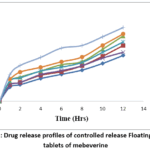 |
Figure 1: Drug release profiles of controlled release Floating matrix tablets of mebeverine Click here to View Figure |
In vitro Dissolution studies
All of the tablet formulations underwent dissolution tests using the USP paddle method (apparatus II). The studies Indicates that the matrix tablet formulations F1–F3, which contained Klucel HF, the percentage of drug released increased from 59.36 to 84.69%, however the drug release was not extended for 12 hours. In formulations F4–F6, which included Kollipher P407 63.55 to 87.33%, the matrix tablet formulations did not allow the drug to release for up to 12 hours. The drug release was prolonged up to 95.66% at 12 hours by the F7 formulation, which contained a mix of Kollipher P407 and Klucel HF in different ratios as rate-controlling polymers.The invitro data and release profile were showed in Table 4 & Figure 1.
Table 5: Controlled release floating matrix tablets of mebeverine: dissolution parameters
| Formulation | Zero Order | First Order | Higuchi | Peppas | ||||
| K0
(mg/hr) |
R2 | K1
(h-1) |
R2 | KH
(mg/h1/2) |
R2 | N | R2 | |
| F1 | 6.454 | 0.926 | 0.255 | 0.930 | 40.369 | 0.922 | 0.474 | 0.911 |
| F2 | 6.687 | 0.932 | 0.274 | 0.964 | 41.235 | 0.947 | 0.525 | 0.932 |
| F3 | 6.698 | 0.955 | 0.288 | 0.976 | 42.369 | 0.955 | 0.697 | 0.941 |
| F4 | 6.541 | 0.933 | 0.288 | 0.939 | 41.258 | 0.936 | 0.489 | 0.922 |
| F5 | 6.789 | 0.941 | 0.301 | 0.969 | 42.369 | 0.957 | 0.569 | 0.938 |
| F6 | 6.874 | 0.956 | 0.377 | 0.979 | 43.587 | 0.968 | 0.770 | 0.944 |
| F7 | 7.015 | 0.977 | 0.411 | 0.981 | 44.258 | 0.999 | 0.830 | 0.955 |
Release Kinetics
The release kineticsshowed the finding was that all the floating matrix tablet formulations showed a linear first order release rate with R2 values of 0.930 and 0.981. The zero order plots of none of matrix tablet formulations were linear. As such the release rate of the drug out of each of the matrix tablet formulations was linear and followed the first order release rate constant (K1) and dependent on the concentration. A plotting of the medication released versus time at each formulation of the floating matrix tablets showed that they were linear giving Higuchi constants which ranged between 0.922 and 0.999. Its drug release was carried out using the diffusion process on the matrix tablet formulations. The release exponent (n value) ranged 0.474 to 0.830 in all the matrix tablet formulations implying that drug release in the formulation was via non-fickian diffusion. The dissolution parameters were showed in table 5.
Table 6: Index of Swelling of Controlled Release Floating Matrix Tablets of Mebeverine HCL
| Formulation | Swelling Index (%) | ||
| 1hr | 6hr | 10hr | |
| F1 | 62.36 | 74.89 | 85.36 |
| F2 | 64.25 | 77.61 | 90.32 |
| F3 | 68.25 | 80.58 | 92.36 |
| F4 | 64.25 | 75.86 | 87.25 |
| F5 | 66.36 | 81.22 | 92.96 |
| F6 | 69.11 | 84.56 | 94.55 |
| F7 | 72.36 | 89.74 | 101.36 |
Swelling index
All formulations of floating matrix tablets undergo swelling index features. When compared to formulations F4 to F6 made with Kollipher P407 as a polymer, the floating matrix tablet formulations F1 to F3 with Klucel HF as the polymer often swell more slowly. The formulation F7, which combined Kollipher P407 and Klucel HF, demonstrated a significant swelling index of 101.36%.The results were showed in Table 6.
FTIR Analysis
I.R. Spectral investigations on a few selected mebeverine HCL controlled released floating matrix tablets were conducted using BRuker FT. Using 200 mg of finely ground and dried KBr, triterate 1–2 mg of the sample to be examined. Spectra in the range of 4000–400 cm-1, or occasionally as low as 200 cm-1, were recorded using an I.R. FTIR spectrophotometer. These amounts are often adequate to provide a disc with a diameter of 10–15 mm and an appropriate intensity spectrum. Figures 2-5 and Table 7 displayed the drug, polymer, and optimised formulation I.R.
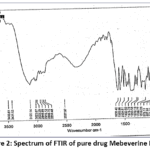 |
Figure 2: Spectrum of FTIR of pure drug Mebeverine HCL Click here to View Figure |
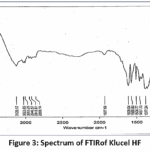 |
Figure 3: Spectrum of FTIRof Klucel HF Click here to View Figure |
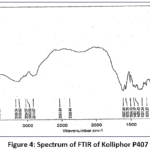 |
Figure 4: Spectrum of FTIR of Kolliphor P407 Click here to View Figure |
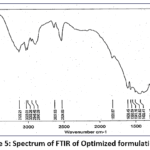 |
Figure 5: Spectrum of FTIR of Optimized formulation F7 Click here to View Figure |
Table 7: Interpretation of FTIR Spectra
| Functional groups present | Wave number (cm-1) | |||
| Pure drug | Klucel HF | Kolliphor P407 | Optimized formulation (F7) | |
| N-H Stretching | 3431.53 cm-1 | 3441.87
cm-1 |
3491.09 cm-1 | 3421.25 cm-1 |
| -C=C- Stretching | 2859.48 cm-1 | 2859.14
cm-1 |
2890.29 cm-1 | 2914.57 cm-1 |
| C-N Stretching | 1432.60 cm-1 | 1457.73
cm-1 |
1435.41 cm-1 | 1429.43 cm-1 |
DSC Studies
The thermal characteristics of mebeverine controlled-release floating matrix tablets produced by direct compression were investigated using a Shimadzu DSC 60 device. The DSC curves provided insight into the heat flow characteristics of the formulations, helping to identify potential interactions between the drug and excipients.A standard open alumina crucible was used to weigh 10 milligrammes of the material and heated in a rate of 10 degrees Celsius per minute before being purged with dry nitrogen. Figures 6-10 and Table 8 displayed the drug, polymers, and optimised formulation F7’s DSC thermogram.
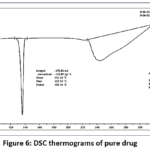 |
Figure 6: DSC thermograms of pure drug Click here to View Figure |
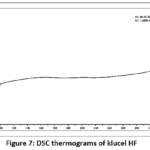 |
Figure 7: DSC thermograms of klucel HF Click here to View Figure |
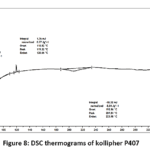 |
Figure 8: DSC thermograms of kollipher P407 Click here to View Figure |
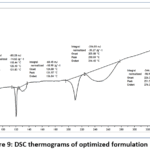 |
Figure 9: DSC thermograms of optimized formulation F7 Click here to View Figure |
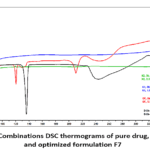 |
Figure 10: Combinations DSC thermograms of pure drug, polymers &optimized formulation F7 Click here to View Figure |
Table 8: DSC thermogram interpretation
| Mebeverine HCL | Klucel HF | Kollipher P407 | Optimized Formulation (F7) |
| 138.460C | 89.530C | 93.630C | 57.490C & 136.84 0C |
| High Endothermic Peak | Wide
Endothermic Peak |
Wide
Endothermic Peak |
High Endothermic Peak &Wide Endothermic Peak |
In vitro floating studies
When measuring the tablet’s floating time with 0.1N HCl solution at 900 mL in USP XXIII dissolution apparatus II, the stimuli was set to rotate at 75 rpm. The experiment was performed at room temperature, set at 37 °C ± 0.5 °C. The floating time is taken as the length of time the tablet remains on the dissolution medium’s surface, The findings of this study are presented in Table 9.
Table 9: Floating lag and floating times of controlled release floating matrix tablets of mebeverine
| Formulations | F1 | F2 | F3 | F4 | F5 | F6 | F7 |
| Floating lag time (mins) | 5 min | 10 min | 15 min | 4 min | 8 min | 10 min | 2 min |
| Floating time (hrs) | >7 | > 8hrs | >9 hrs | >8 hrs | > 9hrs | >10 hrs | >12hrs |
The formulations F1 through F3, which contained only Klucel HF, floated for 5 to 15 minutes and stayed afloat for more than 9 hours. The Kollipher P407 formulations F4–F6 floated with a lag time of 4–10 min and stayed floating for more than 10 hours. With a lag time of two minutes, the formulation F7, which contained klucel HF and Kollipher P407, floated and continued to do so for more than twelve hours.
Discussion
Because the floating matrix tablets displayed satisfactory pre-compression flow properties, they were shown to be well-suited for direct compression. Incorporation of microcrystalline cellulose ensured that every formulation produced tablets of uniform weight. Following the post-compression assessments, the investigators verified that every formulation adhered to IP specifications, thereby confirming its physical and chemical stability. Incorporating Klucel HF and Kolliphor P407 into F7 simultaneously improved drug release and sustenance of the floating profile. The in-vitro dissolution results revealed that a heightened polymer loading, especially that in F7, led to a prolonged drug release. Among all formulations, F7 displayed the most advantageous release profile and maintained drug delivery over a 12-hour period, most probably arising from the synergistic action of the polymers serving as rate-limiting matrices. Investigation of release kinetics revealed that every formulation obeyed first-order kinetics, indicating that its release was controlled by drug concentration. Findings obtained from Higuchi analysis together with the Peppas n-value corroborated that the release preceded via a diffusion–erosion mechanism (non-Fickian). Swelling profiles further recornfirm the diffusion-controlling model: stronger swelling of the F7 formulation is associated with more pronounced release delay and superior matrix stability as time progresses. Consequently, FTIR and DSC findings revealed no notable chemical interaction between the drug and excipients, thereby confirming their compatibility and the stability of the formulation. Floating investigations demonstrated that Kolliphor P407 enhanced the buoyancy behaviors. Floating lag time and duration were approximately optimal for gastroretentive delivery when both polymers were combined in F7. Taken as a whole, formulation F7 proved to be the most effective controlled-release floating matrix tablet owing to its superior drug release, stability, and floating characteristics. These findings, thus, underscore its capability for increasing Mebeverine’s bioavailability.Formulation F7 (comprising of Klucel HF and Kolliphor P407) increased the sustained release and floating, presumably due to the synergistic matrix-forming effects of these two surfactants. The release behavior can however be influenced by factors like the porosity of the tablet, compression force as well as the interactions with effervescent agents. The non-Fickian diffusion model implies that there is a combination of diffusion and erosion that may depend on the swelling of polymers and solubility of Mebeverine, which is sensitive to the pH. Despite the fact that Kolliphor P407 increased the buoyancy, the ratio of gas-generating agents and speed of hydration of polymers are also important factors in the duration of floating. Altogether, drug release and gastroretention are controlled by polymer composition and formulation parameters.
Conclusion
The present investigation effectively illustrated the preparation of Mebeverine HCL-controlled release floating matrix tablets using Klucel HF and Kolliphor P407 polymers. Of the seven formulations tested, F7 produced the most favorable drug release pattern, delivering 95.66% within twelve hours and sustaining buoyancy for over that period with virtually no lag time. The selected concoction of Klucel HF and Kolliphor P407 efficiently sustained drug release while enhancing gastric retention. FTIR and DSC analyses demonstrated that no interactions occurred between the drug and the excipients, thereby signifying formulation stability. The kinetic mechanism involved is non-Fickian diffusion followed by both polymer swelling and erosion. Formulation F7 likewise displayed an acceptable swelling index coupled with strong physical attributes. Taken together, this strategy furnishes a promising framework for improving Mebeverine HCL bioavailability and therapeutic performance in the management of irritable bowel syndrome through gastro-retentive drug delivery systems.
Acknowledgement
The Authors extend their sincere gratitude to Vasudha Pharma Limited, Visakapatnam, as well as to the management at V.V. Institute of Pharmaceutical Sciences, Gudlavalleru.
Funding Sources
The author(s) received no financial support for the research, authorship, and/or publication of this article.
Conflict of Interest
The authors do not have any conflict of interest.
Data Availability Statement
This statement does not apply to this article.
Ethics Statement
This research did not involve human participants, animal subjects, or any material that requires ethical approval.
Informed Consent Statement
This study did not involve human participants, and therefore, informed consent was not required.
Clinical Trial Registration
This research does not involve any clinical trials.
Permission to reproduce material from other sources
Not Applicable
Author Contributions
- Balakrishna Talamanchi: Conceptualization, Supervision, Methodology Design and Final Review and Approval of manuscript.
- Miriyala Preethika: Field Data, Field Experiment, Record keeping, Analysis of Data, Preliminary manuscript writing.
- Mohammad Rasool: Formulation Development, Physicochemical analysis, Literature review.
- Mantada Harika: Support in Drug Release works, Statistics.
- Jujjuvarapu Divyasri: Data interpretation, In vitro Buoyancy Studies.
- Meesala Gayathri Vana Malika: Documentation, Support in the Study of Characterization.
- Ravulakollu Lakshmi Kumari: Compatibility Studies, Compilation on Results.
- Tattukolla Richa Sai Sri: Making Data tabulations, Graph combined, Formatting Manuscript.
- Seeram Rohini Priya: Survey on Literature, Tools of Analysis.
- Malla Sai Siva Sankar: Contribution of Dissolution Study Design and Data Recording.
References
- Agyilirah GA, Green M, Ducret R. Evaluation of the gastric retention properties of a cross linked polymer coated tablet versus those of a non‐disintegrating tablets. Int J Pharm. 1991; 75:241 – 247.
CrossRef - Hoffman F., Pressman J.H., Code C.F. Controlled entry of orally admnistered drugs physiological considerations. Drug Dev Ind. Pharm. 1983; 9: 1077 – 1085.
CrossRef - Ritschel WA., and Kearns GL. Absorption/Transport Mechanisms, in handbook of Basic Pharmacokinetics including Clinical Applications, Ritschel W.A, and Kearns, G.L. Eds. (American Pharmaceutical Association, Washington, DC,), p.63 1999.
- Harder S., Furh U., Bergmann D. Ciprofloxacin Absorption in Different regions of the Human GIT Investigation with the Hf Capsule Br. J. Clin. Pharmacol. 1990; 30(1), 35-39.
CrossRef - Rouge N., Buri P., Doelkar E. Drug Absorption Site in the gastrointestinal tract and Dosage Forms for Site-Specific Delivery. Int. J. Pharm.1996; 136(1), 17-139.
CrossRef - Chungi V.S., Dittere L.W., Smith R.B. Gastrointestinal Sites for Furosemide Absorption in Rats. Int.J.Pharm. 1979; 4: 27-38.
CrossRef - Drewe J., Beglinger C., Kissel T. The Absorption Site of Cyclosporin in Human GIT, Br. J. Clin. Pharmacol. 1992; 33(1): 39-43.
CrossRef - Cremer K. Drug Delivery: Gastro-Remaining Dosage Forms, Pharm. J. 1997: 259 (108) .
- Kohri N. Improving the Oral Bioavailability of Sulpiride by Gastric-Retained Form in Rabbits, J. Pharm. Pharmacol. 1996: 48, 371-374.
CrossRef - Singh B.N., and Kim K.H. Floating Drug Delivery Systems: An Approach to Oral controlled Drug Delivery via Gastric retention, J. Controlled Rel. 2000; 63 (1-2), 235-259.
CrossRef - Gardner C.R. Gastrointestinal barrier to Oral drug Delivery, in Directed Drug Delivery, Borchardt. R.T. Repta, A.J. and Stella, V.J.Eds. (Human Press, new Jersey), 1985: 61-82 (1985).
CrossRef - Streubel A., Siepmann J., Bodmaier R. Drug Delivery To The Upper Small Intestine Window Using Gastroretentive Technologies. Curr. Opin. Pharmacol. 2006; 6: 501-508.
CrossRef - Rosa M., Zia H., Rhodes T. Dosing and testing in vitro of a bioadhesive and floating drug delivery system for oral application. Int J Pharm. 1994; 105(1): 65–70.
CrossRef - Singh B.N., Kim K.H. Floating drug delivery systems: an approach to oral controlled drug delivery via gastric retention. J Control Release. 2000; 63(3): 235–59.
CrossRef - Streubel A., Siepmann J., Bodmeier R. Floating matrix tablets based on low density foam powder: effects of formulation and processing parameters on drug release. Eur J Pharm Sci. 2003; 18(1):37–45.
CrossRef

Accepted on: 24-06-2026
Second Review by: Dr. Md. Sarwar Hossain
Final Approval by: Dr. Patorn Piromchai