Electroencephalograms (EEG) Signal-Based Hand Movements Classification for Human-Brain Interface Using Random Kernel Convolutional Filters
 , Hiren Mewada2and Lingala Syam Sundar3*
 1Department of Chemistry, University of Aveiro, Aveiro, Portugal.
2Department of Electrical Engineering, College of Engineering, Prince Mohammad Bin Fahd University, Al Khobar, Saudi Arabia.
3Department of Mechanical Engineering, College of Engineering, Prince Mohammad Bin Fahd University, Al Khobar, Saudi Arabia.
Corresponding author E-mail: sslingala@gmail.com
Download this article as:
ABSTRACT:Brain’s electroencephalograms (EEG) signals, which represent human actions, are a crucial stage in human-machine interaction. It is essential to develop user-machine interfaces that are dependable, robust, and affordable. Complex and computationally intensive methods were formerly necessary to accurately classify brain signals. This study presents a classification of hand movements using the brain’s EEG signals with reduced computational complexity. A novel approach of integrated RandOm Convolutional KErnel Transform (ROCKET) and ridge classifier (RC) was proposed for feature extraction and classification. Brain signals associated with three hand movements left, right, and up are classified using the proposed model. The proposed algorithm achieves an accuracy of 89.53% with precision scores of 98.93%, 96.82%, and 91.67% for the three movements. The comparison with state-of-the-art models shows that the proposed model improves classification by 19.93% compared to the base model of the LSTM network. Simple linear classifiers integrated with ROCKET can attain high accuracy while minimizing computational complexity. It is illustrated how the proposed method can classify brain signals with minimal parameter adjustment needs, presenting a viable solution to the human brain and machine interface.
KEYWORDS:Electroencephalograms; Health-care; Human-brain interface; Human-machine interface; Machine learning
Introduction
The human-machine interface (HMI) simplifies control and accessibility by enhancing communication between the user and the machine. The classification of brain signals that signify human actions is crucial for developing sophisticated neural interfaces capable of interpreting brain activity. This connection allows human-machine interface to comprehend and react to users’ intentions instantaneously, promoting applications in assistive technologies, rehabilitation, and cognitive enhancement, thereby bridging the gap between human cognition and machine responsiveness. The electroencephalograms (EEGs) and electromyography (EMGs) captured using wearable devices (Gabriel et al1) are the most straightforward approaches for recording brain signals during physical tests and analysis. These signals are significantly influenced by variations in measurement conditions, including electrode placement, individual participant differences, muscle fatigue, and the timing of the experiment. Additionally, the noise significantly impacts these signals due to their low amplitude levels.
We propose a computationally efficient method for classifying left, right, and stop hand movements, making it suitable for resource-constrained computing devices. EEG data were acquired using an Emotive device while subjects executed motor control through these three movements. An integration of ROCKET and the RC is introduced, capitalizing on ROCKET’s powerful feature extraction capabilities while leveraging the RC’s efficiency in handling high-dimensional data. This combination enhanced the classification accuracy without imposing significant computational overhead, making it suitable for real-time assistive technologies.
The electroencephalogram (EEG) Fourier series expansion and its classification using ensemble KNN for motor imagery task classification were presented by Bhalerao et al². This framework achieved a classification accuracy of 86.12%. Ansari et al³ used XGBoost for EEG-based wheelchair navigation, achieving 60% accuracy in classifying four movements. The research work conducted by Hazar et al4 used EMG signals generated using a Myo Armband worn on the upper arm. A precision of 99.9% was achieved using a support vector machine (SVM) with 32 distinct hand gestures.
Gull et al5 employed quadratic SVM, RBF-SVM, and multilayer perceptron to separate the four types of upper limb movements. Using Gaussian-based feature vectors, quadratic SVM and RBF-SVM obtained 76.92% and 75.96% accuracies. Javed et al6 classified four right-hand motions: thumb, index, middle, and index-finger combined, with 65% accuracy using logistic regression. The LSTM with an attention mechanism (Zhang et al7) was proposed to classify left- and right-hand movements. Time-domain features, i.e., mean, variance, skewness, kurtosis, zero crossings, area under the signal, and peak-to-peak distance, were obtained from EEG signals. An accuracy of 83.2% was achieved through cross-subject classification.
Kadhim et al8 initially segmented the hand region from the video stream, and subsequently, a feature set of texture and color information was prepared to train the LSTM network, which was integrated with the Inception network. The model obtained 87.57% accuracy with an average precision score of 84.34%. A dataset comprising several arm positions was produced and published utilizing EMG signals and hand kinematics (Kyranou et al9). A multi-label classifier was then employed for classification. The accuracy was 58% due to improper arm alignment. To classify hand movement into three categories for imagery motor control, Mewada et al10 proposed an integration of a linear regression model with a Restricted Boltzmann machine. The model obtained 89.53% accuracy on the test dataset. EEG-based spoofed speech classification using iMFCC and BiLSTM was presented by Mewada et al11. Altameem et al12 presented a classification of three hand movements. The FFT and CWT scalogram features were utilized for classifying EEG-based hand movements. XGBoost demonstrated strong performance, achieving an accuracy of 88% compared to VGG and ResNet.
The study shows moderate performance due to the noise and variability in EEG signals captured using the BCI interface. Complex feature extraction methods are crucial to the model’s performance, which may limit its potential for real-time assessment. Therefore, extracting features and classifying them using computationally efficient machine learning algorithms represents an appropriate solution among the various approaches.
Materials and methods
Random kernel convolutional filters
For ECG classification, the primary step is to collect the ECG data related to hand movement. A wearable ECG device and a portable ECG device are the most convenient methods for capturing an ECG from the scalp or hands for motor imagery applications. Once ECG’s raw data are captured, their classification is adopted. For classification, models ranging from simple machine learning to complex deep learning have been presented in the literature.
Much literature presented lightweight CNN models (Chaudhari et al13, and Mewada et al14) for resource-constrained devices. An alternative approach, where ECG signals were reshaped into 2D signals (Mewada et al15), and a lightweight DNN network was proposed by Mewada and Pires16. CNN and DNN use fixed-size kernels in filtering, and their weights and biases are adjusted in the training phase. The weights are updated during the backpropagation phase of the learning network. In contrast, the filter’s weights are initialized randomly in the ROCKET-based neural network. This random initialization allows diverse feature space exploration without being constrained by learned parameters. Thus, it does not require extensive training, offering the least training time and computational cost, with very few parameters to be optimized. Therefore, in the proposed approach, initially, frequency bands are obtained using the Fourier transform. Later, the ROCKET and RC integrated model is proposed for classification.
Ruiz et al17 demonstrated that ROCKET’s training time is significantly less compared to other traditional machine learning models achieving similar accuracy. ROCKET modifies time series data by employing convolution with 10000 random convolution kernels, each with a randomly selected length, weights sampled from the standard normal distribution, and biases drawn uniformly. Both dilation and padding are determined randomly. From the resultant feature maps, ROCKET calculates two features: the proportion of positive values and the maximum value.
Figure 1 indicates the concept of the brain-hand interface. The participant uses wearable devices and performs imaginary actions. Based on the imaginary actions, the brain neurons of the human participant have different levels of excitation. These excitations are captured in terms of ECG signals. The row ECG signals have very little amplitude, and the signal is in the time domain. Therefore, signals are preprocessed, including normalization and transformation, which help provide a more concise feature extraction strategy. Later features can be extracted, and using classification mode, the imaginary action of participants can be identified.
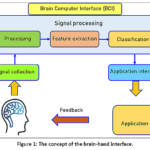 |
Figure 1: The concept of the brain-hand interface. Click here to View Figure |
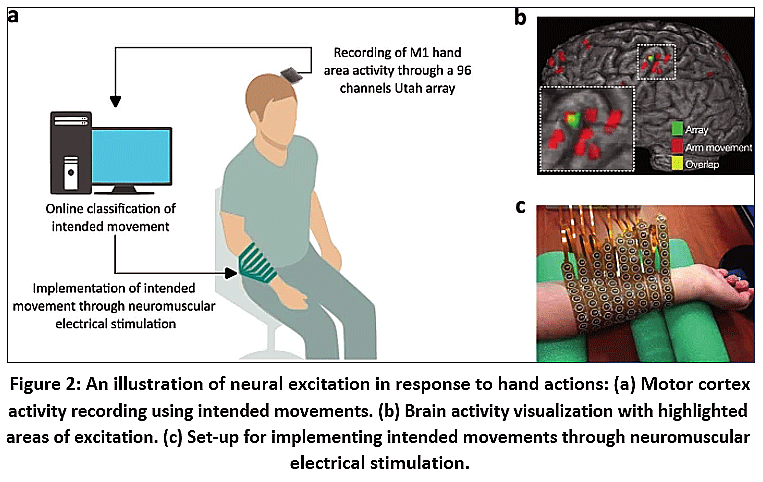 |
Figure 2: An illustration of neural excitation in response to hand actions: (a) Motor cortex activity recording using intended movements. (b) Brain activity visualization with highlighted areas of excitation. Click here to View Figure |
Figure 2(a) shows how activities are recorded. Through a 96-channel Utah array, neural activity from the part of the participant’s left motor cortex that controls hand movements was recorded as the participant tried to move his right hand. They used a nonlinear support vector machine to determine the motor attempts based on oscillating power in the multiunit range (234-3750 Hz) for each channel. A custom NMES sleeve was used to carry out the interpreted movement (panel c) (Serino et al18), An fMRI scan in Figure 2(b) shows areas that are coded for hand movement (red), array position (green), and the space where the two are joined (yellow). Lastly, a custom NMES device was placed on the participant’s hand, allowing them to perform the intended task (Bouton et al19). In the proposed approach, the dataset was obtained from Torquato20. The author used an emotive device to capture scalp ECG signals. The user asked to perform two actions and one rest condition. Use a soft ball and hold it, and instruct them to move their hand either to the right or the left based on the visual arrow on the monitor screen. If the user sees a dot, they stop moving their hands. Using these methods, a 114-electrode device captured the EEG signals from the scalp. Later, the Fourier transform is used to process the signals for identification.
Data analysis
The RC to classify the ROCKET features works in three stages: initialization, fitting, and prediction. In the first stage of initialization, three parameters alpha, maximum iteration, and solvers are initialized. Alpha represents the regularization strength to prevent the model from overfitting. A high value of alpha can reduce overfitting. The solver is an algorithm for minimization that utilizes either singular value decomposition, Cholesky decomposition, the least squares approach, or the sparse conjugate gradient solver. Lastly, the maximum iteration is used by the solver in the fitting stage. In the second stage, the classifier is trained using trained features obtained from the ROCKET. The fitting stage ensures the minimization of the objective function defined as:

Where W is the weight, b is the bias, x is the input feature in Hz, and y is the predicted value or probability value of three classes. Ridge regression lowers the variance of the estimates by penalizing the sum of the squared coefficients. It reduces the standard errors by making the coefficients smaller. This stage produces a matrix that is used for predicting new data. The last stage is to validate the model using an unknown test dataset. The matrix calculated from the fitting stage is used as input, and it performs the projection on the new test dataset using this matrix. Later, it finds the distance between the test feature and the specific predicted sample. The overall flowchart of the proposed method is shown in Figure 3. Where the dataset is initially processed and normalized. The neural network-based method, specifically ROCKET in the proposed approach, consists of two phases: a training phase and a test phase. The train dataset with labeling is provided to ROCKET to train the model based on an internal feature extraction process with randomized kernel weights. Later, a linear regression model, i.e., a Ridge classifier, is used to identify the movement type.
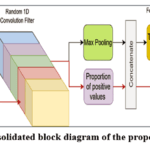 |
Figure 3: Consolidated block diagram of the proposed method. Click here to View Figure |
Results
To validate the model, a dataset provided by Torquato20 is used. The data was collected using 114 electrodes using an EMOTIV device. The user attempted to control the object while following a 25-minute data collection protocol with different cycles that addressed various situations. Throughout the learning phases, the subject saw pictures showing voluntary motor movements, specifically an arrow pointing to the left and right direction, and a circle symbolizing no movement. Using this pictorial information, corresponding hand movements were performed for left, right, and stop (closing fingers) actions, as shown in Figure 4.
These ECG signals are processed using a Fourier transform, which provides power values over a range of frequencies. Later, the frequency bands are divided into five frequency bands, including theta (4-8 Hz), alpha (8-12 Hz), low beta (12-15 Hz), high beta (15-30 Hz), and gamma (30 Hz and above), and a total of 25 power values are obtained for these five bands. Specifically, the hand movement types are classified as ‘stop’, ‘left’, and ‘right’, with 5225, 5000, and 5057 samples recorded for each movement, respectively. The dataset is split into training and test datasets with an 80:20 ratio.
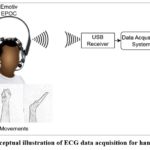 |
Figure 4: Conceptual illustration of ECG data acquisition for hand movements. Click here to View table |
In the experiment, though kernels are random, they are parameterized with lengths of {7, 9, 11} having equal probability. The weights are normalized in the range of [0, 1]. The bias is added to the activation function. Dilations are computed with d = 2x, where x ~ U(0, A) and A = log2 ((Linput-1)/( Lkernel-1). Linput and Lkernel are the length of data and kernel respectively. To train the RC, a five-fold cross-validation is used. The alpha is selected from 10 e-3 to 10 e3.
Discussion
The model achieved 95.98% and 89.53% accuracy for the training and test data, respectively. The model is further validated using precision, recall, and F1-score as listed in Table 1. For the test dataset, the precision dropped to 83.94%, with a recall of 89.81%, resulting in an F1-score of 86.77% due to the incorrect identification of the left movement as the right movement.
The proposed model is compared with traditional CNNs. Altameem et al12 employed a two-stage approach, involving the extraction of features and the subsequent use of a classifier to identify or classify them. They transformed the signal into the Fourier and wavelet domains, obtaining FFT and CWT coefficients as a feature set. Additionally, a CWT scalogram is obtained from the EEGs of hand movement. Later, VGG, ResNet, and XGBoost were used for classification. XGBoost, utilizing FFT features, achieved a maximum accuracy of 88%. This is a computationally intensive approach as it needs Scalograms and may introduce artifacts that complicate interpretation. It may cover the redundant information in the feature set. The Graz BCI scenario included in the OpenVibe installation was used to classify hand movements from EEG data of Fakhruzzaman et al21. The model was assessed under six scenarios, yielding an accuracy of 76.67%. The EEGs are preprocessed by Dey et al22 eliminating DC offsets and artifacts. Subsequently, standard deviation, mean, median, and power spectral entropy were derived as features. An ICA was used for feature size reduction, and an SVM was utilized for classification. This model achieved 83% accuracy. However, statistical features may sometimes limit their application to more complex and larger datasets, such as those involving increased numbers of classes in EEG signals. A SVM-based stand-alone approach was presented in Gómez-Morales et al.23 to classify hand movements into left and right categories. Seven participants participated in testing the model. The model obtained a maximum accuracy of 95.24% for the fourth participant. The model’s average accuracy for both left and right-side movement classification was 78.5%. The author found that variation in inter- and intra-subject significantly impacted the model’s performance.
We evaluated the LSTM model on the same dataset. We observed that model accuracy was limited to 74.65%. A comparison in Table 2 shows that the proposed model obtained a good classification rate among all. The main advantage of the proposed model is its lower computational cost compared to deep learning models.
Table 1: Quantitative analysis of brain EEG signal analysis for hand movement.
|
|
Training Data | Test Data | ||||
| Class | Precision (%) | Recall (%) | F1 Score (%) | Precision (%) | Recall (%) |
F1 Score (%) |
|
Stop |
98.93 | 96.34 | 99.14 | 94.68 | 90.50 | 92.54 |
| Left | 96.82 | 94.60 | 95.69 | 90.19 | 88.29 |
89.22 |
|
Right |
91.67 | 97.15 | 94.34 | 83.94 | 89.81 |
86.77 |
Table 2: Comparison of the proposed model with state-of-the-art models.
|
Model |
Accuracy (%) |
|
LSTM |
74.65 |
| SVM23 |
78.5 |
|
FFT + CWT + XGBoost12 |
88 |
| ResNEt5012 |
85 |
|
DenseNET12 |
84 |
| Graz BCI21 |
76.67 |
|
ICA+ SVM22 |
83 |
| Proposed model |
89.53 |
Table 2 shows that the proposed model outperformed other CNN and machine learning algorithms.
Traditional machine learning algorithms rely on manually extracted features, such as FFT and CWT. In comparison to machine learning models, the randomized kernel used in ROCKET successfully captured a wide range of temporal features from the Fourier spectra of ECG signals. Thus, automatic feature extraction from the Fourier spectrum leads to enhanced performance compared to SVM. The major weakness of CNN networks is the tuning of a large number of hyperparameters. In contrast, the ROCKET has minimal hyperparameters and therefore requires fewer computations to adjust these parameters for the proposed applications. This can significantly reduce the time and resources needed for model development, making it more accessible for applications in action recognition, including ECG signal analysis.
Conclusion
A less computational approach for edge-based devices is presented to classify hand movement intentions, i.e., stop, left, and right, using EEG data. The ECG data’s power values over four bands are transformed again to the feature set using a random kernel-based convolution operation. These features were classified into three categories using the ridge classifier. The model performed well, achieving 95.98% accuracy on the training data. According to the test data, the model achieved an accuracy of 89.53%. This shows that the model can be generalized, but there’s room for improvement in terms of its robustness and reliability in practical settings. Subsequent efforts will focus on the real-time evaluation and deployment of the model, which is essential for practical BCI applications.
The proposed approach is constrained to three-hand movement classification. In the future, a wider range of hand movements, including complex gestures, as well as the movement of other body parts such as legs, toes, and knees, can provide more diverse human-machine interface applications. Another weakness of the model is that it does not account for user feedback. A potential feedback integration within the system can enhance its uses in real-life applications.
Acknowledgement
The author TAR acknowledges the University of Aveiro, and the authors HKM, and LSS acknowledges the Prince Mohammad Bin Fahd University.
Funding Sources
The author(s) received no financial support for the research, authorship, and/or publication of this article.
Conflict of Interest
The author(s) do not have any conflict of interest.
Data Availability Statement
This statement does not apply to this article.
Ethics Statement
This research did not involve human participants, animal subjects, or any material that requires ethical approval.
Informed Consent Statement
This study did not involve human participants, and therefore, informed consent was not required.
Clinical trial registration
This research does not involve any clinical trials.
Permission to Reproduce Material from other Sources
Not applicable.
Authors’ contribution
- Thota Apparao: Visualization, Supervision.
- Hiren Mewada: Data Collection, Analysis, Writing – Review & Editing.
- Lingala Syam Sundar: Conceptualization, Methodology, Writing – Original Draft.
References
- Gabriel CL, Pires IM, Coelho PJ, et al. Mobile and wearable technologies for the analysis of ten-meter walk test: A concise systematic review. Heliyon, 2023; 9(6): e16599.
CrossRef - Bhalerao SV, Ainwad SS, Pachori RB. Chapter 3-FBSE-based automated classification of motor imagery EEG signals in brain-computer interface. Brain-Computer Interfaces: Advances in Neural Engineering. 2025; 57-90.
CrossRef
- Ansari MF, Edla DR, Dodia S, Kuppili V. Brain-computer interface for wheelchair control operations: an approach based on fast fourier transform and on-line sequential extreme learning machine. Clinical Epidemiology and Global Health. 2019; 7: 274-278.
CrossRef
- Hazar Y, Ertuğrul FÖ. Developing a real-time hand exoskeleton system that controlled by a hand gesture recognition system via wireless sensors. Biomedical Signal Processing and Control. 2025; 99: 106886.
CrossRef - Gull MA, Iqbal J, Tiwana MI. Spatial temporal based classification for antebrachium and carpus movement of EEG data using emotive head set. Biomedical Engineering and Medical Imaging. 2014; 1(6).
CrossRef
- Javed A, Tiwana M, Rashid N. Recognition of finger movements using EEG signals for control of upper limb prosthesis using logistic regression. Biomedical Research. 2017; 28(17): 7361-7369.
- Zhang G, Davoodnia V, Sepas-Moghaddam A, Zhang Y, Etemad A. Classification of hand movements from EEG using a deep attention-based LSTM network. IEEE Sensors J. 2020; 20(6): 3113-3122.
CrossRef - Kadhim MK, Chen SD, Chen CP. Enhanced dynamic hand gesture recognition for finger disabilities using deep learning and an optimized Otsu threshold method. Engineering Research Express 7, 2025, 1: 015228.
CrossRef
- Kyranou I, Katarzyna S, Kianoush N. EMG dataset for gesture recognition with arm translation. Scientific Data 12, 2025, 1: 100
CrossRef
- Mewada HK, Miral D, Ivan MP. A low computational EEG-based hand movements classification using a restricted Boltzmann machine for brain-computer interface applications. Procedia Computer Science 265 (2025): 722-727.
CrossRef
- Mewada HK, Al-Asad JF, Almalki FA, et al. Gaussian-filtered high-frequency-feature trained optimized BiLSTM network for spoofed-speech classification. 2023; 23(14): 6637.
CrossRef - Altameem A, Sachdev JS, Singh V, Poonia RC, Kumar S, Saudagar AKJ. Performance analysis of machine learning algorithms for classifying hand motion-based EEG brain signals. Computer Systems Science and Engineering. 2022; 42(3): 1095-1107.
CrossRef
- Chaudhari J, Mewada H, Patel A, Mahant K, Vala A. Computation less palm-print verification using wavelet oriented zero-crossing signature. IIUM Engineering J. 2022; 23(1): 222-232.
CrossRef - Mewada HK, Sundar LS, Patel B, Desai M, Khan A. A lightweight sequential convolutional neural network for smart grid stability analysis. Transdisciplinary J. Engineering & Science. 2024; 15.
CrossRef
- Mewada HK. 2D-wavelet encoded deep CNN for image-based ECG classification. Multimedia Tools and Applications. 2023; 82(13): 20553-20569.
CrossRef
- Mewada H, Pires IM. Electrocardiogram signal classification using lightweight DNN for mobile devices. Procedia Computer Science. 2023; 224: 558-564.
CrossRef
- Ruiz AP, Flynn M, Large J, Middlehurst M, Bagnall A. The great multivariate time series classification bake off: A review and experimental evaluation of recent algorithmic advances. Data Mining and Knowledge Discovery. 2021; 35(2): 401-449.
CrossRef - Serino A, Bockbrader M, Bertoni T et al. Sense of agency for intracortical brain-machine interfaces. Nature Human Behaviour. 2022; 6: 565–578.
CrossRef
- Bouton C, Shaikhouni A, Annetta Net al. Restoring cortical control of functional movement in a human with quadriplegia. 2016; 533: 247–250.
CrossRef
- Torquato F. EEG data from hands movement. Published online 2019. https://www.kaggle.com/datasets/fabriciotorquato/eeg-data-from-hands-movement
- Fakhruzzaman MN, Riksakomara E, Suryotrisongko H. EEG wave identification in human brain with Emotiv EPOC for motor imagery. Procedia Computer Science. 2015; 72: 269-276.
CrossRef
- Dey A, Bhattacharjee S, Samanta D. Recognition of motor imagery left and right-hand movement using EEG. In: 2016 IEEE International Conference on Recent Trends in Electronics, Information & Communication Technology (RTEICT). IEEE; 2016:426-430.
CrossRef - Gómez-Morales, Óscar Wladimir, et al. EEG Signal prediction for motor imagery classification in brain-computer interfaces. Sensors 25.7 (2025): 2259.
CrossRef

Accepted on: 26-09-2025
Second Review by: Dr. Grigorios Kyriakopoulos
Final Approval by: Dr. Prabhishek Singh